Guides / Processes
Thread Locking Patches vs Prevailing Torque Features
October 27, 2026

Vibration and thermal cycling can turn a tightened bolt back until the joint is loose. Plants solve this in two main ways: they add a locking feature to the thread, or they add a feature that creates friction by deformation. The two groups behave differently under heat, with reuse and in cost. Choosing between them on a custom fastener is a drawing decision that has to be made before the quote, because it changes the process route.
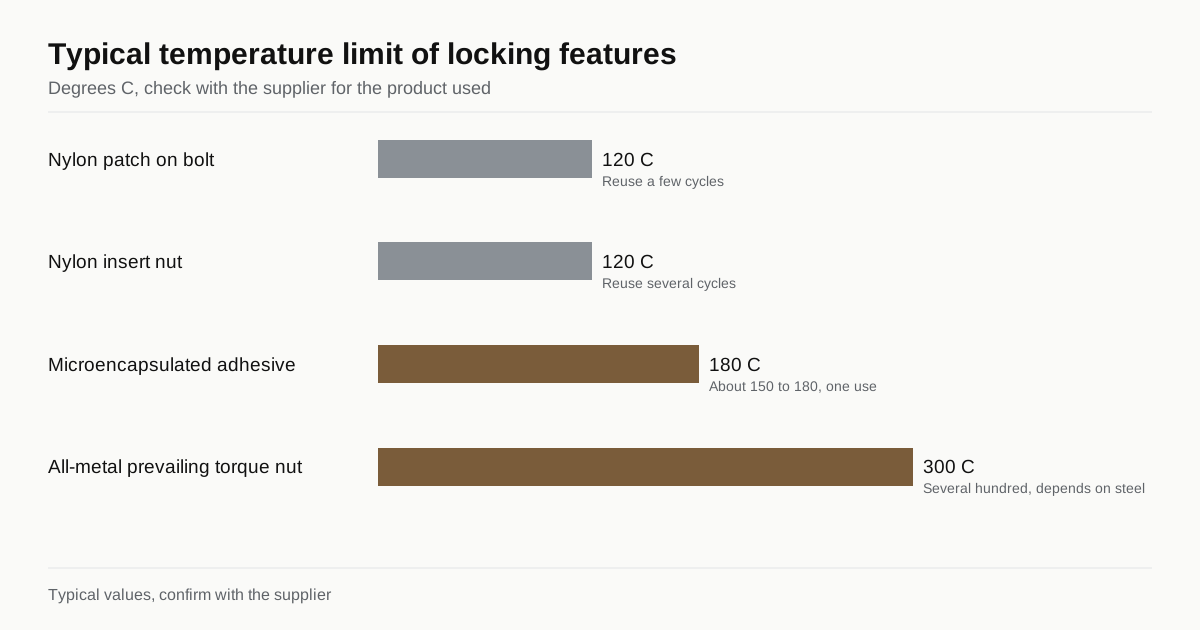
This guide compares the options, shows typical figures and lists what to put on the print.
What each option does
Thread locking patch. A patch is a layer of plastic or adhesive applied to a section of the thread. When the bolt is screwed into a mating thread, the patch is squeezed between the flanks and adds friction. The patch also resists loosening because the thread no longer has free play.
Prevailing torque feature. Here the locking comes from geometry or an added insert. A nylon insert nut has a polymer ring that grips the bolt thread. An all-metal prevailing torque nut has a distorted top that grips by elastic deformation. A bolt may have a slightly deformed thread section, or a lobe shape, that works the same way. The torque to turn the fastener, before it seats, is called the prevailing torque. ISO 2320 sets requirements for prevailing torque steel nuts.
The two groups give a different result in practice. A patch works on a plain thread and needs no special mating part. A prevailing torque nut needs the special nut, though the bolt can stay standard.
The main types
| Type | How it works | Typical temperature limit | Reuse | Typical use |
|---|---|---|---|---|
| Nylon patch on a bolt | Polymer pellet or strip fused to the thread, adds friction | About 120 °C | A few cycles, torque falls | General machinery, automotive |
| Microencapsulated adhesive patch | Capsules burst at assembly, adhesive cures in the thread | About 150 to 180 °C, check with the supplier | One use | Vibration, sealing against leaks |
| Dry film or anaerobic coating | Adhesive film activated at assembly | Depends on the product | One use | Light vibration and sealing |
| Nylon insert nut (ISO 7040 type) | Polymer ring grips bolt thread | About 120 °C | Several cycles | General use under moderate vibration |
| All-metal prevailing torque nut (ISO 7042 type) | Distorted metal grips thread | Up to several hundred degrees, depends on steel and coating | Several cycles | High heat, exhaust, engines |
| Deformed thread bolt | Thread section is oval or lobed | Same as the bolt | Several cycles | Where no nut change is possible |
Temperature figures are typical. The limit depends on the polymer or adhesive, on the exposure time and on the load.
Where each works best
Nylon patch. It suits general machinery, because the patch is cheap, the bolt works with any standard nut or tapped hole and several reassembly cycles are possible. A patch also adds a seal against fluid creep through the thread in some designs. Heat is the limit, and oils and solvents can swell some patches.
Microencapsulated adhesive. It gives the strongest resistance to loosening in a bolt that is not meant to be removed often. Capsules hold a resin and a hardener, and assembly breaks them. The bolt needs a cure time, often a day for full strength, and the mating surface and temperature affect it. The shelf life of the patch on the shelf is limited, and the coating on the bolt matters because some surface finishes slow the cure.
Nylon insert nut. It suits moderate vibration at normal temperature, and it keeps the bolt standard. It cannot take heat, and it needs enough thread length for the bolt end to pass through the insert.
All-metal prevailing torque nut. It suits heat and parts that see repeated assembly. It is more expensive and less consistent in torque, and the torque falls with reuse.
Loosening is a design problem too
Locking features slow rotation. They do not create clamp force. Loosening has two main causes, and the feature helps with only one.
- Rotation under transverse vibration. The joint slips sideways and the nut unwinds. Patches and prevailing torque features resist this.
- Loss of preload from embedment and relaxation. Surfaces settle and the clamp load drops. A locking feature does little here, and the fix is better joint design, a longer grip and correct preload.
If safety depends on the joint, test it. A transverse vibration test, as defined in ISO 16130 and in DIN 65151, shows how a combination behaves. The figures vary with the joint, so the test is the only reliable answer.
What it means for a custom order
A patch is applied after plating or coating, on a separate line. The applier needs to know the thread size, the patch type, the position and the length. A typical print specifies:
- Patch type and any standard it follows.
- Location, measured from the end of the bolt, and the length of the patch, normally a section of a few thread pitches.
- Arc of coverage, either a partial strip or a full ring.
- Torque limits, the first-on and first-off values after assembly.
- Coating before patching, since a thick coating changes the thread size.
Minimum quantity matters. Patch lines run in batches, so a small run may carry a setup charge. A thread must also be long enough: a patch needs clear thread on both sides of it. A short thread leaves no room, which is a reason to review the print before the order. See how to source custom fasteners for how these extras change the route and the price.
For nuts, a custom prevailing torque nut needs its own tooling or a stock blank with an insert, and the quantity decides which is practical. A thread gauging note should say whether the gauge is used before or after the patch, because the patch changes the way the gauge goes on.
How to choose
- Is heat above about 120 °C possible? If yes, rule out nylon and look at all-metal features or high temperature adhesive.
- Will the joint be taken apart often? If yes, choose a nylon patch or an all-metal feature. If rarely, a microencapsulated patch holds best.
- Is the mating part standard? If you cannot change the nut or tapped hole, choose a patch.
- Is leakage through the thread a concern? A patch seals better than a nut feature.
- Is there a vibration test requirement? Test the actual combination.
Examples from real assemblies
A motor mount bolt, M8, in a machine that runs for years. The bolt sees vibration at a steady frequency and the joint is opened only for service. A nylon patch on the bolt gives enough prevailing torque, the bolt works with the existing tapped holes and it can be reused for a few service cycles. The designer checks that the case temperature stays below the patch limit.
A bracket screw, M5, in an electronic enclosure that is never opened. A microencapsulated adhesive patch locks the screw after assembly, which stops loosening during shipping and use. The assembly line allows time for cure before the unit ships. Because the screw is used once, reuse does not matter.
An exhaust shield bolt, M8, near 400 °C. Nylon would melt and the adhesive would break down. An all-metal prevailing torque nut or a deformed thread bolt works here. Torque falls with each reuse, so the service manual says to replace the nut at each removal.
Torque values and testing a patch
A locking feature changes two torque numbers. The first is the prevailing torque, which the screw needs before it seats. The second is the removal torque after the joint is tightened. Standards such as ISO 2320 set limits for nuts, and for patches the supplier and the buyer agree on values. A good order states a first-on maximum, so the installer is not surprised by a very stiff thread, and a first-off minimum, so the screw cannot be backed out by hand.
Ask the plant for samples to test in your assembly before the first release. Run the vibration test that matches the use, record the torque going on and coming off and note the effect of any coating. A patch that works on plain steel can behave differently on a zinc flake coating or on stainless. The test costs little compared with a loosening problem in the field, and it tells you how many reuse cycles the patch can survive.
Common ordering mistakes
- Asking for a nylon patch on a part that sees heat above the patch limit.
- Placing the patch too close to the end of a short thread, leaving no clean thread.
- Forgetting that a patch changes the torque to preload relation.
- Not allowing cure time for adhesive patches before the unit is loaded.
- Specifying a locking feature and a lock washer together, where one cancels the other.
One clear line on the print for type, position and torque keeps the quote accurate.
Checklist for the RFQ
- The locking type you want, or the loosening risk if you want the plant to propose one.
- Maximum service temperature and fluids in contact.
- Number of expected disassembly cycles.
- Patch location and length, if you have it.
- Torque range and the preload target.
- Annual volume and release size, since patch lines work in batches.
Put these in the first message and the quotes will line up. When you are ready, send your RFQ and we match it with up to three makers that can supply the feature you need.
Frequently asked questions
Does a thread locking patch replace a lock washer?
It can, in many designs, but the two do not work the same way. A patch adds friction or adhesion to the thread itself and resists loosening. A lock washer mainly keeps preload under embedment and does little against vibration. Check the joint with a vibration test if loosening would be unsafe, and do not rely on a washer alone.
Can a patched bolt be reused?
A nylon patch can be reused a few times, with the prevailing torque dropping each cycle. A microencapsulated adhesive patch cures at assembly and is intended for one use. After removal, the cured material is damaged and the bolt should be replaced or re-patched.
Is a locking feature a substitute for correct preload?
No. A locking feature resists rotation but does not create clamp force. A joint tightened to too low a preload can still slip and fail by fatigue. Specify a tightening method and torque range together with the locking feature.
Need this fastener made?
Send the print with the grade and annual volume. We match you with up to 3 makers that run the right route and reply within 24 business hours.
Send my RFQ