Guides / Processes
Thread Rolling vs Thread Cutting on Custom Fasteners
October 28, 2026
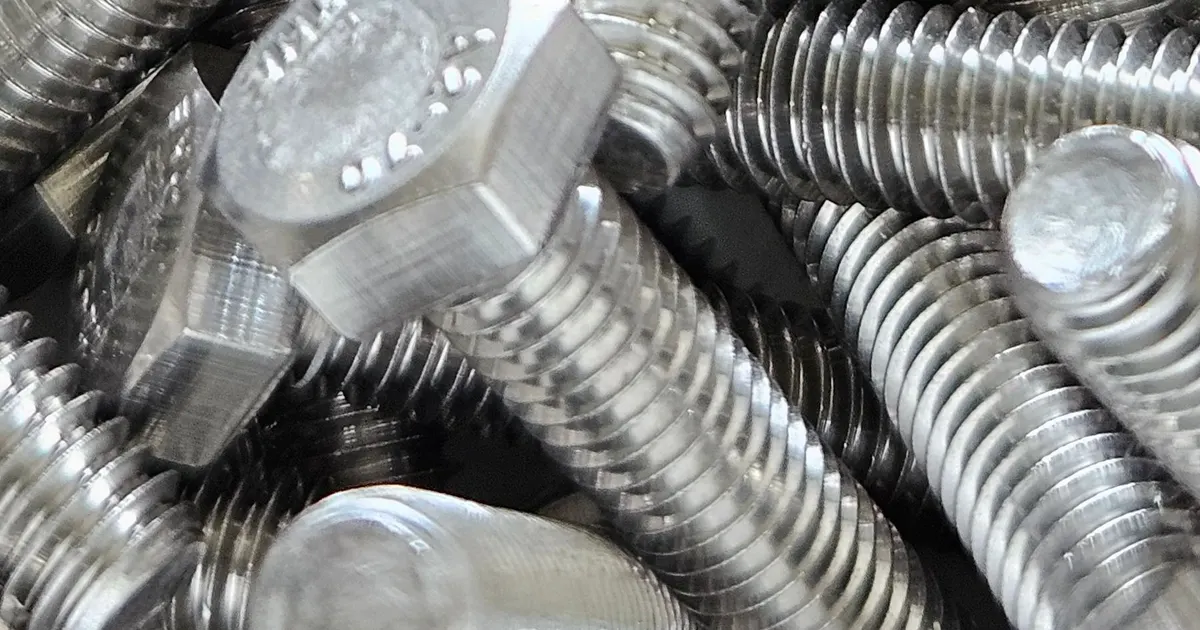
Thread rolling pushes a thread into a round blank with hardened dies, so the metal moves. Thread cutting removes metal with a tool to leave the thread form behind. Both can produce a thread that gauges correctly. They differ in what happens to the grain of the steel, in how many seconds each part takes and in which materials and hardness levels they accept. For a part that carries a cyclic load, that difference decides whether the bolt lasts a month or ten years.
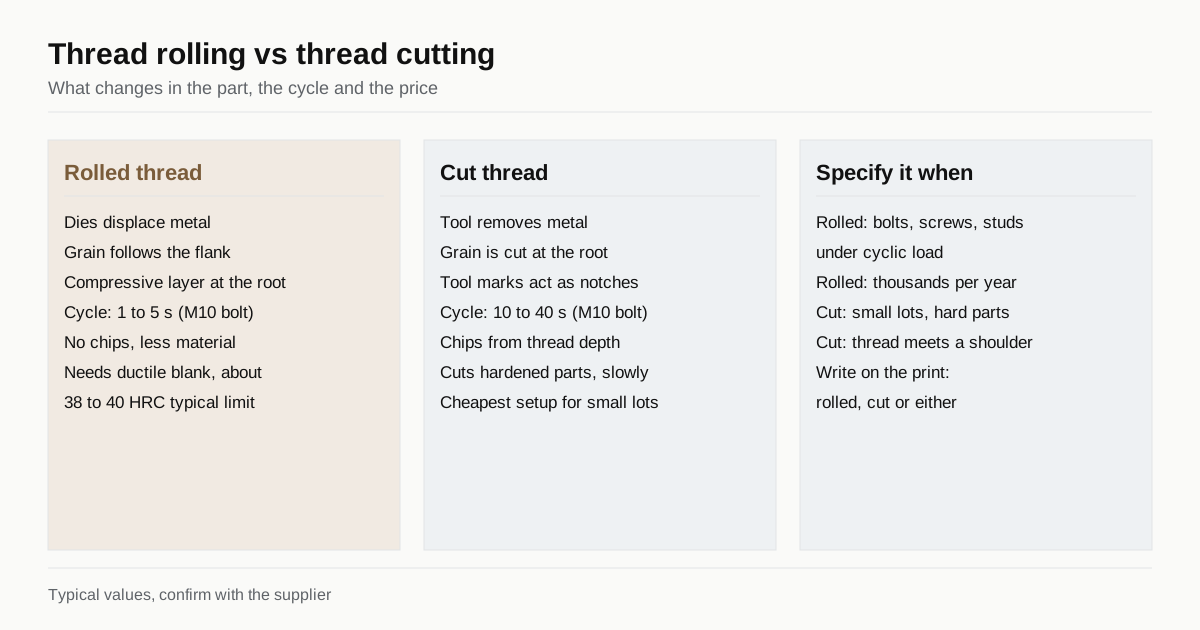
This guide explains how each process works, where the real strength gap shows up, what each one costs and how to word the print so the quote you get is the part you want.
How the two processes form a thread
Rolling. The blank goes between two flat dies, or two or three cylindrical dies, that carry the thread form in reverse. The dies press into the surface and displace metal outward, so the crest rises while the root is pushed down. A cold roll takes from under a second on a small screw to a few seconds on a larger bolt. No chips leave the part.
Cutting. A single point tool on a lathe, a thread mill or a die head cuts the helix into a blank that is already at the full major diameter. Taps and dies work the same way for internal threads and small external ones. Cutting takes more passes, produces chips and is slower, but it needs no thread specific tooling beyond an insert or a cutter.
One consequence is easy to miss. A rolled thread starts from a blank that is close to the pitch diameter, not the major diameter, because the displaced metal builds the crest. So the blank diameter on a headed part is smaller than the nominal size. The print should give the thread size, and the maker sets the blank size to hit the gauge.
What rolling does to strength
A rolled thread has three advantages over a cut one.
- Continuous grain flow. Cutting slices through the grain at the thread root. Rolling bends the grain to follow the flank, so there is no cut fibre to start a crack.
- Cold work at the surface. The root layer is hardened by deformation and carries compressive residual stress. Cracks start in tension, so a compressive layer delays them.
- A smoother root. Rolled surfaces are burnished. Tool marks on a cut thread act as small notches.
For static tensile strength these effects matter little, and a cut thread of the same geometry reaches nearly the same breaking load. Fatigue is different. In a bolted joint under load cycles, failures almost always start at the first loaded thread or at the thread runout, and a rolled thread gives a longer life at the same stress amplitude.
The order of rolling and heat treatment also matters. Many plants roll threads on the soft blank, then quench and temper the bolt. That is efficient, and it is acceptable for most standard work under ISO 898-1. For fatigue critical parts, rolling after heat treatment keeps the compressive layer that heat treatment would otherwise relax. It also means the blank must be machinable at the heat treated hardness, which limits the route. State the sequence on the print if it matters. Our guide to fastener heat treatment covers what happens in the furnace.
Typical figures side by side
| Rolled thread | Cut thread | |
|---|---|---|
| Cycle time, M10 bolt | About 1 to 5 seconds | About 10 to 40 seconds |
| Parts per minute, small screw (flat dies) | About 50 to 300 | Not applicable |
| Material waste | None | Chips from the thread depth |
| Fatigue behaviour | Better, with compressive root layer | Lower, cut grain at root |
| Tooling | Roll dies per size and pitch | Insert, mill or die head |
| Die or tool life | Hundreds of thousands of parts | Insert wears in hundreds of parts |
| Hardness limit | About 38 to 40 HRC typical, higher with special setup | Cuts hardened material, but slowly |
| Setup for a small lot | Die change and adjustment | Program and offset only |
All values are typical and depend on the machine, the diameter and the material. Treat them as a way to compare, not as a quote.
Where cost falls
Rolling wins on piece price once the quantity covers the die cost. A set of roll dies for one size and pitch is a one-time purchase that the plant usually spreads across many orders, so for common sizes you often pay nothing extra. For an unusual pitch or a special profile such as a trapezoidal or a buttress form, the dies are custom and the cost shows up on the quote.
Cutting wins at low volume. A turning shop can start a thread on a part that was never made before with only a program change, and the setup does not scale with part count. For a few hundred pieces, the cycle time penalty is small compared to the die cost and lead time of rolling.
Material cost moves the balance too. Rolling uses the blank at near pitch diameter, so a headed part is made from a smaller wire. On a cut part the thread starts at the full diameter, so the stock is larger and a part of it becomes chips. At volume, that adds up. If you are choosing between forming routes first, cold heading vs machining sets the broader context.
When you need a cut thread
Rolling is not always possible. Cut threads are the right answer when:
- The material is too hard or too brittle to deform, for example a bolt already hardened above the roller’s limit.
- The thread runs right up to a shoulder or a head with no runout, so a roll die has nowhere to end.
- The thread is too short or too close to another feature for the dies to grip.
- The pitch or profile is unusual and the quantity is too small to justify a die.
- The tolerance class is tighter than rolling holds economically.
Some stainless and nickel alloys work harden quickly. They roll well on the right setup, but ask the maker. Our guide on martensitic and PH stainless fasteners lists the grades where hardness changes the route.
How to write it on the print
The print is where the process choice gets fixed. Three lines settle most questions:
- The thread callout with the tolerance class, for example M12 x 1.75 6g under ISO 965 or 1/2-13 UNC-2A under ASME B1.1.
- A process note: thread rolled, or thread cut allowed.
- If rolled, the sequence: rolled before heat treatment, or rolled after.
Add the thread length and the runout. A rolled thread needs a short runout at the end, and a drawing that shows the thread ending in a sharp shoulder will be answered with a question or a cut thread. Thread gauging shows how the finished thread is checked, and it is worth naming the gauge system on the print as well.
A short decision guide
Choose rolling when the part is a bolt, screw or stud under any cyclic load, when the quantity runs to thousands per year and when the material is ductile at the final hardness. Choose cutting when the lot is small, the part is already hard, the thread meets a shoulder or the profile is non standard. Allow either when the load is static and you want the lowest price, and let the quotes show you the gap.
Two worked examples
A class 10.9 flange bolt, M10 x 1.5 x 40, 150,000 pieces a year, fitted to a vibrating bracket. Rolling is the clear route. The blank is cold headed, quenched and tempered, and the thread is rolled at a few seconds per piece or less on a high speed machine. If fatigue life is a stated requirement, the print can ask for rolling after heat treatment, and the plant will check that its rolling dies and machines handle the hardness. A cut thread on this part would raise the cycle time many times over and give a weaker thread root, with no benefit.
A stainless set screw, M6 x 12, 400 pieces a year, in several lengths. Cutting wins on a Swiss lathe. The part is turned, threaded and parted off in one setup, and a second length needs only a program change. Roll dies for six lengths and a few hundred pieces a year would cost more than the piece price saving. The load is static, so the fatigue advantage does not matter.
The pattern holds across most orders: rolling pays when the quantity is steady and the load is cyclic, and cutting pays when the lot is small or the part changes often.
Inspection differences
The two processes fail in different ways, so inspection differs too.
- Rolled threads can show laps or seams at the crest if the blank was oversize or the die was worn. A plant should check the crest of the thread under magnification at first article and at set intervals, and it should watch the pitch diameter as the dies wear.
- Cut threads can show torn flanks, a rough finish or a drifting pitch diameter as the insert wears. The check is the same gauge set, with more frequent insert changes and a finish check by eye or by comparator.
- Both need the GO and NOT GO gauges described in the thread gauging guide, and a record of when the gauges were last calibrated.
Ask the plant how often it samples during a run, not only at the end of it. A thread that drifts out of tolerance in the middle of a lot is easiest to catch when someone checks every few hundred pieces.
Checklist before you send the print
- Thread size, pitch and tolerance class, with the standard named.
- Rolled, cut or either, and the load type: static or cyclic.
- Heat treatment sequence if the property class is 8.8 or higher.
- Thread length and runout dimensions.
- Annual volume and the size of each release.
With these five items, makers can quote a rolled or cut thread without a second round of questions. When the print is ready, send your RFQ and we will pass it to up to three makers whose route fits the part.
The thread is one step among several: see the custom fastener manufacturing process for how it fits with route, tooling and lead time.
See also the reference page on unified inch threads, UNC and UNF, including UNR and UNJ roots.
Frequently asked questions
Is a rolled thread always stronger than a cut thread?
In static tensile strength the difference is small, because the thread root area is nearly the same. The gain shows up in fatigue life, where a rolled thread keeps an unbroken grain flow and a compressive layer at the root. For a bolt under a steady load the two behave much alike. For a bolt under vibration or load cycles, rolling is the better choice.
Can a hardened bolt still be rolled?
Only up to a limit. Roll dies deform the metal, so the blank has to stay ductile. Many plants roll up to roughly 38 to 40 HRC and some go higher with special dies and care. Above that range the thread is usually cut or ground. Ask the maker for the hardness limit of their rolling setup before you fix the route.
Do I need to write rolled thread on the print?
Yes, if it matters to you. A print that only shows M12 x 1.75 6g leaves the process open, and a machine shop will cut it because that is the quickest route for a small lot. Add a note such as thread rolled, and state whether rolling happens before or after heat treatment.
Need this fastener made?
Send the print with the grade and annual volume. We match you with up to 3 makers that run the right route and reply within 24 business hours.
Send my RFQ