Guides / Sourcing
CBAM for Imported Steel Fasteners: What EU Buyers Must Report
October 30, 2026
Yes: steel screws, bolts and nuts are CBAM goods. Heading 7318 is on the list in Annex I of Regulation (EU) 2023/956, and the definitive regime has applied since 1 January 2026. An EU importer that stays at or below 50 tonnes of CBAM goods per calendar year is exempt. Above that, the importer must hold authorised declarant status, report embedded emissions and surrender certificates. This guide sets out what that means for a buyer of made-to-print fasteners and what to ask a maker. It is not legal advice, so confirm details with a customs broker.
Figures below are as of October 2026, taken from the text of the regulations in the Official Journal.
CBAM and fasteners: where they sit in the regulation
CBAM Annex I lists goods by Combined Nomenclature code. Under iron and steel it includes 7318: screws, bolts, nuts, coach screws, screw hooks, rivets, cotters, cotter pins, washers and similar articles of iron or steel. Annex II adds that for these goods only direct emissions are taken into account. Indirect emissions from electricity are not counted for steel goods.
Goods originating in Iceland, Liechtenstein, Norway or Switzerland are outside the scope (Annex III). Everything else shipped into the EU customs territory is in scope when the code matches.
The wording matters for custom parts. Bolts, studs, nuts, washers and rivets sit in different subheadings of 7318, but all of them are inside the heading. Heading 7326, other articles of iron or steel, is on the list too, so a machined pin or a forged special can be in scope under that code. Check the code of every part number against Annex I, not only the most common one.
The 50-tonne exemption and the cliff
Article 2a exempts an importer when the net mass of imported CBAM goods in a calendar year does not cumulatively exceed 50 tonnes. The threshold counts all CN codes together per importer. A buyer who also imports steel plate, aluminium or cement adds those tonnes to the fasteners.
The exemption has a cliff. If the importer passes the threshold during the year, it is subject to all obligations for all emissions embedded in all goods imported in that year. The first 50 tonnes do not stay free.
For fasteners the tonnage is easy to cross, because steel parts are heavy and a few container loads a year add up quickly. Count it from the net weights on your own shipping documents. An importer who expects to cross the line must apply for authorisation in advance (Article 5(1b)). Importers that applied by 31 March 2026 were allowed to keep importing while the authority decided.
What a declarant has to do
An authorised CBAM declarant must:
- Submit a CBAM declaration through the CBAM registry by 30 September each year, the first in 2027 for the year 2026.
- Report the quantity of each good, the embedded emissions and the number of certificates to surrender, with verification reports where actual emissions are used.
- Surrender CBAM certificates by the same date. Member States sell them from 1 February 2027.
- From 2027, hold in the registry at the end of each quarter certificates that cover at least 50 percent of the emissions embedded in goods imported since the start of the year.
The certificate price for 2026 imports is the quarterly average of EU ETS auction closing prices in the quarter of import. From 2027 the Commission publishes a weekly average (Article 21). A free allocation adjustment reduces the certificates due in the early years, and the rules for it are in Article 31 and a separate implementing act.
An importer not established in a Member State cannot be the declarant. Its indirect customs representative takes that role (Article 5(2)). So the Incoterm and the importer of record on an order change who carries the duty.
Default values per tonne of bolts
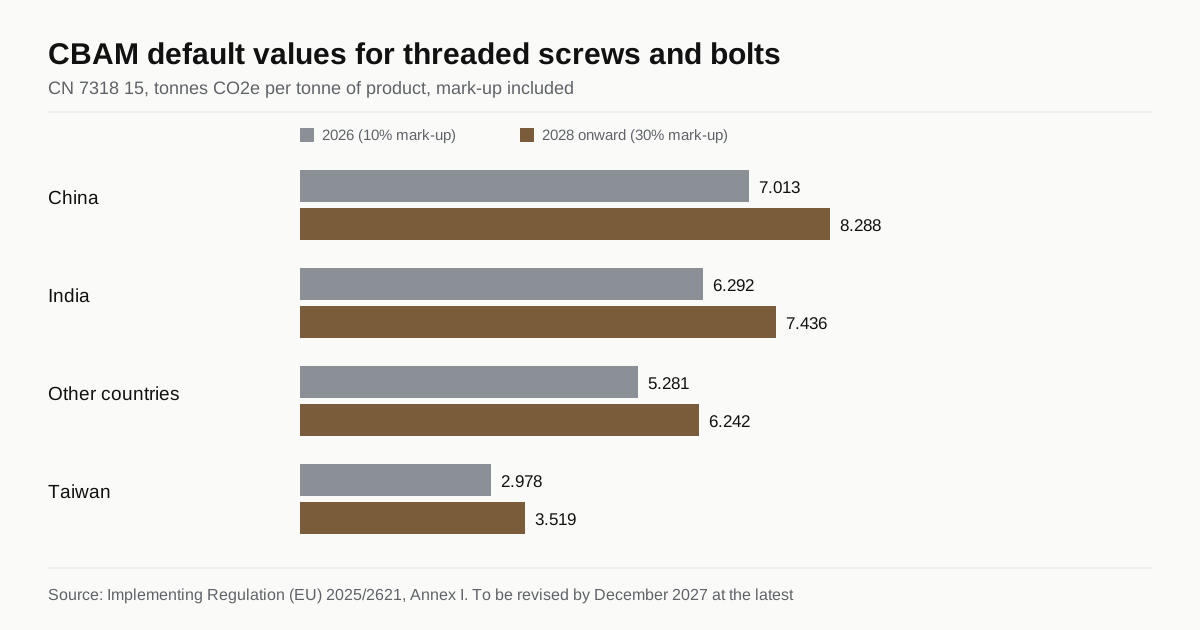
When the maker cannot supply verified actual data, the declarant uses the Commission default values in Implementing Regulation (EU) 2025/2621. They are set per country and CN code, in tonnes of CO2e per tonne of product, and they carry a mark-up: 10 percent for 2026, 20 percent for 2027 and 30 percent from 2028. The regulation prints decimal commas, so 7,013 means 7.013.
| Origin | CN 7318 15 threaded screws and bolts, base | 2026 | 2027 | 2028 onward |
|---|---|---|---|---|
| China | 6.375 | 7.013 | 7.650 | 8.288 |
| India | 5.720 | 6.292 | 6.864 | 7.436 |
| Taiwan | 2.707 | 2.978 | 3.249 | 3.519 |
| Other countries and territories | 4.801 | 5.281 | 5.761 | 6.242 |
An illustration of scale, with an assumed carbon price of EUR 70 per tonne of CO2e that is not a forecast: a default of 5.281 for 2026 means about EUR 370 of certificates per tonne of bolts, and 8.288 in 2028 means about EUR 580, before the free allocation adjustment. Whether that is large or small depends on the part price. For a low-value commodity bolt it is material. For a high-grade made-to-print part it may be a small share.
The Commission has said it will revise the default values and mark-ups by December 2027 at the latest, so treat the table as a snapshot.
Actual emissions and what a maker can supply
A bolt is a complex good in CBAM terms. Annex IV adds to the plant’s own attributed emissions the embedded emissions of the input materials (precursors) listed in Annex I, which for a fastener means the steel wire or rod. Actual-data reporting therefore needs two layers: the wire mill and the fastener plant. Many small plants will not have this, which is why the default values matter in the first years.
Ask the maker, before you place an order with volume:
- The CN code and the 7318 subheading it would use, and the country of origin and the country of the wire.
- Whether it can provide installation-level emissions data, and whether an accredited verifier has checked them.
- The steel route of the wire: blast furnace or electric arc. Cold heading wire grades lists the wire grades, and the route sets most of the embedded carbon.
- The net mass per part and per shipment, so you can track the 50-tonne count.
- A named contact for emissions data, and a statement of how long it keeps records.
Fold these into the custom fastener RFQ checklist so every quote includes them.
What is still moving
On 17 December 2025 the Commission proposed to extend CBAM to about 180 more downstream steel and aluminium products. According to a law firm summary dated 7 October 2026, the Council adopted its position on 12 June 2026, Parliament on 15 September 2026, and the first political trilogue is set for 20 October 2026. Check the Legislative Train Schedule or the Official Journal for the outcome. Fasteners under 7318 are already covered, so the proposal does not relieve them, and it may bring in the finished goods that contain them. It also changes anti-circumvention rules, which matter if a supply chain moves the last production step from one country to another. For the EU duty that already turns on origin, see EU anti-dumping duties on steel fasteners.
Cost and timing checklist for buyers
- Count tonnes per calendar year across all CBAM goods, not only fasteners.
- Decide before the first order who is the importer of record and who is the declarant.
- Budget a range of EUR per tonne using the default table, then ask makers for actual data to see if it is lower.
- Check the CN code on every part number, not only on the most common one.
- Plan for the first declaration and surrender on 30 September 2027 for 2026 imports.
To compare quotes on the same scope, send your RFQ with the CN code, annual tonnage and origin you are considering. We match it with up to three makers, and they reply within 24 business hours. See also how to source custom fasteners.
Sources
- Regulation (EU) 2023/956, consolidated text including the 2025 amendments (EUR-Lex)
- Regulation (EU) 2025/2083 simplifying CBAM (EUR-Lex)
- Implementing Regulation (EU) 2025/2621, default values (EUR-Lex)
- European Commission, Carbon Border Adjustment Mechanism
- European Parliament Research Service, CBAM briefing, July 2026
- Mayer Brown, CBAM downstream extension and anti-circumvention, October 2026 (law firm summary, directional)
Frequently asked questions
Are steel fasteners covered by CBAM?
Yes. Heading 7318 (screws, bolts, nuts, coach screws, screw hooks, rivets, cotters, cotter pins and washers of iron or steel) is listed in Annex I of Regulation (EU) 2023/956. The definitive regime applies from 1 January 2026. Check the CN code on your customs declaration, because the code decides whether the rule applies.
Is there a minimum quantity below which CBAM does not apply?
Yes. Article 2a sets a single threshold of 50 tonnes of net mass per importer per calendar year, counted across all CBAM goods together. Stay at or below it and you are exempt. Pass it and every obligation applies to all emissions in all goods imported that year, not only the excess.
Do I need the maker's actual emissions data?
No, but default values are higher by design. The Commission default for a country includes a mark-up of 10 percent in 2026, 20 percent in 2027 and 30 percent from 2028. Actual, verified data from the plant can lower the figure, and it is worth asking for when volume is large.
Who pays CBAM, the maker or the buyer?
The authorised CBAM declarant pays, which is the importer or its indirect customs representative. A maker outside the EU does not pay unless the sale terms make it the importer of record. Settle this in the Incoterm and the contract before the first order.
Need this fastener made?
Send the print with the grade and annual volume. We match you with up to 3 makers that run the right route and reply within 24 business hours.
Send my RFQ