Guides / Sourcing
Custom Fastener MOQ: What Sets the Minimum Lot Size
November 6, 2026
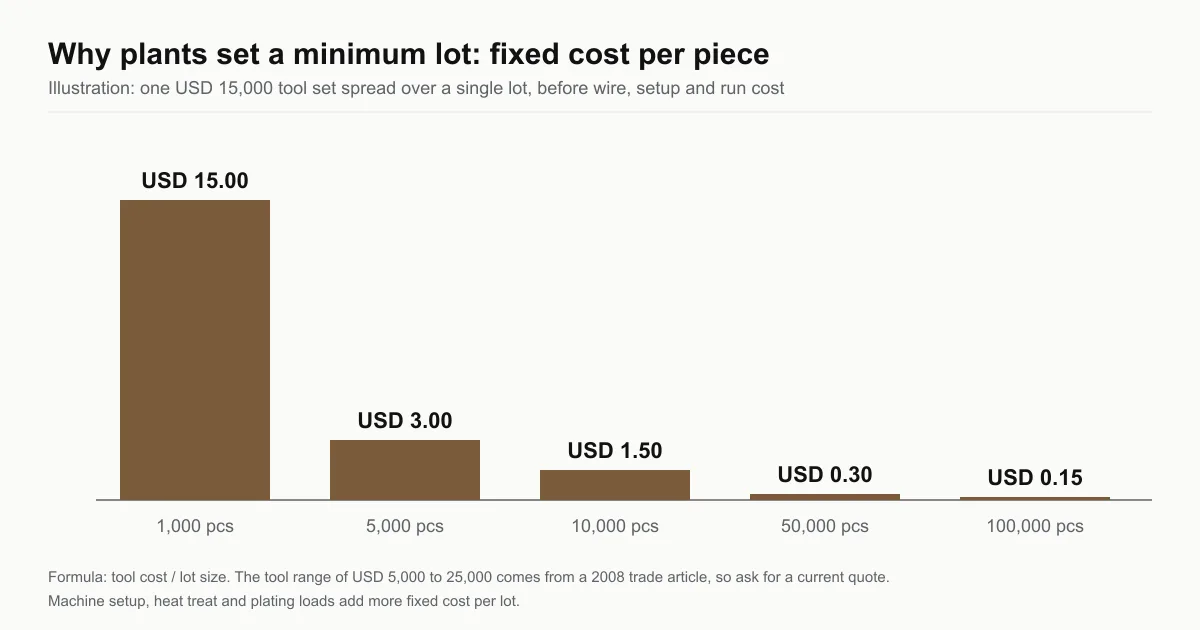
A custom fastener MOQ is the smallest lot a plant will run, and for a cold headed part it is often in the thousands or tens of thousands of pieces. The number is not set by the price list. It comes from fixed costs that every lot must carry: a die set, a machine setup, a coil of wire, a furnace load and a plating lot. If your print needs fewer pieces than that, the useful question is not “why is the minimum so high” but “which of those fixed costs can I move or share”.
This guide breaks the minimum into its parts, shows the arithmetic with clearly labelled assumptions and lists the ways buyers order less without paying a large premium. No public survey of fastener minimums exists, so where a number comes from a single source it is labelled as directional.
What a minimum lot has to cover
A plant prices a lot as fixed cost plus a per piece cost. The per piece cost covers wire, machine time, scrap and finishing. The fixed cost is paid whether the lot is 1,000 pieces or 100,000, so a small lot spreads it over very few pieces.
| Cost item | Fixed per lot or per piece | What sets it | How a buyer can lower it |
|---|---|---|---|
| Die set and punches | Fixed, once per part number | Wire diameter, head shape, station count | Use a standard head or drive, share an existing die family |
| Machine setup and first piece approval | Fixed, every lot | Number of stations, tolerance, operator time | Fewer, larger releases or a blanket order |
| Wire coil | Fixed in practice | Coil weight, grade, wire condition | Allow the plant to use a nearby grade or wire size |
| Heat treatment load | Fixed, per furnace load | Section size and furnace capacity | Combine lots of similar parts with the plant |
| Coating or plating lot | Fixed, per barrel or rack | Process and shop minimum | Ask whether coating can follow a stock blank |
| Inspection and records | Mostly fixed per lot | Sampling plan, certificates | Agree a sampling plan once, reuse it |
The first row is the largest on a new part. A 2008 article in Today’s Machining World quotes tool sets at “perhaps $5,000 to $25,000” depending on part geometry. Treat that range as dated and directional, since it is nearly two decades old, but the shape of the argument has not changed: the die is a fixed cost, and a small lot cannot absorb it. Our guide to cold forming tooling cost shows what drives that number.
The arithmetic: tool cost spread over the lot
Take a tool set at USD 15,000, which sits inside the range above, and spread it over different lot sizes. This is arithmetic, not a quote.
- 1,000 pieces: USD 15.00 per piece
- 5,000 pieces: USD 3.00 per piece
- 10,000 pieces: USD 1.50 per piece
- 50,000 pieces: USD 0.30 per piece
- 100,000 pieces: USD 0.15 per piece
A bolt that sells for well under one dollar cannot carry USD 15 of tooling, which is why a plant refuses a 1,000 piece lot on a new die set. At 10,000 pieces the tool still adds USD 1.50 each, so many plants pick a minimum near or above that point. If you pay for the dies up front, the plant does not need to recover them in the lot, and the fixed cost it still needs to cover shrinks to setup, wire and finishing.
Why a coil of wire is a lot in itself
A header runs wire from a coil. British Steel lists cold heading wire rod coils of 1,800 to 2,200 kg in rod diameters of 5.5 to 17.0 mm, and drawn wire for fasteners also arrives in coils. A worked example shows how many pieces one coil makes. These are assumed sizes for the arithmetic only.
- Wire diameter 7.0 mm and a slug length of 40 mm: volume is about 1.54 cm³, which at 7.85 g/cm³ weighs about 12.1 g.
- A 2,000 kg coil then makes roughly 165,000 slugs before scrap.
- Wikipedia gives heading speeds of 60 to 400 parts per minute. At 100 parts per minute, 165,000 pieces take about 28 hours of running time. At 60 and 400 parts per minute the range is about 46 hours down to 7 hours.
Two things follow. First, a header makes a lot of 10,000 pieces in under three hours even at the slow end of that range, so the machine time is small and the setup time around it is large. Second, for a special grade or an annealed wire condition the plant may buy or draw wire for your part only, and a partial coil of an unusual grade is hard to reuse. Ask whether your grade is a stock wire or a special purchase, because that single answer often explains the minimum. Our guide to cold heading wire grades lists the common ones.
Setup, heat treat and coating add their own minimums
Setup time is the reason a plant would rather run 50,000 pieces once than 10,000 pieces five times. The cost is operator and machine hours to install punches, adjust dies, run samples and approve the first pieces. Public sources give no standard figure for hours of setup, so ask each plant for it.
Heat treatment and coating are sold by the load. A furnace load or a plating barrel has a fixed cost, and a tiny lot of long bolts can still fill a rack. If the heat treatment is done by an outside shop, that shop may have its own minimum charge. Fastener heat treatment explains the steps that sit behind the charge.
How to order less than the minimum
A plant that quotes 10,000 pieces is describing the cost of its route, not refusing your business. These options reduce the lot without breaking the economics.
- Machine the first lot. A CNC shop sets up with a program and a bar, so its minimum can be a few pieces to a few hundred. One pin maker reports that machined solid pins cost about ten times as much as cold headed ones in production, but the setup cost of machining is lower, which is why it wins at small quantities.
- Pay for the tooling. You carry the fixed cost, the plant carries the run. Settle ownership, storage and transfer in writing before you pay.
- Order a blanket release. Commit to a yearly quantity and release it in lots. The plant runs the economic lot and ships against your schedule. Say both numbers on the RFQ.
- Start from a stock blank. If the plant already makes a similar headed blank, your changes may be a thread, a cross hole or a different length, which a machine shop adds on a small lot.
- Relax a feature that adds a station. A special head or an undercut can add a station and punch set. See cold heading vs machining for where the route changes.
- Accept a larger first lot and store the rest. If the part is stable and the shelf life is long, one big release can cost less than several small ones.
Quantity thresholds also vary by plant. The same trade article puts one shop’s cost effective runs between a couple of thousand and 250,000 parts, and reports another heading shop with recurring orders of around 1,000 for special large wood screws. A third manufacturer says only that its minimums are more flexible than they used to be, and gives no number. The spread shows that your part, not the industry, sets the answer.
What to put on the RFQ
Give the plant what it needs to choose the route and the lot size:
- Annual volume and the release size you prefer
- Whether you will own the tooling and a target date for the first lot
- Whether a machined first lot is acceptable while tooling is made
- Grade, finish and the test or certificate scope, since each adds a lot level cost
- The price breaks you want to see, for example 1,000, 10,000 and 50,000 pieces
The minimum lot is one of several cost and timing items covered in our guide to the custom fastener manufacturing process.
The custom fastener RFQ checklist lists the fields in order. When you send your print, up to three makers whose route fits the volume quote the same document, and they reply within 24 business hours.
Sources
- Today’s Machining World, cold forming versus machining (2008 article, tool set range and run size figures)
- Wikipedia, Heading (metalworking) for production speeds of 60 to 400 parts per minute
- British Steel, cold heading wire rod for coil weights and rod diameters
- Fastener and Fixing Magazine, cold headed vs machined solid pins (pin maker article, directional)
- The Federal Group, cold forming versus machining cost reduction (vendor article, directional)
Frequently asked questions
What is a typical MOQ for custom cold headed fasteners?
No public survey gives one number. Plants that run multi-station headers often quote lots in the thousands to tens of thousands, and some accept less. The minimum depends on part size, tooling status, grade and finish. Ask each plant for its minimum release and its minimum annual volume as two separate figures on the same print.
Can I order 500 custom bolts?
Usually not from a cold heading plant on a new die set, because the tool cost spread over 500 pieces dominates the price. A CNC machining shop can make 500 pieces from bar stock with only a program and a setup. Many buyers start with a machined first lot, then move to heading when volume is proven.
Does paying for the tooling lower the MOQ?
It can. If you pay for the dies, the plant no longer needs to recover them in the first lots, so the minimum may fall to what the setup and the wire lot require. Agree who owns the dies, where they are stored and what happens if you change plants before you pay.
Why do plants quote a minimum annual volume as well?
Dies are built for a part that will run repeatedly. A plant that builds a die set for a one time order has to recover the whole cost in that order. Annual volume tells the plant whether the tool will earn its cost over several lots, which can justify a smaller release size.
Need this fastener made?
Send the print with the grade and annual volume. We match you with up to 3 makers that run the right route and reply within 24 business hours.
Send my RFQ