Guides / Sourcing
EU Anti-Dumping Duties on Steel Fasteners and How to Prove Origin
October 31, 2026
The EU charges anti-dumping duty on certain non-stainless steel screws, bolts and washers that originate in China, at rates from 22.1% to 86.5% of the net price at the EU frontier. Regulation (EU) 2022/191 sets the duty, and it names the CN codes it covers. Fasteners made in other countries are not covered, but customs can ask where a part really originates. This guide covers the codes, the rates, the proof you should hold, the expiry date and what to put on a made-to-print order. It is not legal advice, so confirm any shipment with a customs broker.
Facts below are as of October 2026 and come from the Official Journal text.
EU anti-dumping on fasteners: what the regulation covers
Article 1 of Implementing Regulation (EU) 2022/191 imposes a definitive duty on certain fasteners of iron or steel, other than stainless steel:
- wood screws (excluding coach screws);
- self-tapping screws;
- other screws and bolts with heads, with or without their nuts or washers, excluding screws and bolts for fixing railway track material;
- washers;
when they originate in the People’s Republic of China. The regulation lists CN codes 7318 12 90, 7318 14 91, 7318 14 99, 7318 15 58, 7318 15 68, 7318 15 82, 7318 15 88, ex 7318 15 95, ex 7318 21 00 and ex 7318 22 00, with TARIC codes for the “ex” lines. The CN and TARIC codes are for information, and the product description decides.
That description leaves things out. Stainless fasteners are outside it. Nuts (7318 16) are not on the list. Headless studs and threaded rod are not “screws and bolts with heads”. A made-to-print part still needs a check against both the description and the TARIC code of the actual declaration.
The duty is a percentage of the net, free-at-Union-frontier price, before duty. That is the price at the EU border, which normally includes freight and insurance to that point, so a higher freight bill raises the duty.
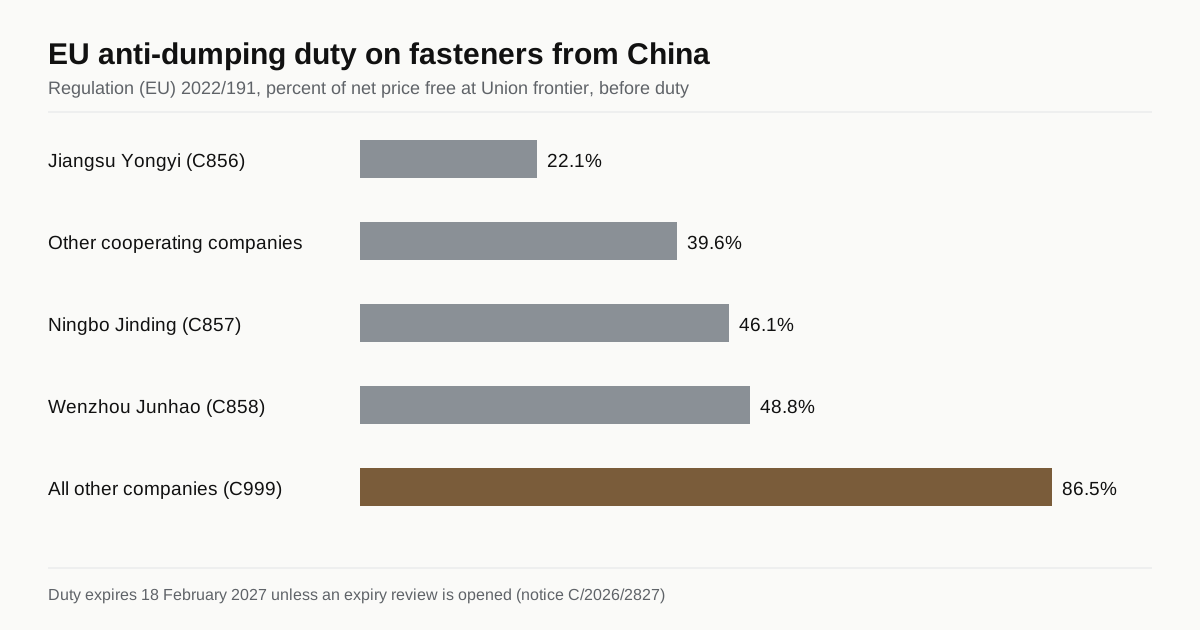
Duty rates by company
| Producer group | Duty rate |
|---|---|
| Jiangsu Yongyi Fastener Co., Ltd. (TARIC C856) | 22.1% |
| Ningbo Jinding Fastening Piece Co., Ltd. (C857) | 46.1% |
| Wenzhou Junhao Industry Co., Ltd. (C858) | 48.8% |
| Other cooperating companies listed in the Annex | 39.6% |
| All other companies (C999) | 86.5% |
The Annex list has grown. Regulations 2023/2159 and 2023/2602 accepted new exporting producers, a correction followed in 2024 (2024/1513) and Regulation (EU) 2026/1926 of 7 August 2026 added one more company to the cooperating list. If you buy from a Chinese plant, its TARIC additional code decides the rate, so check it on each invoice.
An individual rate applies only if the importer presents a valid commercial invoice with a signed declaration naming the producer, its address, the TARIC additional code and the country. Without it the 86.5% rate applies. The regulation adds that customs authorities do their usual checks and can require shipping documents even when the invoice is correct.
Duty on origin, not on where the box ships from
The duty follows origin. A fastener shipped from a third country is not charged unless customs establish that it originates in China. Two rules decide origin.
Article 60 of the Union Customs Code. Goods made in more than one country originate where they underwent their last, substantial, economically justified processing in an undertaking equipped for that purpose, resulting in a new product or an important stage of manufacture. Under Article 61, customs may ask the declarant to prove origin and may require additional evidence in case of reasonable doubt.
Annex 22-01 of Delegated Regulation 2015/2446. For chapter 73, the primary rule for heading 7318 is a change of tariff heading. The chapter note says that for heading 7318 mere attachment of constituting parts, without grinding to shape, heat treatment and surface treatment, does not confer origin. The residual rule says that where the primary rules cannot decide, origin is where the major portion of the materials by value originated.
Article 33 of the same delegated regulation adds that a processing step is not economically justified if the facts show its purpose was to avoid trade measures. Article 34 lists minimal operations that never confer origin, among them simple assembly, changes of packing and affixing marks or labels.
The rules read as follows for a fastener. Wire or rod is classified outside 7318, so cold heading, thread rolling and heat treatment of wire in one country would normally make that country the origin. A blank that already sits in 7318 and is only threaded and plated in another country does not change heading, so the primary rule does not decide, and the residual rule looks at where the material came from. Treat that reading as a reason to ask customs, not as a safe assumption.
Circumvention and monitoring
The Commission has acted on circumvention before. In 2020 Implementing Regulation (EU) 2020/611 re-imposed the duty from the earlier Regulation (EC) 91/2009 on fasteners consigned from Malaysia, whether declared as originating in Malaysia or not, for the period covered by an older extension. The wording shows the test: customs look at where the goods came from and where they were made, not at the origin declared on the box.
In the 2022 regulation the Commission added a monitoring clause. If exports from a company with a low individual rate increase sharply in volume, that can count as a change in the pattern of trade within the meaning of Article 13(1) of the basic regulation, and an anti-circumvention investigation may follow. A buyer who sources from a low-rate Chinese plant should expect scrutiny if volumes rise.
The earlier measure on stainless fasteners from China, Taiwan and the Philippines lapsed in January 2017, according to trade press reporting a Commission notice. It does not apply today.
Expiry and what to watch
Commission notice C/2026/2827 of 29 May 2026 states that the duty under Regulation 2022/191 expires on 18 February 2027 unless a review is initiated. Union producers may request an expiry review no later than three months before that date, which is around 18 November 2026. The notice does not say whether a review will be requested, and this article was written in October 2026, before that deadline. Check the Official Journal for a review notice, because a review changes how long the duty stays in force. Do not plan a price on the assumption that the duty will lapse.
Duty may also interact with CBAM, which covers the same CN heading. The CBAM guide for steel fasteners covers that second layer of cost.
What proof to keep, and what to put on the order
Keep this file for every lot you import, whatever the origin:
- Producer identity. Name and address of the plant that made the part, matching the invoice.
- Wire or rod certificate. The mill name and country on the certificate for the steel. A lot record that shows the heat number and the mill country is the base proof. See fastener proof load, wedge tensile and hardness tests for what the plant’s test file should hold.
- Process route card. Which plant did heading or machining, thread rolling, heat treatment and plating, with dates.
- CN and TARIC code. The same code on the order, the invoice and the declaration.
- Certificate of origin or origin declaration where the buyer, the broker or the customs office asks for one.
- For Chinese origin: the producer’s TARIC additional code and the signed invoice declaration from Article 1(3).
On the order, require the maker to state the country of each process step and to tell you before it changes a step or a sub-supplier. The manufacturing route sets origin as much as the paperwork does, so read cold heading vs machining when you compare routes across countries.
Quotes on the same scope
A duty adds a percentage to the quote, so compare landed cost, not unit price. Add the duty rate for the origin, the freight in the customs value and, from CBAM, the certificate cost. Where origin is not obvious, ask your broker for a ruling or binding origin information before the first shipment. To get quotes with origin and route stated, send your RFQ with the part number, grade, annual volume and the origin you can accept. We match it with up to three makers, and they reply within 24 business hours. See also how to source custom fasteners.
Sources
- Implementing Regulation (EU) 2022/191, definitive anti-dumping duty on fasteners from China (EUR-Lex)
- Implementing Regulation (EU) 2026/1926, new exporting producer (EUR-Lex)
- Notice of impending expiry, C/2026/2827, 29 May 2026 (EUR-Lex)
- Implementing Regulation (EU) 2020/611, Malaysia (EUR-Lex)
- Regulation (EU) No 952/2013, Union Customs Code, Articles 60 and 61 (EUR-Lex)
- Delegated Regulation (EU) 2015/2446, Articles 32 to 34 and Annex 22-01 (EUR-Lex)
- Fastener and Fixing Magazine, EU confirms expiry of stainless steel anti-dumping regulations (trade press, directional)
Frequently asked questions
Which steel fasteners carry EU anti-dumping duty?
Regulation (EU) 2022/191 covers non-stainless iron or steel wood screws, self-tapping screws and other screws and bolts with heads, with or without nuts or washers, plus washers, originating in China. It lists CN codes 7318 12 90, 7318 14 91, 7318 14 99, 7318 15 58, 68, 82 and 88 and parts of 7318 15 95, 7318 21 00 and 7318 22 00.
What are the duty rates?
Company rates are 22.1 percent, 46.1 percent and 48.8 percent for the three sampled producers, 39.6 percent for other cooperating producers and 86.5 percent for all other companies. The rate applies to the net price free at the Union frontier before duty.
When does the duty on Chinese fasteners expire?
A Commission notice of 29 May 2026 gives 18 February 2027 as the expiry date unless an expiry review is opened. EU producers may request a review up to three months before that date. Check the Official Journal for a review notice before you plan beyond February 2027.
How do customs decide the origin of a fastener?
Under Article 60 of the Union Customs Code, origin is the country of the last substantial, economically justified processing. Customs may ask for proof and extra evidence. Keep wire certificates, process route cards and the producer name and address, and consider binding origin information for borderline parts.
Need this fastener made?
Send the print with the grade and annual volume. We match you with up to 3 makers that run the right route and reply within 24 business hours.
Send my RFQ