Guides / Sourcing
Custom Fastener Lead Time: Where the Weeks Go
November 7, 2026
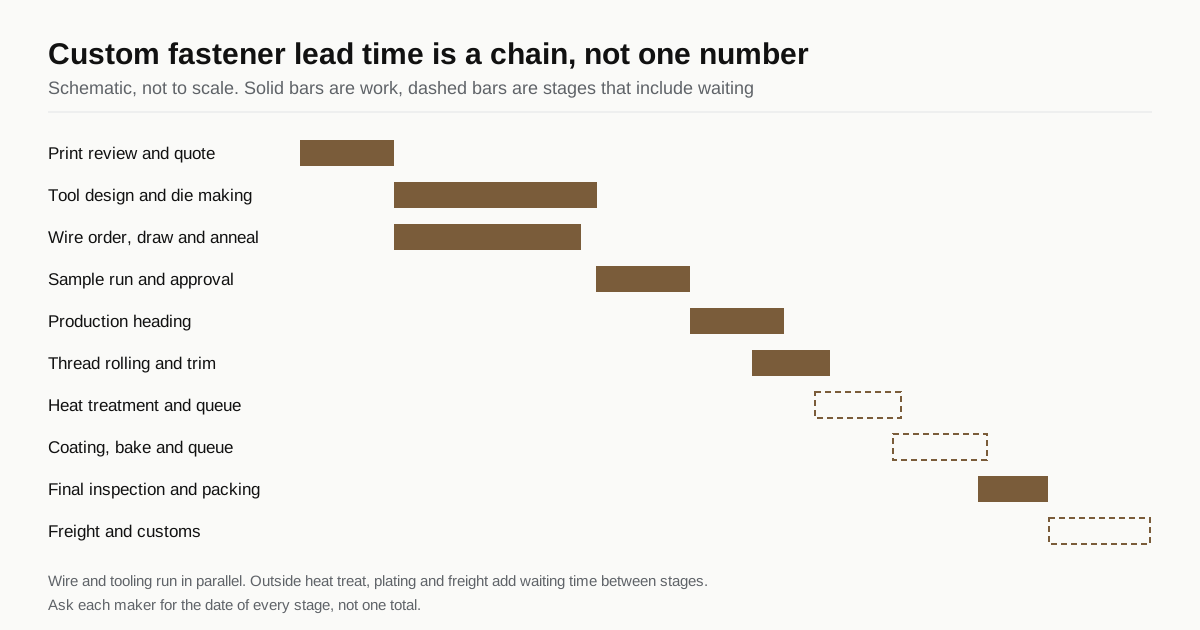
Custom fastener lead time is the sum of a chain, not a single number: tooling and wire first, then samples, then production, heat treatment, coating, inspection and freight. For a made-to-print part on new tooling, expect the first lot to take weeks, and expect the slowest stage to be one that waits in a queue rather than one that does work. A repeat order is much shorter, because the dies exist and only the run, the finishing and the freight remain.
No public source publishes a lead time benchmark for custom fasteners, so this guide gives you the structure instead of a figure: which stages exist, which can run in parallel, where waiting hides and what dates to ask for. It also shows how to read two quotes that give different totals.
The chain, stage by stage
| Stage | What happens | Can it overlap another stage? | Question for the maker |
|---|---|---|---|
| Print review and quote | Maker checks the route, grade and tolerances | No, it starts the clock | When does your lead time start: PO, print approval or sample approval? |
| Tool design and die making | Dies and punches are designed, ground and fitted | Yes, with wire | Do you already own dies that fit this part? |
| Wire order, draw and anneal | Wire of the right grade and condition is bought or prepared | Yes, with tooling | Is the wire a stock item or a special purchase? |
| Sample run and approval | First pieces are made and measured, you approve | No, waits for tool and wire | How many sample pieces and which tests? |
| Production heading | Header forms blanks | Short once running | What is your machine slot for this size? |
| Thread rolling and trim | Threads are rolled, heads trimmed | After heading | Is it in house? |
| Heat treatment | Hardening and tempering for classes 8.8 and up | Waits for blanks | Is it in house or outside, and what is the queue? |
| Coating and bake | Plating or flake coating, hydrogen relief bake if needed | Waits for heat treat | In house or outside, and what is the queue? |
| Final inspection and packing | Sampling, records, labels | Last step before shipping | Which certificate is ready at shipment? |
| Freight and customs | Transit to your dock | Outside the plant | Quoted ex works or delivered? |
Tooling and wire run in parallel
The longest early stage is new tooling, and a trade article on cold forming describes design and setup for cold formed parts as “often measured in weeks”. The same plant orders wire while the dies are made, so a plant that waits to order wire until the dies are finished adds weeks for no reason. Ask whether the wire order is placed at PO or at sample approval.
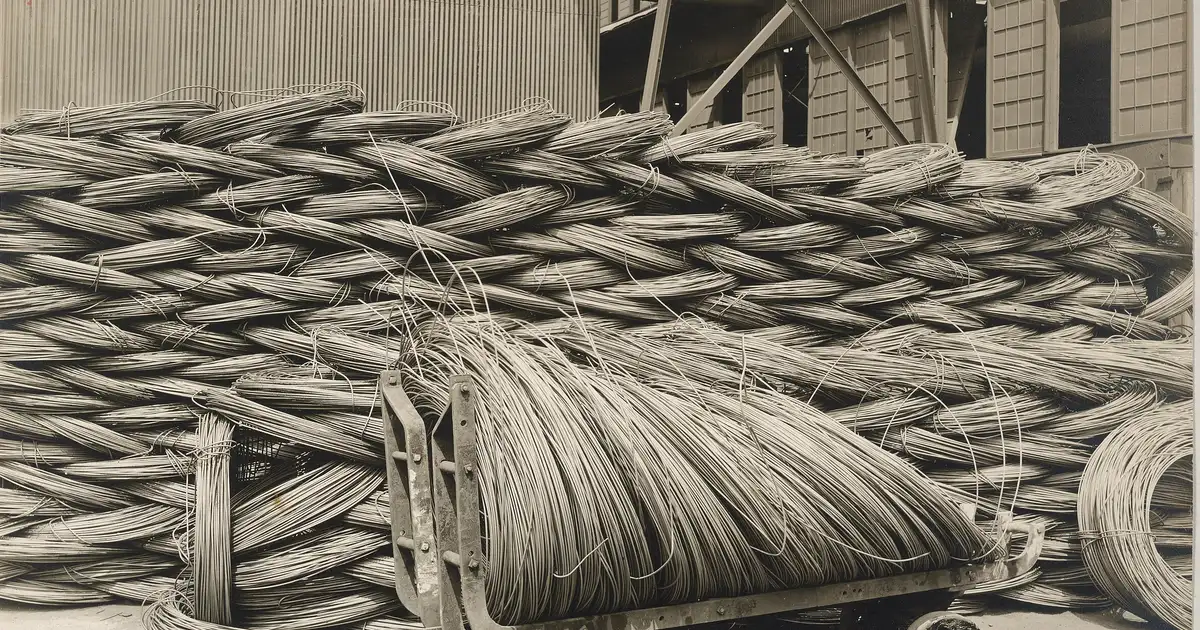
Wire is a stage of its own. British Steel lists cold heading rod in coils of 1,800 to 2,200 kg and in diameters of 5.5 to 17.0 mm, and drawing and annealing to your size and condition follow the rod. A common grade in a stock size can be pulled from a store. A special grade or an unusual size means a mill or wire drawer must make it. Our guide to cold heading wire grades explains which grades are routine. For how die size changes cost and time, see cold forming tooling cost.
The header is rarely the long pole
A multi-station header forms parts at 60 to 400 per minute according to Wikipedia. A lot of 10,000 pieces takes under three hours at the slow end of that range. Even a 165,000 piece coil, worked out in our custom fastener MOQ guide, runs in about a day or two. The time lives around the machine: getting a slot, setting it up, approving samples and waiting for the next step.
Where queues hide: heat treat, coating and freight
Heat treatment. ISO 898-1 requires class 8.8 steel to be quenched and tempered, and the higher classes use the same route, so every blank for those classes goes through a furnace. If the plant has its own line, the cycle is hours. If it sends blanks to an outside shop, the blanks wait in that shop’s queue, plus transport both ways. Read fastener heat treatment for what the furnace does, and ask the plant whether treatment is in house.
Coating and bake. Electroplated high strength fasteners can pick up hydrogen, so coating may be followed by a baking step. One finishing shop gives a bake of 4 to 24 hours depending on hardness and coating thickness, which is directional only. ISO 4042:2022 revised its measures on baking, so the requirement on your drawing and the plater’s practice should match. The bake adds hours, but the plating shop’s queue adds days. See hydrogen embrittlement in 10.9 and 12.9 bolts for the reasoning.
Certificates and tests. If you ask for a witnessed test or a third party certificate, the plant waits for the inspector. The traceability guide shows which documents are ready at shipment and which add time.
Freight and customs. A date ex works is not a date at your dock. Sea freight, customs clearance and inland transport can exceed the production time on a long route. The transit time depends on your lane, so ask a forwarder for the current figure rather than assuming a number.
How to compare two quotes
Two makers can quote different totals for the same part for good reasons. Put both quotes into the same table:
| Item | Maker A | Maker B |
|---|---|---|
| Lead time starts at | PO or print approval | Sample approval |
| Tooling exists already | Yes or no | Yes or no |
| Wire condition | Stock or special | Stock or special |
| Heat treat and coating | In house or outside | In house or outside |
| Date for samples | ||
| Date for first lot ex works | ||
| Incoterm |
If one maker starts the clock at sample approval and the other at the PO, the totals cannot be compared. Fix the start point first, then compare.
Ways to shorten the chain
- Send a complete print and the full RFQ in one pass, so quotes do not wait on questions. The custom fastener RFQ checklist lists the fields.
- Approve samples on a written test list, so approval is one decision.
- Ask for a staged shipment: part of the lot first, the rest later.
- For a repeat order, say so and ask the plant to hold wire or blanks against a forecast.
- Use a stock blank or a standard head if the function allows it.
- Consider a machined first lot while tooling is made. Our guide to cold heading vs machining shows when that makes sense.
What to write on the RFQ
For the route choice that sets which stages your part needs, read the custom fastener manufacturing process.
State the date you need the first lot, the incoterm, whether a partial shipment is acceptable and who owns the tooling. Then send your RFQ. Up to three makers whose route fits the part quote the same document, each with stage dates, and they reply within 24 business hours.
Sources
- Today’s Machining World, cold forming versus machining (2008 article, design and setup time)
- British Steel, cold heading wire rod for coil weights and rod diameters
- Wikipedia, Heading (metalworking) for heading speeds
- Fast Fix Technology, studying EN ISO 898-1 for the quench and temper requirement
- Finishing and Coating, ISO 4042:2022 updates for the revised baking measures
- Alpha Detroit, post-plating bake timing (finishing shop article, directional)
Frequently asked questions
How long does a custom fastener take from print to delivery?
No public survey gives a single figure, and a trade article describes design and setup for cold formed parts as often measured in weeks. Total time depends on whether tooling exists, the grade, outside heat treat and coating, and freight. Ask each maker for the date of every stage instead of one total.
What delays a custom fastener order the most?
Usually a stage that waits in a queue: new tooling, special wire, outside heat treatment, plating and bake, or sea freight. The heading machine itself is rarely the long pole, since a lot of 10,000 pieces runs in hours. Find the stage with the longest wait and see if it can run in parallel.
Does a repeat order take as long as the first one?
Usually not, because the dies already exist and the process is proven. The remaining time is wire, machine slot, heat treat, coating and freight. Say so on the PO and ask the plant to hold wire or a blank stock against a forecast if your schedule needs a short repeat lead time.
Should I ask for lead time ex works or delivered?
Ask for both. A date ex works tells you when the lot leaves the plant. Delivered dates add freight, customs and inland transport, which can exceed the production time on a long route. Put the incoterm on the RFQ so every maker quotes the same point.
Need this fastener made?
Send the print with the grade and annual volume. We match you with up to 3 makers that run the right route and reply within 24 business hours.
Send my RFQ