Guides / Sourcing
Custom Anchor Bolts and Foundation Studs Made to Print
October 13, 2026
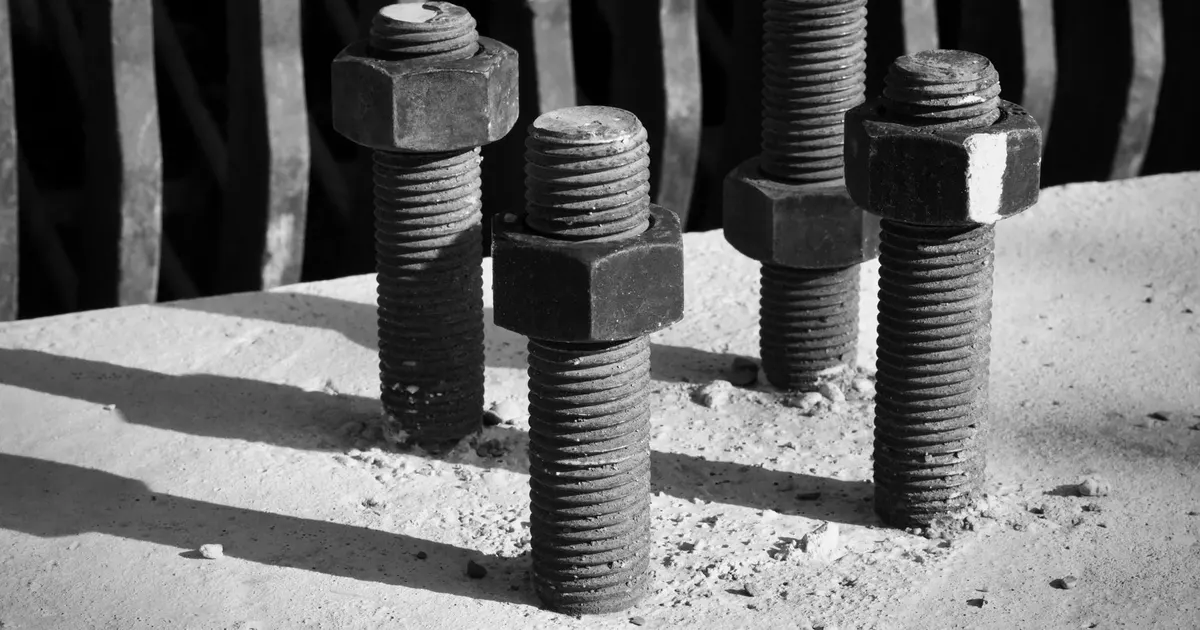
Anchor bolts hold structures to concrete: base plates under steel columns, machine frames, tanks, towers and equipment skids. They are simple in shape, usually a straight rod with a thread at the top and a hook, a bend or a head at the bottom. They are also safety critical, because after the concrete is poured they cannot be replaced. That is why the print needs to be complete before the plant starts, and why the standard and the dimensions need to be clear.
This guide covers the common shapes, the ASTM F1554 grades, thread and length choices, galvanizing and what to state in an RFQ.
Common styles
| Style | Shape | How it anchors | Typical use |
|---|---|---|---|
| Straight rod | Threaded one or both ends, no bend | Nut and plate washer at the bottom end | Heavy structures, deep embedment |
| L bolt | Rod with a 90 degree bend at the bottom | Bend bears on concrete, plus bond | Light to medium structures |
| J bolt | Rod with a U shaped hook | Hook bears on concrete, plus bond | Light structures |
| Headed bolt | Heavy hex or square head at the bottom | Head bears on concrete | Medium to heavy loads |
| Rod with anchor plate | Plate welded or nutted at the bottom | Plate spreads the load | Heavy loads, large diameters |
A design engineer picks the style and the embedment depth under rules such as ACI 318 for anchoring to concrete. A buyer orders what the drawing shows.
ASTM F1554 grades
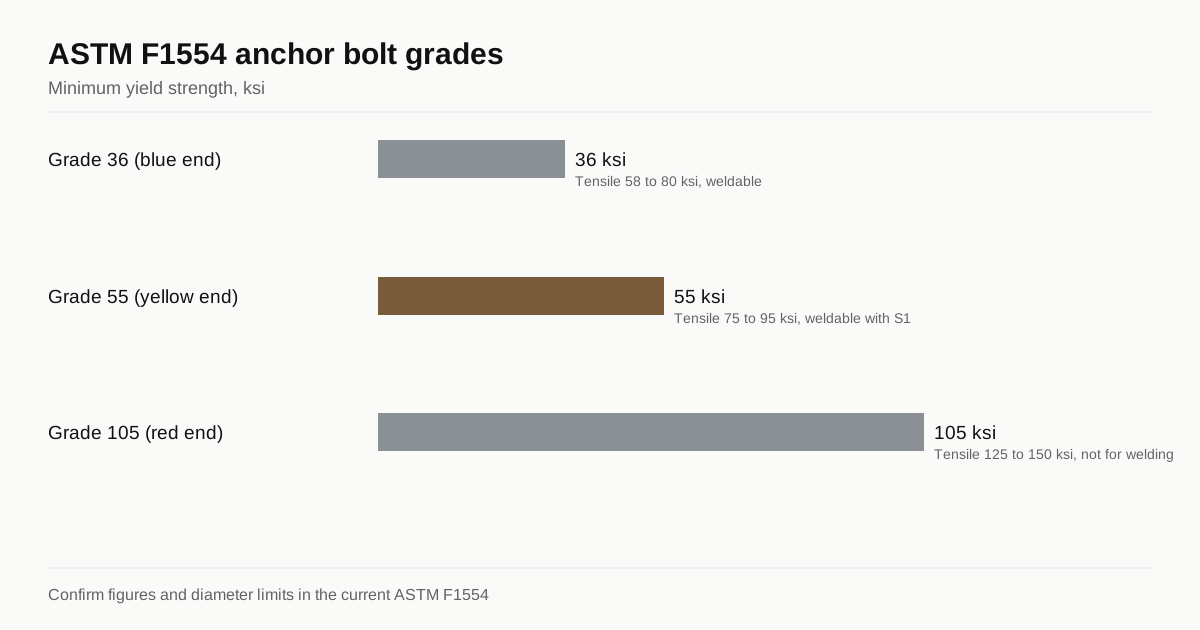
ASTM F1554 is the common standard for anchor bolts in the United States. It covers three strength levels.
| Grade | Minimum yield | Tensile strength | End color code | Notes |
|---|---|---|---|---|
| 36 | 36 ksi (250 MPa) | 58 to 80 ksi | Blue | General use, weldable |
| 55 | 55 ksi (380 MPa) | 75 to 95 ksi | Yellow | Weldable with Supplement S1 |
| 105 | 105 ksi (725 MPa) | 125 to 150 ksi | Red | High strength, not for welding |
Check the exact figures and the diameter limits in the current edition of the standard. Other standards appear on prints too, such as ASTM A307 for low strength bolts and ASTM A193 for high temperature, and users abroad apply ISO 898-1 classes. For the grade of structural bolts used in connections, a different standard applies.
Grade 36 is the usual choice for general use, because it is easy to bend and weld and costs the least. Grade 55 gives more capacity for the same diameter, so smaller or fewer bolts may do. Grade 105 gives the highest capacity, with a bolt that is much harder, which has consequences for bending and for galvanizing. See hydrogen embrittlement in 10.9 and 12.9 bolts, since Grade 105 behaves like those classes.
Thread, length and projection
An anchor bolt has three important lengths, and the print should show all three.
- Embedment length. The length that sits in the concrete, from the bottom to the top surface. The design sets it.
- Projection. The length that stands above the concrete, which has to cover the base plate, any grout, the leveling nut, the top nut and a few threads of margin.
- Thread length. The length threaded at the top. It must cover the whole projection that holds nuts, or the nuts will not seat.
For diameters up to 1 inch, the thread is typically UNC with 2A tolerance. Above 1 inch it is usually 8UN, with 8 threads per inch. Metric projects use ISO coarse threads with 6g. The thread can be cut or rolled, and rolled is better for fatigue loaded parts such as towers and machines. The rolling vs cutting guide describes the choice.
A bottom thread is added when a nut and plate washer anchors the rod. A straight rod anchored with a nut needs thread at both ends, and the lower end must be long enough to hold the nut and some margin.
Bending
L and J bolts are bent from straight rod. The bend can be hot or cold depending on diameter and grade. Standards set a minimum bend diameter to avoid cracking, and large diameter or high strength bars need a hot bend. A bend before galvanizing is normal, but a bend after galvanizing can crack the zinc, so the process order matters.
The print should show the leg length, the bend radius or inside diameter, and the tolerance. Tolerances on a bent anchor are loose compared with machined parts, but they must still allow the template to fit.
Galvanizing and coating
Many anchor bolts are galvanized for outdoor structures. ASTM F2329 or A153 applies to hot dip galvanized fasteners.
- Nut fit. The zinc layer adds to the thread, so nuts are tapped oversize by a set allowance. Specify this on the order and match nuts and bolts from the same supplier.
- Grade 105. High strength steel can pick up hydrogen in pickling before galvanizing. The standard covers precautions, and the plant should say how they handle it.
- Alternative coatings. Mechanical galvanizing and zinc coatings are used for threads that need a tighter fit.
- Plain steel. Embedded parts in concrete often stay uncoated, since the alkaline concrete protects steel, while the projecting part gets the coating.
State whether the full length or only the top is coated, and whether to leave the embedded part plain.
Nuts, washers and templates
Anchor bolts normally come with heavy hex nuts and plate washers. ASTM A563 covers nuts for these bolts, with a grade matched to the bolt. Template holes or a template plate hold the bolts in position during the pour, and some buyers order bolts pre-assembled with a template, or with plastic sleeves to give room for adjustment.
Mixed up grades cause problems on site. Color codes on the end of the bolt, as listed above, help the crew check what they have.
Typical manufacturing route
Straight rods are cut from bar or from threaded stock, threaded at the ends and bent where needed. Headed bolts are hot forged or hot headed, since the size is large for a cold former, and then machined and threaded. For long or large diameters, hot forging is the common route, as in cold heading vs machining. Lots are usually small and project based, with deliveries timed to the pour schedule.
What to state on the print
- Standard and grade: ASTM F1554 Grade 36, 55 or 105, or an ISO equivalent.
- Diameter, thread series and class.
- Overall length, bend leg and radius or head dimensions.
- Thread length at each end.
- Nuts and washers: grade, number per bolt and finish.
- Coating, the part it covers and the nut tapping allowance.
- Marking and color code.
- Certificates: mill test report and coating certificate.
Examples of anchor bolt orders
Twelve L bolts, 3/4 in diameter, 18 in long with a 4 in leg, Grade 36, hot dip galvanized, for a small equipment pad. The plant cuts rod, bends the leg, threads the top 4 in and ships with heavy hex nuts and flat washers. The thread allowance for galvanizing is agreed before threading, and the nuts are tapped oversize to match.
Sixteen headed anchor bolts, 1-1/2 in, Grade 55 with S1, 36 in long, for a steel column base. The head is hot forged, the shank is machined to length and the top is threaded 8UN. The design calls for weldable steel because the bolts are tack welded to a template. The plant provides carbon equivalent values on the certificate.
Eight Grade 105 rods, 1-1/4 in, 60 in long, for a wind loaded sign foundation. The rods are threaded at both ends and fitted with plate washers and nuts at the bottom. The plant notes the hydrogen precautions for galvanizing Grade 105 and says how the parts will be treated. Straightness is checked on each rod, since 60 in of rod can bow in handling.
Site and handling points
Anchor bolts live a hard life before they are even installed. The threads need to be protected from concrete splatter, which hardens on the thread and stops the nut. Plastic caps, tape or sleeves over the projecting thread solve most of it. The bolts must stay in position during the pour, so the template must hold them. After the pour, the crew checks projection and plumb before steel arrives.
A few details reduce trouble. Mark the grade on each bolt or bundle, with the color code. Bundle bolts by location when the drawing varies from one column to the next, and label the bundles. Pack nuts and washers in the same crate as the bolts so that they stay with the project. Ship in lengths the truck can carry, and protect galvanized threads in transport, since a chipped zinc layer or a bent thread shows up on site and is slow to fix. Ask the plant about packing before the order, because bundling by location takes labor and should be on the quote.
Checklist for the RFQ
- Drawing with all lengths and the style.
- Grade and standard, with weldability if needed.
- Coating and nut allowance.
- Quantity and delivery date tied to the pour.
- Packing and marking by project or by location.
The general structure of a quote is in custom fastener RFQ checklist. To start, send your RFQ and we match it with up to three makers that supply anchor bolts to print.
Frequently asked questions
What is the difference between an anchor bolt and a foundation stud?
In most orders they mean the same thing: a threaded steel rod cast into concrete to hold a base plate or machine. The word stud tends to be used for a straight rod threaded at one or both ends, while anchor bolt covers bent L and J shapes and headed types as well. The print should show the shape, not rely on the name.
Can I weld an anchor bolt?
Only grades that allow it. ASTM F1554 Grade 55 has a supplement for weldability, with limits on carbon equivalent. Grade 36 is generally weldable by its chemistry and Grade 105 is not. State the need for welding on the print, so the plant picks a compatible steel and the right supplement.
Why does a galvanized anchor bolt need a tapped oversize nut?
Hot dip galvanizing adds a zinc layer to the thread, which would jam a standard nut. The usual fix is to tap the nut oversize by a set allowance, or to thread the bolt undersize before galvanizing. Both must be defined on the order, or the nuts will not run on.
Do anchor bolts need to be gauged?
Yes, as with any thread. State the thread class, the gauging point and whether the check is before or after galvanizing. Anchor bolts are long, so the plant also checks straightness and the bent shape.
Need this fastener made?
Send the print with the grade and annual volume. We match you with up to 3 makers that run the right route and reply within 24 business hours.
Send my RFQ