Guides / Grades and Materials
Hydrogen Embrittlement in 10.9 and 12.9 Bolts: How to Prevent It
October 22, 2026
Hydrogen embrittlement is a delayed failure of a high strength bolt. A small amount of hydrogen enters the steel, moves to the highly stressed zone under the head or at the first thread, and the bolt cracks at a load far below its tensile strength. The break comes with no warning stretch, and often after the part has been installed. The higher the strength of the steel, the more sensitive it is, which is why the risk concerns class 10.9 and 12.9 above all.
This guide explains where the hydrogen comes from, why hardness drives the risk and which steps in the process lower it. It also lists tests, so you can ask a plant what controls they run.
What happens inside the steel
Hydrogen atoms are small enough to diffuse through steel at room temperature. In a stressed bolt, they migrate to the zone of highest tensile stress, which is the fillet under the head or the root of the first loaded thread. There they gather at grain boundaries and defects and lower the force needed to open a crack. Under a steady tensile load the crack grows slowly, then the bolt breaks suddenly.
Three conditions must meet for a failure:
- Hydrogen in the steel. Enough to reach a threshold.
- Tensile stress. A tightened bolt carries a high stress by design.
- A susceptible material. A hard, high strength microstructure.
Remove one of the three and the failure does not happen. In practice, a bolt designer cannot remove the stress, so the control levers are the hardness of the steel and the amount of hydrogen that gets in.
Where the hydrogen comes from
Process sources. Acid pickling, used to remove scale before coating, produces hydrogen at the steel surface. Electroplating, especially zinc, generates hydrogen at the cathode during deposition, and part of it enters the part. Some cleaning baths and paint strippers do the same.
Service sources. A bolt exposed to corrosion in service can pick up hydrogen from the reaction at the surface. Bolts under cathodic protection, for example in marine or buried service, can also absorb hydrogen. This is called environmental hydrogen embrittlement, and baking after manufacture does not help because the source is still present in service.
Steelmaking and welding. Dissolved hydrogen from the steel mill and from welding is a smaller source in fastener practice, but it is why a bolt should not be welded after heat treatment.
Why hardness sets the risk
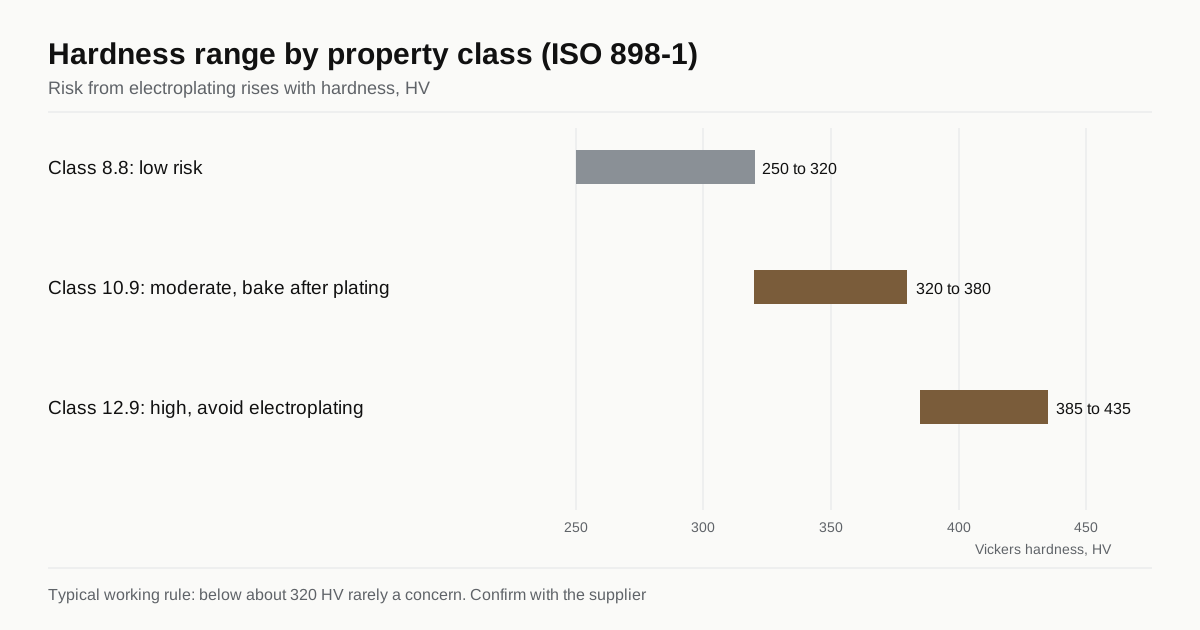
Susceptibility rises with strength. ISO 898-1 notes that for property class 10.9 and above, the risk of embrittlement exists, and many users restrict plating on class 12.9 or avoid electroplating entirely. A common working rule is that steel below about 320 HV is rarely a concern, steel from about 320 to 390 HV needs controls and steel above that needs a coating process that does not add hydrogen.
| Property class | Hardness range (HV) | Risk from electroplating | Typical control |
|---|---|---|---|
| 8.8 | 250 to 320 | Low | Normal process, no special steps |
| 10.9 | 320 to 380 | Moderate | Hardness near the low end, baking after plating |
| 12.9 | 385 to 435 | High | Avoid electroplating, or use a non electrolytic coating |
Two bolts of the same class can differ. A class 10.9 bolt at 375 HV is much more sensitive than one at 330 HV. A buyer can cut risk by adding a maximum hardness to the print, such as 36 HRC, instead of leaving the full ISO range open. This gives the plant a smaller window to hit, and the tempering temperature goes up with it. Fastener heat treatment explains how that window is set in the furnace.
Prevention steps that work
Lower the hardness. If the design allows, stay at the low end of the class range or choose class 10.9 over 12.9. A little more bolt diameter in a lower class is often safer than a smaller bolt in the highest class.
Avoid acid. Use mechanical descaling, such as shot blasting, or alkaline cleaning, instead of acid pickling on parts above class 10.9. Where acid is unavoidable, use inhibitors and keep the time short.
Choose a coating that adds little hydrogen. Mechanically applied zinc and non electrolytic zinc flake coatings, covered by ISO 10683, are applied without electrolytic deposition. They are widely used for high strength bolts for this reason. Electroplating is still used for 10.9 with a baking step.
Bake after plating. Baking drives hydrogen out before it concentrates under stress. The usual window is around 190 to 230 °C for several hours, started soon after plating, because delay lets hydrogen move to the stress zone and a dense layer then holds it there. Standards such as ISO 4042 and ASTM F1941 describe the practice. Treat the exact time and temperature as a plant specification and ask for it in writing.
Control the sequence. Write the order of heat treatment, cleaning, coating and baking on the process route, and ask the plant to confirm it before the first release.
Reduce stress concentration. A generous radius under the head and a smooth thread runout reduce the peak stress where hydrogen gathers. The same radius also helps fatigue.
How plants test for it
Direct proof of a safe lot is hard, because failures are delayed. Plants use two types of checks.
- Preloading tests. ISO 15330 describes a test where a plated bolt is tightened to a high fraction of its proof load and held for 48 hours or more. A bolt that cracks during the hold shows the process leaves too much hydrogen. It is a process qualification test.
- Incremental step load tests. ASTM F1940 and F519 describe methods that find the threshold stress for cracking. They are used to qualify a coating process or a batch of steel.
Neither replaces control of the process. Ask whether the plant runs a preloading test on a sample from each plated lot, or only when qualifying a process, and what the bake record shows. The mechanical tests in fastener testing do not detect hydrogen, since a bolt can pass tensile and proof tests and still carry hydrogen that has not yet moved to the stressed zone.
Design choices that lower the risk
- Use the lowest property class that meets the clamp and fatigue need.
- Specify a maximum hardness for 10.9 parts that will be plated.
- For 12.9, state that electroplating is not allowed and name an acceptable alternative.
- Do not weld or plate a part after final heat treatment without agreement.
- In marine or buried service, ask whether the steel and coating combination can pick up hydrogen in the environment.
For critical joints, the choice of grade and class comes first. Our summary of fastener grades and classes shows how the classes compare.
A typical failure story
A buyer orders class 12.9 socket head screws with a bright zinc plating for a machine frame. The parts pass tensile and hardness checks at the plant. After assembly, some screws break within two days, with the head separating cleanly from the shank at the fillet, and the fracture surface shows the intergranular pattern typical of hydrogen damage.
In the review, the plant reports that the lot went through acid pickling and standard zinc electroplating, with a bake that started the next morning after the parts sat overnight in a wet barrel. The delay and the dense zinc layer locked in hydrogen. The fix has three parts: a different coating that adds no hydrogen, a lower hardness for the screws that remain at risk and a bake that starts within hours of plating on any electroplated lot.
The story shows why the controls work as a set. Each one alone leaves a gap, and a certificate that shows bake time and delay protects the buyer from the most common gap.
Field signs and what to do
Hydrogen cracks in service tend to show the same marks. The fracture sits at the head to shank fillet or the first thread. The surface is bright, with little stretch or necking, and the break appears without added load. Other bolts from the same lot may be cracked and not yet broken.
If you see one failure in the field, treat it as a lot problem. Stop use of the lot, look for the same marks on other parts, keep the broken pieces for a lab examination and gather the lot number and the plating records. A laboratory can identify the mechanism from the fracture surface. Ask the plant for its bake log and its preloading test results for that lot, and compare with the print. This kind of case is also why a buyer should keep lot records for a few years after delivery.
Checklist for the RFQ
- Property class and any maximum hardness.
- Coating type, or a statement that electroplating is not allowed.
- Baking requirement: temperature, time and maximum delay after plating.
- Whether you need a preloading test report with the lot.
- Service environment, especially marine, buried or cathodically protected.
Include these items so quotes are comparable. To start, send your RFQ and we match it with up to three makers that handle high strength bolts.
The hardness windows of classes 8.8, 10.9 and 12.9 are tabled in fastener hardness conversion.
See also the reference page on class 10.9 bolts, with hardness windows and coating rules by class.
The process audit used to prove a plating line is under control is explained on the ASTM F1940 reference page, and the coating standards on the ISO 4042 and ISO 10683 page.
Frequently asked questions
How long after tightening can a bolt fail from hydrogen embrittlement?
Failures are delayed. A bolt can break within hours of tightening or weeks later, with no change in load. That delay is the reason the problem is hard to catch in incoming inspection. A bolt that passes every test at the dock can still carry hydrogen that has not yet moved to the stressed zone.
Is class 8.8 safe from hydrogen embrittlement?
The risk is low and rises with hardness. Steel below roughly 320 HV is rarely affected in normal plating. Class 10.9 sits at the edge, and class 12.9 is the most sensitive. A bolt with a hardness at the top of its range is more at risk than the same class at the bottom.
Does baking always remove the hydrogen?
Baking helps only if it starts soon after plating and runs long enough, because a dense plating layer traps hydrogen in the steel. It is a process control, not a guarantee, and it works best together with a hardness limit and a coating process that adds little hydrogen.
Need this fastener made?
Send the print with the grade and annual volume. We match you with up to 3 makers that run the right route and reply within 24 business hours.
Send my RFQ