Guides / Processes
Fastener Heat Treatment: Quench, Temper and Decarburization
October 19, 2026
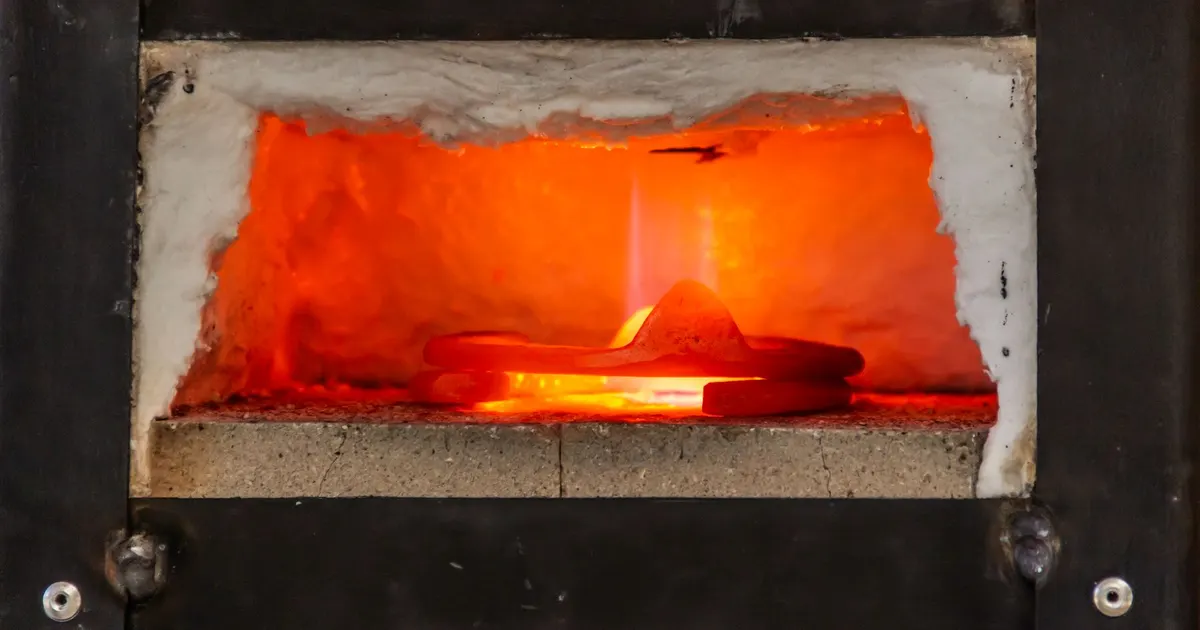
Heat treatment gives a bolt its strength. The wire or bar that enters the furnace has a modest tensile strength, and the same steel leaves it as a part that can carry a class 10.9 or 12.9 load. A bad furnace cycle can wreck an otherwise correct part, and the damage is usually invisible until the bolt fails in service. For a buyer, that makes heat treatment the process step that deserves the most questions.
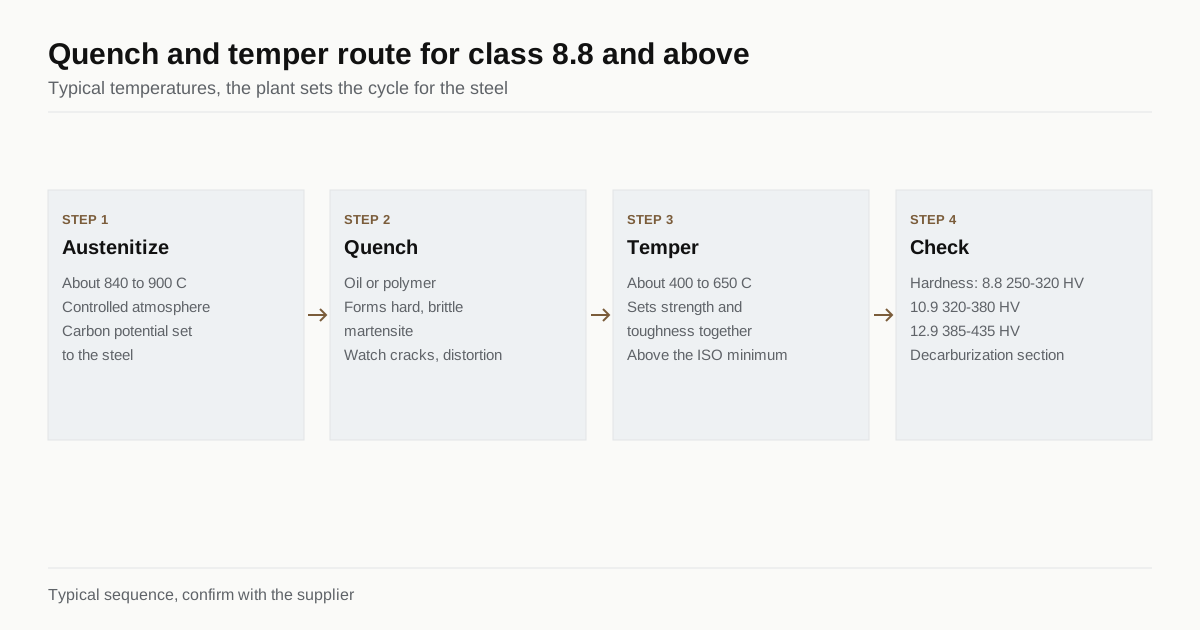
This guide explains quench and temper in plain terms, shows how hardness maps to property class, explains decarburization and lists what to ask the plant.
Why most bolts above class 8.8 are quenched and tempered
Low strength fasteners, up to about class 5.8, are made from low carbon steel and need no heat treatment. They get their strength from the cold work of forming. Higher classes need more, and the route is quench and temper.
The sequence has three stages:
- Austenitize. The parts are heated into the austenite range, typically around 840 to 900 °C depending on the steel. The carbon dissolves into the iron.
- Quench. The parts drop into oil, polymer solution or sometimes water. The fast cooling traps the carbon and forms martensite, a very hard and brittle structure.
- Temper. The parts are reheated to a lower temperature, commonly in the range of about 400 to 650 °C, and held. Carbon precipitates as fine carbides and the structure becomes tough. A higher tempering temperature gives lower strength and more toughness.
ISO 898-1 sets a minimum tempering temperature for each property class so that the steel is not left too brittle. The actual figure is in the standard’s table, and a plant should work to it or higher.
Hardness and property class
The finished hardness tells you whether the process worked. ISO 898-1 gives hardness ranges for each class, and a plant checks them on samples from each lot.
| Property class | Typical steel family | Vickers hardness (HV) | Rockwell C (HRC) |
|---|---|---|---|
| 8.8 | Medium carbon or low carbon boron steel, quenched and tempered | 250 to 320 | 22 to 32 |
| 10.9 | Medium carbon alloy or boron steel | 320 to 380 | 32 to 39 |
| 12.9 | Alloy steel such as a chromium molybdenum grade | 385 to 435 | 39 to 44 |
Hardness is a check, not the full requirement. Tensile strength, proof stress, elongation and the wedge test also apply, and fastener testing covers how those are done. A hardness value inside the range with a failed tensile test still means a rejected lot.
The steel grade matters. A low carbon boron wire such as the 10B21 family reaches class 8.8 and often 10.9 on small sizes, because boron raises hardenability at low carbon. Large diameters and class 12.9 usually call for an alloy steel so that the core hardens through. See cold heading wire grades for how the grades differ.
What goes wrong in the furnace
Heat treatment fails in a handful of common ways, and each leaves a trace in the records.
Decarburization. If the furnace atmosphere contains oxygen, carbon leaves the surface of the steel and the skin turns soft. ISO 898-1 limits both partial and complete decarburization, and it measures them on a section through the thread. A decarburized thread root loses fatigue strength and can strip at a load the core would have carried.
Carburization. The opposite problem. An atmosphere with too much carbon makes the surface harder than the core. The standard restricts how far the surface hardness may exceed the core hardness.
Quench cracks and distortion. A part with sharp section changes or a very hard steel can crack in the quench. Long slender bolts also bend. The quench medium, its temperature and the way parts enter the bath all affect the result. A plant that straightens bolts after quenching should say so, because straightening adds stress.
Soft spots and mixed lots. Parts that stick together in the furnace or pile too thick in a belt furnace do not all heat the same way. Hardness scatter across a lot is a warning.
Wrong temper. If the temper is too low, the bolt is strong and brittle. If it is too high, the bolt is tough but does not reach the class. Both show up in the hardness and in the elongation result.
Furnace types in fastener plants
Small headed parts go through continuous mesh belt furnaces. The parts travel on a belt through a heating zone, drop into an oil quench and pass through a tempering furnace. These lines run high volumes of small parts and hold a protective atmosphere, often an endothermic gas or a nitrogen based mix, with the carbon potential set to match the steel.
Larger or longer parts go in batch furnaces, such as integral quench furnaces or pit furnaces. Batch work allows different cycles for different parts, which suits low volumes and large diameters, and it is common for forged and machined fasteners that go out to a heat treater.
Machine shops usually send their parts to an outside heat treater, which adds a few days and a batch charge. Ask who treats the parts and whether the furnace is in the plant’s own control. For small lots, outside treatment is normal and not a quality concern in itself, but the paperwork should travel with the parts.
Typical figures
| Item | Typical range |
|---|---|
| Austenitizing temperature | About 840 to 900 °C |
| Tempering temperature | About 400 to 650 °C, set by the class |
| Hold time | Minutes to an hour or more by section size |
| Quench medium | Oil or polymer for most grades |
| Heat treatment cost share of piece price | A minor share at volume, a major share on small lots with outside treatment |
| Extra lead time if treated outside | A few days |
These are typical numbers. Confirm the cycle with the plant.
Heat treatment and what comes next
The step after heat treatment is often coating. A high strength bolt that is electroplated can pick up hydrogen and crack later, so the order of operations and the baking step matter. Read hydrogen embrittlement in 10.9 and 12.9 bolts before you specify plating on any bolt above class 10.9. Thread rolling after treatment, covered in thread rolling vs cutting, is another sequence choice to write on the print.
What to ask the plant
- Which steel and which furnace type will make this part?
- What is the furnace atmosphere and how is the carbon potential controlled?
- Is decarburization checked on every lot, and by which method?
- Where do hardness tests happen and how many samples per lot?
- Will the parts be straightened after quench?
- Who treats the parts if the plant does not do it in house?
Examples from the order book
A small class 10.9 screw, M5 x 20, five million a year. This part runs through a continuous mesh belt furnace. The plant controls the atmosphere carbon potential to match the steel, quenches in oil and tempers in a second furnace. Each lot gets hardness checks from several pieces, with a tensile or wedge test on a smaller sample. The risk to watch is part-to-part scatter from piling on the belt, which shows up as hardness spread across the lot.
A class 12.9 socket head cap screw, M16 x 80, 2,000 a year. The volume suits a batch furnace. The steel is a chromium molybdenum alloy so that the core hardens through at that diameter. The quench oil temperature and the agitation matter for distortion, since a long bolt can bend. After tempering the plant measures hardness at the surface and in a section through the thread, and it checks for decarburization on a sample. A plant that treats the part in house gives faster answers when a lot fails.
These examples show why the questions in the previous section matter. The same steel, treated in a different furnace, gives a different risk profile.
Rework and retreatment
Parts that fail hardness are sometimes retreated. Retempering a part that came out too hard is a normal fix, since it lowers hardness and raises toughness. Rehardening a part that came out too soft is more delicate, because a second quench adds distortion and the risk of cracks, and decarburization can get worse with each cycle at temperature. Many buyers write on the print that parts may be retempered but not re-quenched without approval.
Ask what the plant does with a failed lot, and whether it records the number of heat treatment cycles on each lot. A lot with a traceable history is easier to trust than one whose route is unknown. If a retreated lot is allowed, the certificate should say so, and the mechanical tests should be repeated after the retreatment, not carried over from the first pass.
Checklist for the RFQ
- Property class or the tensile and hardness requirements.
- Steel grade if you have one, or leave it open and ask for the plant’s choice.
- Whether you want a decarburization check and a lot certificate.
- Coating or plating that follows heat treatment.
- Annual volume and release size.
State these up front and you will see which quotes include them. To start, send your RFQ and we pass it to up to three makers that match the route and the class.
Heat treatment follows forming and the thread; the whole sequence is in the custom fastener manufacturing process. The hardness window each class must land in is in fastener hardness conversion.
See also the reference page on class 12.9 bolts, where the tempering and decarburization limits are tightest.
Frequently asked questions
Why are bolts quenched and tempered instead of just hardened?
A quenched part is very hard and brittle. Tempering reheats it to a lower temperature so the structure relaxes into a tough one. The tempering temperature sets the final strength and toughness together, which is how a plant lands on a given property class.
What is decarburization and why does it matter on a bolt?
Decarburization is the loss of carbon from the surface of the steel during heating in an atmosphere that is not protective. The skin becomes softer than the core. On a threaded bolt that skin is exactly where fatigue cracks start, so standards limit how much is allowed.
Do I need to ask for heat treatment records?
For property class 8.8 and above it is reasonable to ask for hardness results, the heat treatment lot number and a note on the furnace atmosphere. Many buyers also ask for a decarburization check on a sample from each lot. State what you need on the RFQ.
Need this fastener made?
Send the print with the grade and annual volume. We match you with up to 3 makers that run the right route and reply within 24 business hours.
Send my RFQ