Guides / Grades and Materials
Torque vs Clamp Load: The K Factor on Custom Bolts
November 3, 2026
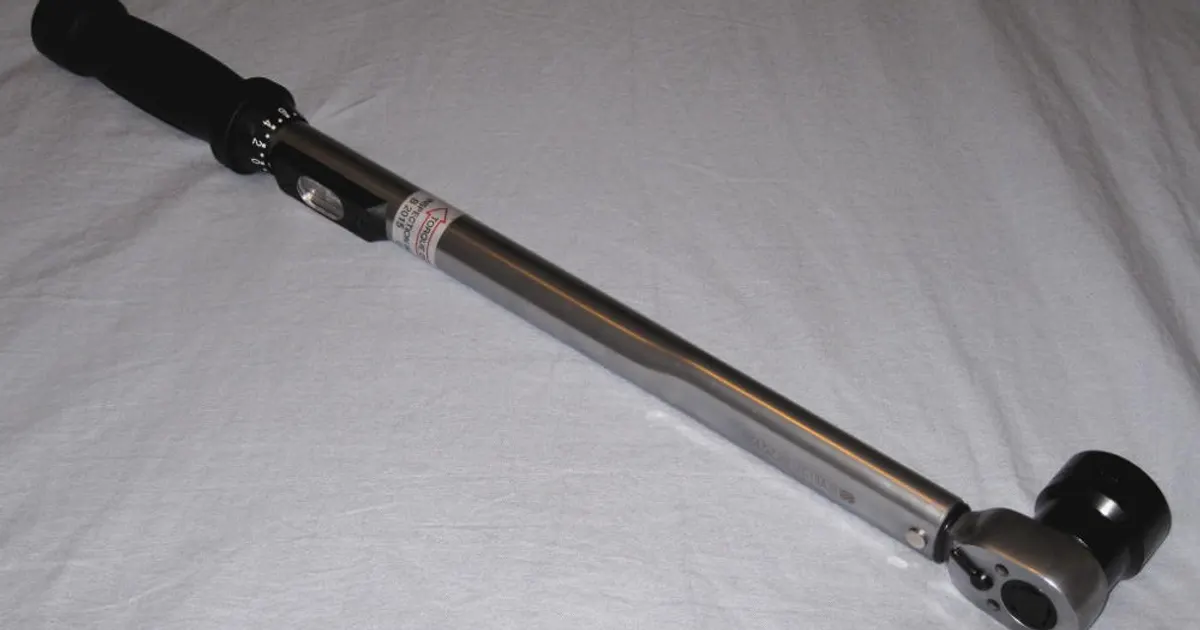
Tightening torque gives you clamp load only through one number, the K factor, and that number moves with finish, lubricant and the parts the bolt runs against. The short formula is T = K x F x d, where T is torque, F is the clamp load you want and d is the nominal bolt diameter. A K of 0.20 is a common starting point for steel bolts, but a drawing that gives a torque without stating the finish and lubricant condition leaves the real clamp load open.
This guide explains where the torque goes, what typical K values look like, what one wrench setting does to clamp load when K changes and what to write on a made-to-print order.
The formula and what K contains
The relation is T = K x F x d. For an M10 bolt, d is 0.010 m, so each kilonewton of clamp load at K = 0.20 needs 2 N·m of torque.
K is not a material property of the bolt alone. According to the Wikipedia article on bolted joints, it depends on the thread geometry, the friction in the threads and the friction under the head or nut. With both friction coefficients at 0.15, the relation simplifies to K close to 0.20, and a test on 1/2-20 UNF bolts gave 0.208. The same article says a torque wrench does not measure preload directly.
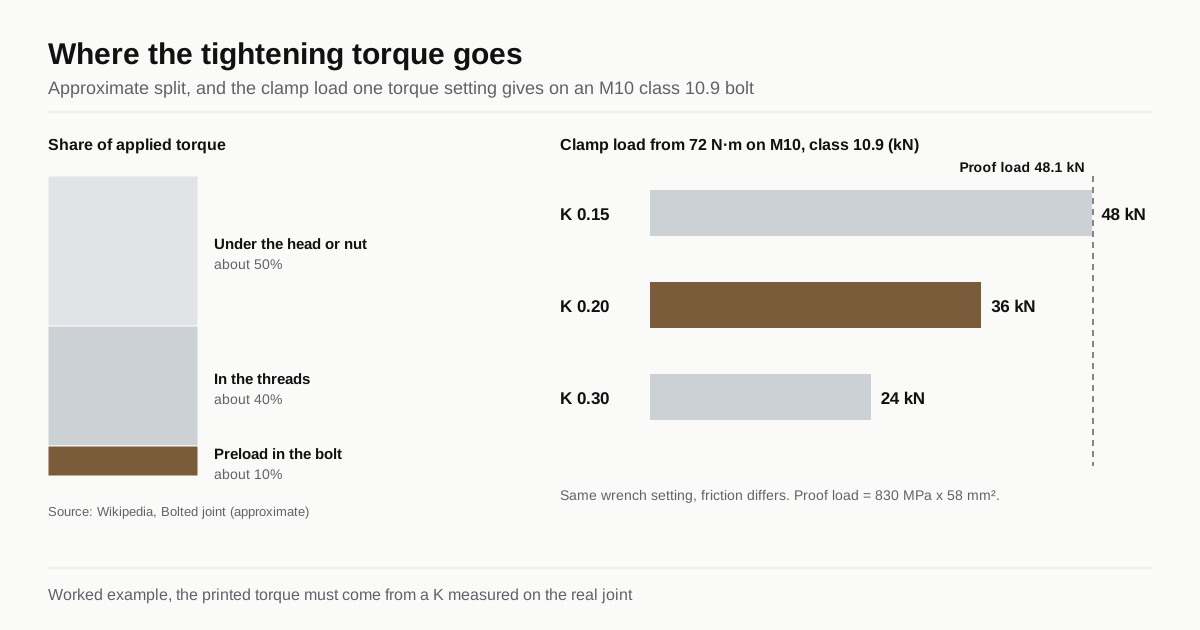
Most of the torque never reaches the bolt. The article gives an approximate split: about 50 percent is lost under the head or nut, about 40 percent in the threads and only about 10 percent goes into stretching the bolt. A small change in friction therefore has a large effect on the preload.
Typical K values by finish
Handbook tables give K by surface condition. The table below comes from the Shigley’s Mechanical Engineering Design values reproduced on AmesWeb, and the Engineering Toolbox lists the same figures for mild steel bolts from 1/4 to 1 inch, plus 0.2 for normal dry condition.
| Bolt condition | K |
|---|---|
| Plain, black finish | 0.30 |
| Zinc plated | 0.20 |
| Lubricated | 0.18 |
| Cadmium plated | 0.16 |
Read these as a rough guide. The Engineering Toolbox calls its method a rough calculation that leaves out the thread pitch, and tells the reader to check manufacturer data. Lubrication can lower the torque needed for a given preload by about 15 to 25 percent, according to the Wikipedia article, and plating changes friction as well.
One wrench setting, three clamp loads
Take an M10 bolt of class 10.9. Our proof load guide uses a proof stress of 830 MPa and a stress area of about 58 mm², which gives a proof load of about 48.1 kN. The usual working target is 75 percent of proof, about 36 kN, and the Engineering Toolbox notes that standard dry torque tables aim at 70 percent of minimum tensile strength or 75 percent of proof.
At K = 0.20 the torque for 36 kN is about 72 N·m. Now fix the wrench at 72 N·m and change only the friction:
| K | Clamp load at 72 N·m | Share of proof load |
|---|---|---|
| 0.15 | about 48 kN | about 100 percent |
| 0.20 | about 36 kN | about 75 percent |
| 0.30 | about 24 kN | about 50 percent |
The numbers are a calculation from the formula and the proof load above, not test data. They show the problem: a bolt that is a little slicker than the table assumed reaches proof load, and a dry or rough one reaches half of the target. In a joint that carries fatigue load, a low preload can let the joint slip or loosen. A preload that reaches proof load leaves no margin and can stretch the bolt for good. See SAE Grade 5 vs Grade 8 for how the 75 percent rule is used on inch bolts.
How accurate is torque control
The same Wikipedia article lists approximate scatter for torque wrenches: about plus or minus 35 percent for unlubricated bolts, 30 percent for cadmium plated ones and 25 percent for lubricated ones. The Engineering Toolbox says a torque wrench is normally no better than plus or minus 25 percent. Other methods do better:
- Bolt extension measured with a gauge: about plus or minus 5 percent.
- Strain gauge or ultrasonic monitoring: about plus or minus 1 percent.
- Preload indicating washers: about plus or minus 10 percent.
- Computer controlled wrenches: about plus or minus 15 percent below yield, about 8 percent with yield sensing.
Torque is cheap and fast, so most joints still use it. The right response is to choose a design preload that stays safe across the scatter, and to control the friction condition, so the scatter is the wrench and not the bolt.
What on a custom bolt changes K
Several print and process choices change K, and a plant can only control the ones you name.
- Finish. Plain, zinc plated, zinc flake and phosphate coatings have different friction. A coating with a built-in lubricant behaves differently from a dry plated one.
- Post-lubrication. Wax or oil added after plating lowers K. Say whether it is required, forbidden or optional.
- Thread method. Rolled and cut threads can differ in surface finish, and friction follows. See thread rolling vs cutting.
- Thread fit and coating thickness. A thick coating on a tight class of fit can raise tightening torque before the bolt seats. The thread gauging guide explains the fit allowance.
- Locking features. A nylon insert or a thread patch adds prevailing torque, which is not clamp load. The patch vs prevailing torque guide covers how to separate it.
- Mating parts. K belongs to the whole joint, so the nut, the washer and the surface under the head all count.
How to test K
For a repeatable number, measure it. ISO 16047 specifies the conditions for torque and clamp force tests on threaded fasteners and related parts. It applies to carbon and alloy steel bolts, screws, studs and nuts with properties set in ISO 898-1, ISO 898-2 or ISO 898-6, in ISO metric threads from M3 to M39. It does not apply to set screws, to screws that form their own thread or to fasteners with self-locking features.
A plant that offers this test can run it on a sample of your lot with your nut and washer, or with a test nut it names. No public price or lead time exists for it, so ask each plant to quote the test on the same scope. If your assembly line needs a torque value with a tolerance, a measured K from the real parts is the only number you can defend.
What to put on the print
- Property class and standard, for example ISO 898-1 class 10.9.
- Finish and any post-lubrication, stated as a requirement.
- The assembly torque and its source, either your own measured K or a customer specification.
- Whether a torque and clamp force test is required, with the standard and the sample size.
- Whether the parts are delivered dry or lubricated, and how the lot is packed to keep that condition.
- A note that finish or lubricant changes need your approval.
Put the same text in your quote request. The RFQ checklist shows where finish and test requirements belong with the rest of the order. This site is a matching service, not a fastener plant. Send your RFQ with the finish and the tightening condition and up to three makers whose process fits the part will quote the same scope within 24 business hours.
The grade sets what a bolt can carry; how to pick it is in our guide to fastener grades.
See also the bolt torque and preload calculator for metric and inch sizes.
Sources
- Wikipedia, Bolted joint: torque-preload relationship, nut factor, accuracy table
- Industrial Fasteners Institute, ISO 16047:2005 listing
- AmesWeb, torque coefficient K factor table (after Shigley) (reference site, directional)
- Engineering Toolbox, bolt torque and load calculator (reference site, directional)
Frequently asked questions
What is the K factor in bolt torque?
K, also called the nut factor, is the single number that links tightening torque to clamp load in the short formula T = K x F x d. It lumps together thread friction, friction under the head and thread geometry. It is found by testing, and it changes with finish, lubricant and the mating surfaces.
What K factor should I use for a zinc plated bolt?
Textbook tables give about 0.20 for zinc plated, 0.30 for plain black, 0.18 for lubricated and 0.16 for cadmium plated steel bolts. Use these only for a rough estimate. A real value for your bolt, nut and joint should be measured, because the scatter between lots can be large.
How accurate is torque as a way to set clamp load?
Not very. One published comparison puts torque wrench scatter at about plus or minus 35 percent for unlubricated bolts and 25 percent for lubricated ones. Methods that measure stretch or strain, or use preload indicating washers, give tighter results at higher cost.
Does lubricant change the torque I need?
Yes. Lubricating the threads and the bearing surface lowers friction, so the same torque gives more clamp load. Published guidance puts the torque reduction for the same preload at about 15 to 25 percent. If a plant adds wax or oil after plating, the torque table on your print must be written for that condition.
Need this fastener made?
Send the print with the grade and annual volume. We match you with up to 3 makers that run the right route and reply within 24 business hours.
Send my RFQ