Guides / Grades and Materials
Martensitic and PH Stainless Fasteners: 410, 416 and 17-4
October 5, 2026
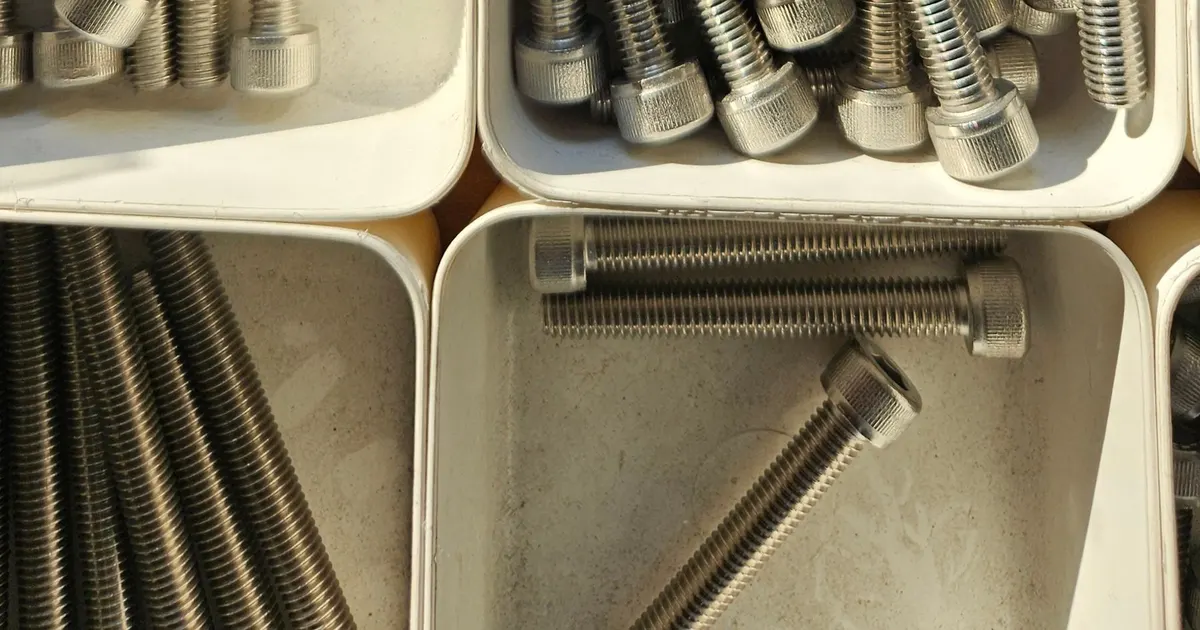
Austenitic stainless steels such as 304 and 316 resist corrosion well but stay soft. If a fastener needs the strength of an alloy steel bolt and still has to survive moisture, you move to the martensitic and precipitation hardening grades. These grades go by many names on a print: 410, 416 and 17-4 PH are the three that custom fastener buyers meet most often, and they behave quite differently.
This guide explains what separates them, what the heat treatment does, where each fits and how to write the grade and the condition on the print.
The three grades in brief
410 stainless. A martensitic steel with about 11.5 to 13.5 percent chromium and a low to medium carbon content. It hardens by quench and temper, like a carbon steel, and it is magnetic. ISO 3506 covers martensitic fasteners in the C1 group, with property classes 50, 70 and 110. ASTM A193 lists 410 as grade B6 for bolting.
416 stainless. The free machining version of 410. A small sulfur addition forms soft inclusions that break the chip, so 416 turns and threads easily. The sulfur lowers corrosion resistance and toughness, and the grade is poor for cold forming. It sits in the free machining group of ISO 3506.
17-4 PH. A precipitation hardening steel, UNS S17400, with about 15 to 17.5 percent chromium, 3 to 5 percent nickel and 3 to 5 percent copper. It is martensitic in structure and hardens by a low temperature aging treatment after solution annealing. It has higher strength than 410 and better corrosion resistance. AMS 5643 and ASTM A564 are the usual bar specifications.
How the heat treatment works
410 and 416 are hardened the same way as a carbon steel: heat to about 950 to 1010 °C, quench in oil or air and temper. The tempering temperature sets the strength. A key rule is to stay out of the tempering band around 400 to 550 °C, where toughness drops and corrosion resistance suffers. Plants temper above that band or well below it.
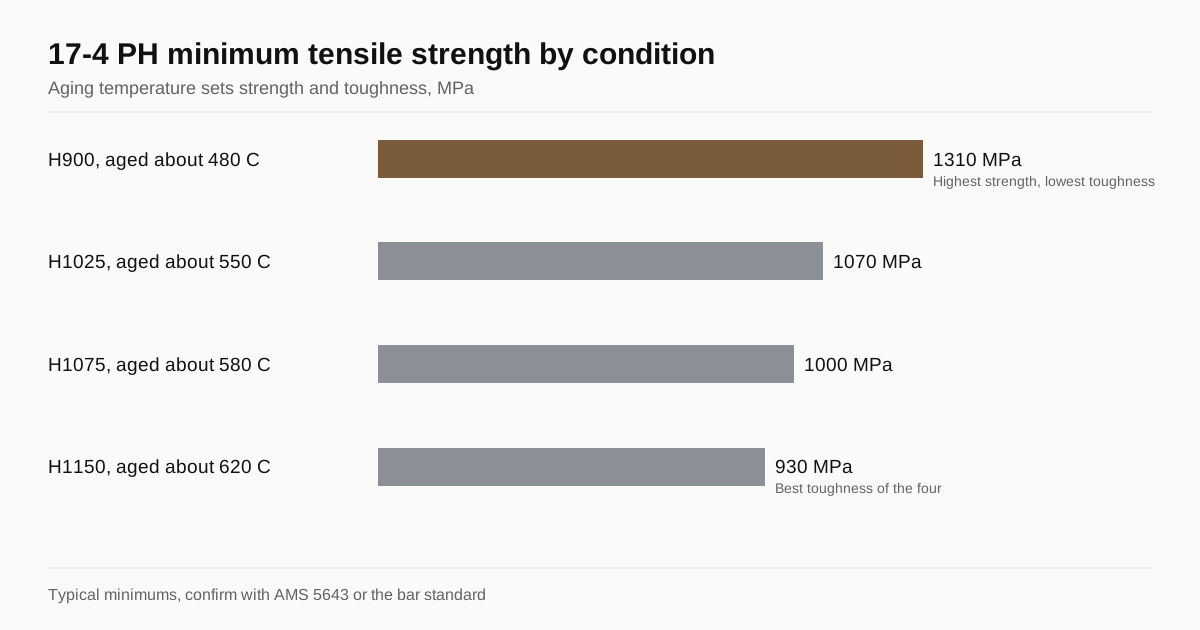
17-4 PH starts in condition A, solution annealed, which is soft enough to machine and to roll threads. The parts are then aged at a set temperature for about an hour. The condition name carries the aging temperature in degrees Fahrenheit.
| Condition | Aging temperature | Typical minimum tensile strength |
|---|---|---|
| H900 | About 480 °C | About 1,310 MPa |
| H1025 | About 550 °C | About 1,070 MPa |
| H1075 | About 580 °C | About 1,000 MPa |
| H1150 | About 620 °C | About 930 MPa |
A lower aging temperature gives higher strength and lower toughness. H900 has the highest strength and the lowest toughness and resistance to stress corrosion cracking, so many marine and oil field users stay at H1025 or above. Always confirm the figures in the standard that applies, such as AMS 5643.
Aging makes the part shrink slightly, by a few hundredths of a percent. The plant allows for this, and for tight tolerances it machines or rolls the thread to a size that lands in tolerance after aging.
Strength and corrosion side by side
| Grade | Strength level | Corrosion resistance | Machinability | Cold heading |
|---|---|---|---|---|
| 410 | Medium to high after quench and temper | Moderate, fair in mild environments | Fair | Possible in the annealed condition |
| 416 | Medium | Lower than 410 | Very good | Poor |
| 17-4 PH | High after aging | Better than 410, near 304 in many media | Fair in condition A | Possible with care, usually machined |
| 304 or 316 (reference) | Low to medium, cold work needed for more | Good to very good | Fair | Good |
Values are typical and depend on condition and section size. For chloride service, none of the martensitic grades equal 316 or the duplex grades, so check the environment before choosing.
Where each grade fits
410. Mid strength parts in mild corrosive settings, such as pumps, valves and general machinery. It is cheaper than 17-4 PH and heat treatable. Corrosion resistance is best when the surface is clean and passivated.
416. Machined parts such as pins, screws and fittings, where machining time is the main cost and corrosion exposure is mild. Avoid it for fatigue critical bolts and where sulfides matter.
17-4 PH. Aerospace, valve, pump and oil and gas fasteners that need high strength with corrosion resistance, in sizes from small screws to large studs. It is more expensive than 410 and needs a more careful route.
If the application can accept a lower strength, an austenitic grade is often better value. The comparison of strength classes in fastener grades and classes places stainless next to carbon steel. For high temperature or seawater service beyond what these grades handle, read Inconel and Monel fasteners.
Manufacturing route and cost
Most 17-4 PH fasteners are machined from solution annealed bar, rolled or cut to thread in condition A and then aged. A small number go through cold heading, mostly in smaller diameters. 410 can be cold headed and hot forged, then heat treated, and the choice depends on diameter and volume. 416 is almost always machined. Cold heading vs machining explains why the route changes the piece price.
Stainless bar is more costly than carbon steel and the material share of the price rises. Ask the plant to quote with the bar form and the diameter, and note that bar of a hard grade wears tools faster, which reflects in the machining rate.
Passivation and finish
Stainless fasteners rely on a thin chromium oxide layer. After machining, parts are passivated in an acid bath, such as the processes in ASTM A967, to remove free iron and restore the layer. A part that skips this step can rust in a salt spray test even when it is made from the right grade. Do not electroplate martensitic stainless without advice, since hydrogen is a concern at high hardness. See hydrogen embrittlement for the principles.
What to write on the print
- Grade and standard. For example 17-4 PH to AMS 5643 or ASTM A564, or 410 to ISO 3506 class 110.
- Condition. H1025, for instance, not just “17-4”.
- Strength or hardness requirement. Tensile strength, yield and hardness range.
- Thread process. Rolled before or after aging.
- Passivation. The standard and the test, if any.
- Magnetic response. If it matters, say so.
Corrosion in practice
Martensitic stainless steels hold their corrosion resistance only when the chromium stays in solution at the surface. Three common problems erode that.
Sensitization and tempering band. A 410 part tempered in the wrong band, or held there during processing, can lose corrosion resistance and toughness. Plants avoid it by tempering outside the band and by cooling quickly through it.
Free iron on the surface. Steel tools, grinding wheels and contaminated baskets leave iron on the part, and the iron rusts in a humid room. Passivation removes it, so ask for it on every machined stainless part.
Crevices and chlorides. All three grades can pit in warm chloride water. A thread under a washer is a perfect crevice. For coastal or de-icing salt exposure, 17-4 PH in an overaged condition such as H1025 or H1150 gives better stress corrosion resistance than H900, and an austenitic or duplex grade may still be the better answer.
Salt spray tests compare finishes, but they do not predict service life. If the part matters, ask the maker what testing it has done on the same alloy and the same finish.
Examples
A pump shaft bolt, M12 x 60, in a fresh water pump. 410 quenched and tempered gives enough strength at low cost, with passivation for the surface. The water has no chlorides, so corrosion is mild.
A valve stem fastener in an offshore valve, M10 studs, heavy load. 17-4 PH in H1025 offers high strength and better resistance to stress corrosion than H900. The buyer states the condition on the print and asks for hardness results on each lot, since hardness is a quick check that aging reached the target.
A small turned pin, 3 mm diameter, thousands a year. 416 turns fast and holds a polished finish. The load is light and the environment is dry indoor air, so the lower corrosion resistance is acceptable.
Common ordering mistakes
- Writing “17-4” without a condition, so the plant supplies whatever is on the shelf.
- Forgetting that H900 and H1150 differ by hundreds of MPa in strength.
- Specifying 416 for a load bearing bolt because it was cheap to machine.
- Skipping passivation on the print.
- Assuming a magnetic part is a defect, when martensitic grades are magnetic by nature.
- Plating martensitic parts without checking hydrogen risk.
A line on the print for each of these closes the gaps, and it takes only a minute to write.
Checklist for the RFQ
- Grade and condition, or the property you need and an open grade.
- Diameter, length and thread, with tolerance class.
- Environment: chloride, temperature, fluid, load type.
- Certificates: material certificate, heat treatment record, hardness result.
- Annual volume and release size.
Give these details and the quotes will compare the same part. To start, send your RFQ and we pass it to up to three makers that work with stainless fasteners.
Why a stainless bolt can pull a magnet, and which chemistry tests settle the grade, is in why stainless bolts attract a magnet.
Frequently asked questions
Are 410 and 17-4 PH fasteners magnetic?
Yes. Both have a martensitic structure and respond to a magnet, unlike the common 304 and 316 austenitic grades, which are usually weakly or non magnetic. If magnetic response matters in your assembly, a martensitic or PH grade is the wrong choice.
Which grade should I pick for a high strength stainless bolt?
For the highest strength in a corrosion resistant fastener, 17-4 PH in an aged condition is the usual answer, and it holds strength better than 410 in many sizes. For a lower cost part that needs moderate strength and mild corrosion resistance, 410 is common. 416 is picked mostly for machined parts, not for load critical bolts.
Can 17-4 PH be cold headed?
It can be formed in the solution annealed condition with the right equipment, but most 17-4 PH fasteners are machined from bar, then rolled and aged. The grade is stiff, so cold heading dies wear faster. Ask the maker which route applies at your diameter and quantity.
Need this fastener made?
Send the print with the grade and annual volume. We match you with up to 3 makers that run the right route and reply within 24 business hours.
Send my RFQ