Guides / Sourcing
PPAP for Custom Automotive Fasteners: What to Request on the RFQ
November 5, 2026
PPAP, the Production Part Approval Process, is a set of 18 records that a supplier gives its customer to show that its process can make a part to print at production rate. The customer decides how much to submit, through one of five submission levels. For a made-to-print automotive fastener, ask for the level your own customer’s supplier quality manual names. Level 3 is the common default. For a standard catalog bolt, a first article report with certificates is usually enough.
This guide shows what each of the 18 elements means on a cold-headed or machined fastener, what to write on the RFQ and where a PPAP is more than you need.
Who asks for PPAP and why
The Automotive Industry Action Group (AIAG) publishes the PPAP manual, which Wikipedia cites as version 4, and PPAP sits inside AIAG’s advanced product quality planning work. The fastener supplier Optimas says AIAG mandates PPAP approval for the automotive industry, and that other OEMs may apply the same ideas through their own processes. In practice the request reaches a fastener plant from a tier 1 or tier 2 buyer, who is passing down what its own customer wrote in the supplier quality manual.
The fastener distributor Field Fastener draws a useful line. Parts that the customer designed for a specific function, with special features, are make-to-print and should get a PPAP, and a level 3 package is reasonable when the features are critical or safety critical. Standard parts to IFI, ASTM, ASME, ISO or DIN specifications are bought off the shelf, and the article argues a PPAP is often unnecessary there. These are positions from trade sources. Your customer’s document is the rule.
The five submission levels
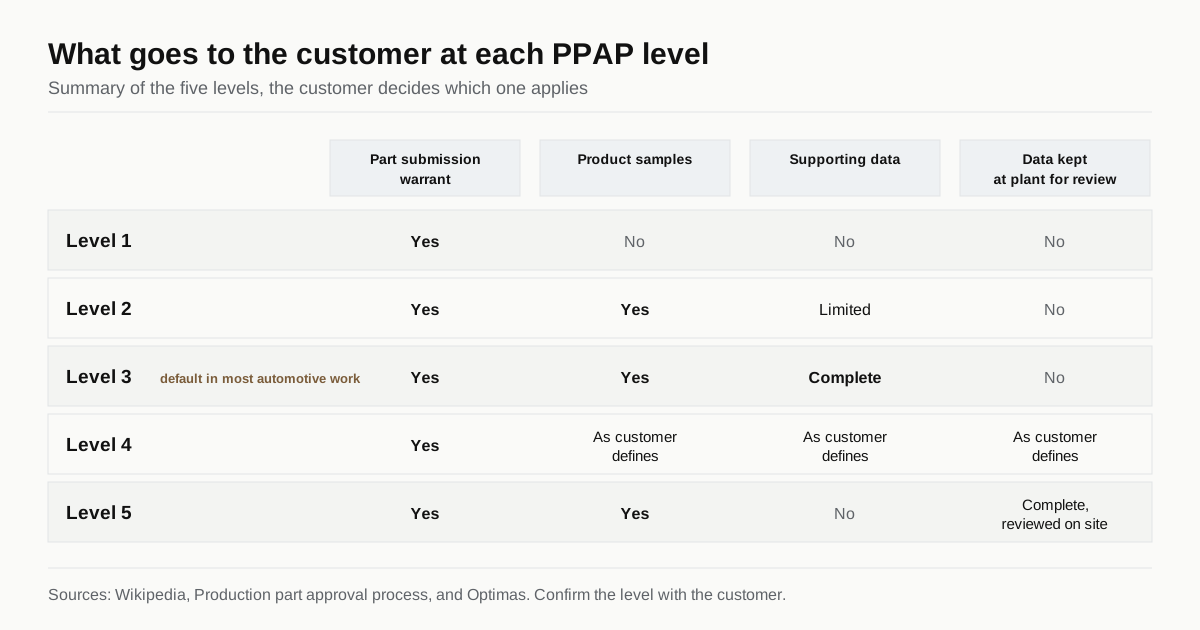
| Level | What goes to the customer |
|---|---|
| 1 | Part submission warrant only |
| 2 | Warrant with product samples and limited supporting data |
| 3 | Warrant with product samples and complete supporting data |
| 4 | Warrant plus other requirements the customer defines |
| 5 | Warrant with product samples, complete data available for review at the plant |
The level descriptions follow Wikipedia and Optimas. The customer sets the level. According to Kaizen, Level 3 is the default in most automotive and manufacturing work, and Level 5 is reserved for safety critical or complex parts that the customer reviews on site. Sources differ on small details of Level 2 and of the elements in Level 3, so ask for the customer’s own table.
The 18 elements on a custom fastener
| # | Element | What it means for a fastener |
|---|---|---|
| 1 | Design records | Your print with standard, grade, finish and revision |
| 2 | Authorized engineering change documents | Written approval for any print change since release |
| 3 | Engineering approval | Customer sign-off on trial parts, when required |
| 4 | DFMEA | Normally the customer’s for a made-to-print part |
| 5 | Process flow diagram | Wire, heading, trimming, thread rolling, heat treatment, coating, sorting, packing |
| 6 | PFMEA | Risks per step, for example a missed quench or a decarburized thread |
| 7 | Control plan | What is measured, how, how often and what happens on a failure |
| 8 | Measurement system analysis | Gauge studies for the critical characteristics |
| 9 | Dimensional results | Measured values for every print dimension on sample parts |
| 10 | Records of material and performance tests | Chemistry, hardness, tensile or proof load, coating thickness |
| 11 | Initial process studies | Capability data on the special characteristics |
| 12 | Qualified laboratory documentation | Scope of the lab that ran the tests |
| 13 | Appearance approval report | Finish, color and surface, when relevant |
| 14 | Sample production parts | Parts from the production process and tooling |
| 15 | Master sample | A retained approved part |
| 16 | Checking aids | Thread gauges, fixtures and their calibration |
| 17 | Customer-specific requirements | Anything in the customer’s manual |
| 18 | Part submission warrant | The signed cover sheet |
The element list comes from Wikipedia. The right-hand column is our reading for fasteners, not text from the manual.
Four elements carry most of the weight on a bolt or screw.
Dimensional results. Thread form and fit are the usual trouble, and the print should name the class, as in thread gauging 6g, 2A and System 22. Head height, under-head fillet, length and run-out need values, not a pass mark.
Material and performance records. Expect chemistry for the heat, hardness and the tests that the property class needs. The proof load, wedge tensile and hardness guide lists them. Tie the records to a lot and a heat, as in the traceability guide.
Capability and measurement. For special characteristics, Kaizen says a Cpk of 1.67 or higher is typically required, and that a gauge repeatability and reproducibility result above 30 percent is unacceptable. These are directional figures from one source. Your customer sets the real targets, so ask what they are before the plant starts the study.
Control plan. Per Kaizen, it defines what to measure, how to measure it, at what frequency and the reaction plan when a value falls out of limits. For a fastener, frequency matters: a heading die wears, a quench furnace drifts and a plating line changes. A control plan that checks only at the start of a run will miss the drift.
When a PPAP is more than you need
Field Fastener points out that a PPAP package can cost $300 or more for each part number, so asking for one on every standard fastener in a bill of materials is waste. The article suggests a first article inspection report instead, with an initial sample inspection report, material and process certificates such as plating and heat treating, and mechanical test certificates. Ask for it with the first purchase order along with the sample quantity.
Use that lighter route when the part is a standard fastener, the risk is low and your customer’s manual allows it. Use a full PPAP when the part is made to print, has a critical or safety feature or when the customer’s manual says so.
Sub-tier suppliers and who owns what
A fastener has several steps that a plant may subcontract: wire drawing, heat treatment, plating and sorting. Customers differ on whether those suppliers need their own PPAP. Settle it in the quote, not after the first run. Ask each plant to say in writing which steps it does in house, which it subcontracts and who signs the records for each.
No public figure exists for how long a PPAP takes for a fastener, because it depends on tooling, the trial run, lab capacity and the customer’s review. Ask each plant to give the date for samples and the date for the full submission as separate items, and to quote PPAP as its own line so it does not hide in the unit price.
What to write on the RFQ
- The submission level, and the customer manual and revision that define it.
- The characteristics marked special or critical on the print, with the capability target if you have one.
- The number of sample parts and who receives them.
- The lot and heat traceability that the records must show.
- Whether the PPAP is due before the first shipment.
- Which subcontracted steps need records, and the retention period.
- How engineering changes are requested and approved.
The RFQ checklist covers the rest of the print and quote request. If you are comparing routes, cold heading vs machining explains which route suits which feature, since the control plan differs.
Common mistakes
- Asking for “a PPAP” with no level or manual revision.
- Asking for the same package on a catalog part and a safety critical part.
- Accepting dimensional results with pass or fail marks and no measured values.
- Taking capability data from a different part number or a different die.
- Skipping the sub-tier question, then finding out that the plater has no record.
- Treating the warrant as the approval. The customer approves the full package, not the cover sheet.
This site is a matching service, not a fastener plant. It does not prepare or sign PPAP documents. Send your RFQ with the level, the special characteristics and the sample quantity, and up to three makers whose process fits the part will quote the same scope within 24 business hours.
Sources
- Wikipedia, Production part approval process: elements, levels, AIAG manual version
- Optimas, PPAP levels and fastener suppliers (fastener distributor, directional)
- Kaizen, PPAP explained: default level, control plan, capability and gauge R&R figures (consultancy, directional)
- Field Fastener, are PPAPs necessary for COTS parts (fastener distributor, directional)
Frequently asked questions
What is PPAP for fasteners?
PPAP is the Production Part Approval Process, a package of records that proves a supplier's process can make a part to the customer's print at production rate. For a custom fastener it covers the print, dimensional results, material and test records, a capability study, a control plan and a signed warrant. The customer sets what to submit.
Which PPAP level should I ask a fastener plant for?
Use the level in your own customer's supplier quality manual. If you are free to choose, Level 3 is the common default for make-to-print automotive parts, and Level 5 suits safety critical parts where you review the data at the plant. Level 1 or 2 may be enough for low-risk parts. Confirm the level with your customer first.
Do standard catalog fasteners need a PPAP?
Usually not. A fastener industry article argues that parts made to ISO, ASTM, ASME or IFI standards are trusted through those standards, and that a PPAP adds cost with little gain. A first article report with material and test certificates is a lighter alternative. Your customer's quality manual still decides.
What is the difference between PPAP and a first article report?
A first article inspection report records measurements and certificates for the first samples against the print. A PPAP is wider: it adds process records such as the flow diagram, risk analysis, control plan, measurement system study and capability data, and ends with a part submission warrant.
Need this fastener made?
Send the print with the grade and annual volume. We match you with up to 3 makers that run the right route and reply within 24 business hours.
Send my RFQ