Guides / Processes
Multi-Station Cold Formers: How Blank Size Sets Tooling Cost
October 11, 2026
Tooling is the largest fixed cost on a cold formed fastener, and the main thing that sets it is the size of the blank. A larger wire diameter needs larger dies and a stronger machine. A longer head forming stroke needs more stations. A special head shape needs custom punches. Once you see how these links work, a tooling quote stops looking arbitrary and you can ask for the changes that bring it down.
This guide follows a part from wire to finished blank, explains where the tooling cost comes from and lists the questions to ask before you approve a die set.
What a multi-station cold former does
A cold former takes wire from a coil, straightens it and cuts a slug to a set length. A transfer mechanism then moves the slug from one die station to the next. At each station a punch hits the slug and the metal flows into the die cavity. A finished blank leaves the last station, usually every fraction of a second.
Formers are grouped by station count. A two die, three blow machine makes simple headed parts, such as a screw blank with a plain or flat head. Three die, four blow and progressive machines with five or six stations make flanged heads, hex heads with washers and parts with a stepped shank. Each added station gives the metal a smaller step to make, which reduces strain per blow and extends die life, but it also adds a die, a punch and the work to make them.
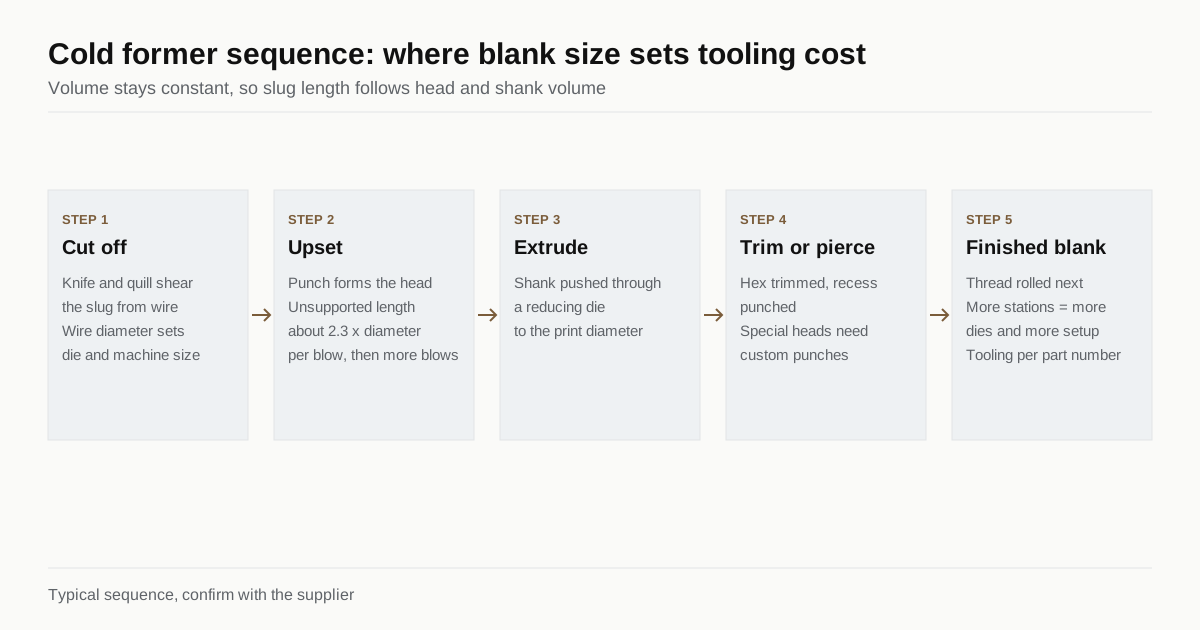
A few things happen along the way:
- Cut off. A knife and a quill shear the wire, and the quality of the slug end affects every following blow.
- Upset. The first blows form the head from the slug.
- Extrude. The shank is pushed through a reducing die to a smaller diameter where the print needs it.
- Trim or pierce. A hex head is often trimmed in a separate die, or a recess is punched into the top.
Because the volume of metal stays the same, the slug length is set by the finished volume of head and shank. A larger head or a longer part needs a longer slug, which the machine must be able to cut and hold.
Why blank size sets tooling cost
Wire diameter. Dies and punches scale with diameter. Larger carbide die inserts cost more in material and take longer to grind. Heavier formers cost more per hour as well, so a maker will quote a larger machine rate for an M16 blank than for an M5 blank.
Head diameter against shank diameter. A cold head cannot grow by any amount in one blow. If the unsupported length of the slug is more than about 2.3 times its diameter, it buckles instead of filling the die. A big head on a thin shank therefore needs a longer slug and more blows to build it. Common rules of thumb put a hex head at about 1.5 to 1.8 times the shank diameter, a flange head larger still, and anything beyond that needs extra stations.
Station count. Every station is a die and a punch set. A part that fits a three station sequence costs less than one that needs five, and the five station tools take longer to align and adjust on the machine.
Head and shank shape. A standard hex or round head uses stock punch geometry. A special recess, a serrated flange, a splined neck or an undercut under the head needs a custom punch or pin. These details also drive wear, since sharp corners in the die break first.
Tolerance. Tight head height or concentricity requirements need precise die fits and more adjustment time during sampling.
Die material. Carbide dies last longer on high strength or abrasive material, but they cost more than tool steel. For stainless or alloy steel, carbide is usual.
Typical figures
| Item | Small part (about M3 to M6) | Mid part (about M8 to M12) | Large part (about M16 to M24) |
|---|---|---|---|
| Typical stations | 2 to 4 | 3 to 5 | 4 to 6 |
| New die set cost (typical range, USD) | A few thousand | Several thousand to about ten thousand | Ten thousand to several tens of thousands |
| Lead time to samples | 3 to 5 weeks | 4 to 6 weeks | 5 to 8 weeks |
| Die set life | Millions of parts | Hundreds of thousands to millions | Hundreds of thousands |
| Machine setup change | A few hours | Several hours | Half a day or more |
These are typical bands and not a quote. A maker with a family of similar parts may reuse dies and quote far less, and a part with a special head can cost more than the upper figure.
How tooling cost reaches the piece price
Plants quote tooling in one of two ways. One way is a separate tooling charge, paid up front or after sample approval, with the dies then owned by you or held for you. The other way is to amortize the tooling over the first quantity, which hides the cost in a higher first order price and often leaves the maker owning the dies.
Either way, the tool cost divides over the number of parts you will buy. A die set of a few thousand dollars spread over 500,000 pieces adds a fraction of a cent. The same set spread over 5,000 pieces becomes a major part of the price. That is why volume decides the route: below a certain quantity, machining a blank costs less than paying for dies. Our guide to cold heading vs machining shows where that crossover usually falls.
Ways to bring the cost down
You do not have to accept the first tooling quote. Four changes help in most cases.
- Use a head the plant already runs. A standard hex, flange or pan head with a common height avoids custom punches.
- Keep the shank within the size range. A shank length or diameter that matches an existing die family lets the maker reuse tooling.
- Relax the tolerance that does not matter. If head height can move by half a millimetre, say so.
- Allow a different blank route for the features that cost the most. A cross hole or a special point can be machined after heading and removes a punch from the die set.
A drawing change before the order costs nothing. The same change after samples can restart tooling.
Questions to ask before you approve a die set
- How many stations does the part need and on which machine?
- Does any of the tooling come from an existing family?
- Is the tool cost separate or in the piece price, and who owns the dies?
- How many parts is the die set expected to run before it needs replacing?
- What is the lead time to samples and to the first release?
- Who pays for rework if the sample fails the print?
Heat treatment and thread rolling come after forming and have their own costs, so add them to the comparison. If you need to review how rolling compares with cutting, read thread rolling vs thread cutting. Wire grade also affects tool life, and cold heading wire grades explains the common ones.
A worked comparison
Take two parts of the same shank diameter, M8, and compare the tooling story.
Part A is a hex flange bolt with a standard flange, a head height close to the plant’s existing punches and a 30 mm shank. It runs on a three die machine, uses an existing family of cut off tooling and needs one new die set with a standard punch shape. The plant quotes a modest tooling charge, a few weeks to samples and a die set life in the hundreds of thousands.
Part B has the same shank, but the head is a large serrated flange with a drive recess, a short neck with a groove and a tight head height tolerance. It needs five stations, a custom punch for the serrations, a pin for the recess and extra work to adjust the head height during sampling. The tooling charge is several times higher, sampling takes longer and the die set wears faster at the serrations.
Both parts have the same wire, the same thread and the same property class. The difference in tooling cost comes from the head. When a buyer sees a high tooling quote, the question to ask is which feature of the head or neck drives it, and whether that feature is needed.
Sample approval and changes after samples
Tooling is built before the first sample, so a change after samples is expensive. Plants usually offer a sample lot from the new dies, measured against the print, and ask for approval before the first release. Use the approval step well.
- Measure the critical dimensions yourself, not only from the plant report.
- Test the sample in the assembly, with the real mating parts.
- Check the head marking and the recess with the real driver.
- Run any test the application needs, such as a torque to failure or a proof load.
- Give a written approval, or a written list of changes.
A change that touches only the print, such as a length or a tolerance on a machined feature, is cheap. A change to the head form or the upset sequence means new punches or dies. If you expect a design change in the first year, tell the plant before it cuts the dies, and ask whether it can build the die set to allow an insert or a spare punch for the likely change.
Checklist for the RFQ
- Drawing with head type, head height and shank length, in a standard format.
- Wire material or the property class you need.
- Annual volume and release size.
- Whether you want to own the dies.
- Target lead time to first samples.
Put these in the first message and the quotes will compare cleanly. When you are ready, send your RFQ and we match it with up to three makers that run cold formers in the right size range.
Order a turned sample lot first: see custom fastener prototypes; the whole route is in the custom fastener manufacturing process.
Frequently asked questions
Who owns the dies after I pay for them?
It depends on the quote. Some makers charge the full tool cost and agree that you own the dies. Others spread the cost across the first orders and keep the dies. Settle it in writing before the order, and ask where the dies are stored and how long they are kept after your last release.
How long does a new die set take to make?
Several weeks is common for a new part with its own carbide dies and punches, plus sample parts and adjustment on the machine. A part that shares most of its dies with an existing family can go faster. Ask for the lead time to first samples, not only to the first release.
Can I cut tooling cost by changing the head or the shank?
Often yes. A standard hex or flange head, a head height close to the maker's existing punches and a shank length within the machine range avoid new tooling. A small drawing change agreed before the order costs far less than a die change after samples.
Need this fastener made?
Send the print with the grade and annual volume. We match you with up to 3 makers that run the right route and reply within 24 business hours.
Send my RFQ