Guides / Sourcing
Custom Shoulder Bolts and Pivot Pins for Machinery
October 16, 2026
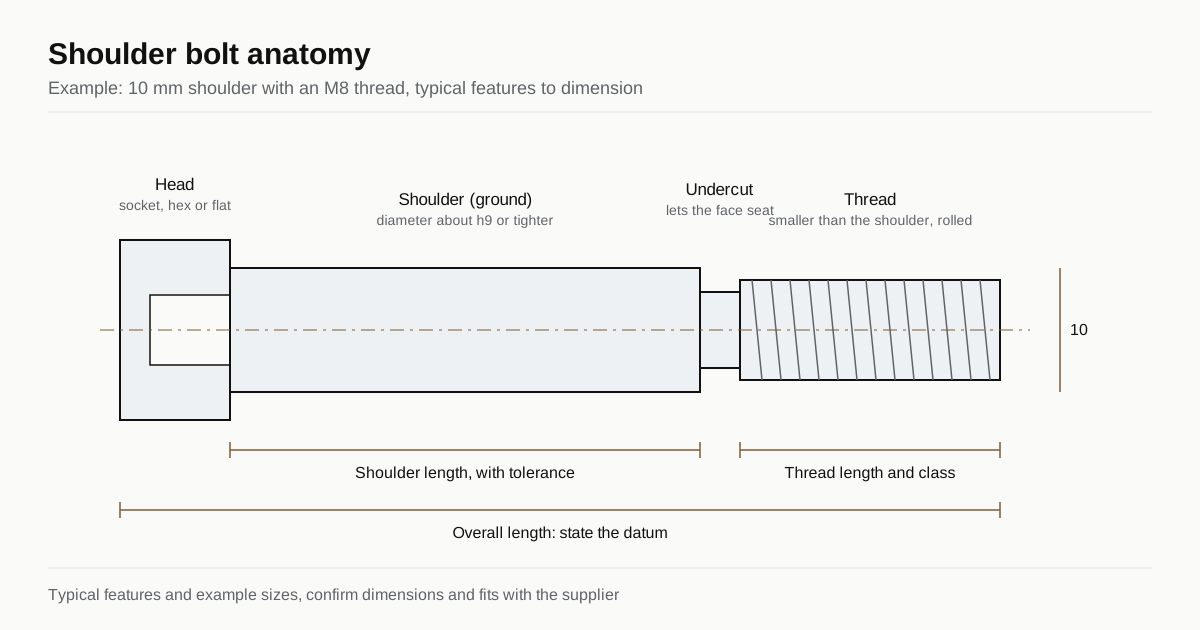
A shoulder bolt looks like a bolt with a plain cylinder under the head. That cylinder, the shoulder, is ground to a close tolerance and acts as a bearing or a locating surface, while the thread at the end only holds the bolt in place. Pivot pins do the same job without a head thread. They show up in linkages, hinges, rollers, cam followers, clevises and machine guards, wherever a part must rotate or slide around a defined axis.
Buyers who order them to print need to specify tolerances that the plant can hold, choose a heat treatment that fits the wear conditions and decide how the part will be made. This guide covers each.
Anatomy of a shoulder bolt
A shoulder bolt has four parts.
- Head. A socket head, a hex head or a flat head. The socket head is common, following ISO 7379 for metric and ASME B18.3 for inch.
- Shoulder. A ground cylinder, with a diameter tolerance of about h9 or tighter, that bears against the part it carries.
- Undercut. A small relief groove where the shoulder meets the thread, so the shoulder face seats flat and the thread has a clean run out.
- Thread. Smaller than the shoulder, rolled or cut, which engages the tapped hole.
A standard pairing for metric parts links the shoulder size with a thread, as in the table. These are typical pairs, and the standard sets the exact values.
| Shoulder diameter (mm) | Thread | Typical use |
|---|---|---|
| 6.5 | M5 | Small linkages, covers |
| 8 | M6 | Light pivots |
| 10 | M8 | General machinery |
| 13 | M10 | Medium pivots, rollers |
| 16 | M12 | Heavier linkages |
| 20 | M16 | Large pivots |
Custom shoulder bolts depart from this table: a longer shoulder, a finer thread, a larger head or a non-standard thread.
Pivot pins and clevis pins
A pivot pin is a straight or stepped pin that carries a rotating joint. A clevis pin has a head at one end and a cross hole or groove at the other for a cotter pin or retaining ring, as in ISO 2341. A press-in pin is held by an interference fit. Pins are made to the same close tolerances as a shoulder, and the bore they run in is made to match.
Retention matters. A headed pin with a cross hole is easy to assemble and inspect. A pin with grooves for E-clips or retaining rings needs groove widths and depths that the clip supplier sets. The groove goes on the print with a tolerance.
Fits and surface finish
The shoulder or pin diameter and the bore tolerance decide how the joint feels.
| Joint type | Typical fit (bore and pin) | Notes |
|---|---|---|
| Free pivot, low speed | H7 and f7 or g6 | Clearance fit, needs lubrication |
| Close sliding fit | H7 and g6 | Less play, for accurate linkages |
| Located pin, pressed in one side | H7 and p6 (press), H7 and f7 (running side) | Pin stays fixed in one part |
| Bushed pivot | H7 on the bushing bore, g6 or f7 on the pin | Wear moves to the replaceable bushing |
Surface finish on the bearing area is commonly Ra 0.4 to 0.8 micrometres, from grinding. A rough finish wears the bore, and a mirror finish may hold oil poorly. State the roughness on the print if wear life matters.
Take care with coatings. A black oxide layer is thin and does not change the diameter by much, but a zinc plating of 8 to 12 micrometres can make the pin larger than its tolerance. Define whether the shoulder is ground after coating or masked during plating.
Material and heat treatment
Pins and shoulder bolts are loaded in shear and bending, and the bearing surface wears. The usual materials are these.
- Alloy steel, quenched and tempered. Typically 4140 or 4340 types, at hardness around 28 to 40 HRC, or class 12.9 for shoulder screws. Tough and strong.
- Case hardened low carbon steel. A hard skin of about 58 to 62 HRC on a soft core, for wear against a bore. It resists wear well but the case is thin, so grinding allowance is small.
- Stainless steel. 303 for easy machining, 316 for corrosion and 17-4 PH for strength with corrosion resistance, see martensitic and PH stainless fasteners.
- Free machining carbon steel. For low load parts that need no heat treatment.
If the bolt is class 12.9, it can be sensitive to hydrogen after plating, as described in hydrogen embrittlement. Case hardening has its own concern, that grinding after hardening can cause burn marks if done badly. A plant should say how it controls this. Fastener heat treatment covers furnace controls.
How shoulder bolts are made
Most custom shoulder bolts and pins are turned from bar on CNC lathes. The head, shoulder, undercut and thread blank are turned in one setup, the thread is rolled or cut, the part is heat treated and the shoulder is ground to final size. The grinding step is what holds the h9 or tighter tolerance. For small diameters, a Swiss type lathe handles long slender parts well.
At high volume, a cold headed blank saves material: the head and rough shoulder are formed, then the shoulder is ground and the thread rolled. Cold heading needs tooling, so it pays off at tens of thousands of pieces a year, as cold heading vs machining explains.
Typical lead time for a first lot is a few weeks, longer if heat treatment and grinding go to outside shops. Tolerances tighter than h9 add grinding time and inspection cost.
Common print problems
- Shoulder length without a tolerance. The shoulder must be a little shorter than the thickness of the part it carries, or the joint clamps and cannot pivot. Specify the length and the tolerance, and state the mating thickness.
- No undercut. Without a relief groove, the shoulder face may not seat or the thread may not clear.
- Thread class missing. State the class so that the plant gauges it correctly.
- Head type unstated. Give the head, drive and height.
- Fit stated only on the bolt. Name the bore and tolerance so the plant can check the pair.
Examples of shoulder part orders
A shoulder screw, 8 mm shoulder, 25 mm shoulder length, M6 x 10 thread, alloy steel class 12.9, 20,000 a year. The plant cold heads a socket head blank with extra shank, grinds the shoulder after heat treatment and rolls the thread. The print gives the shoulder to a close tolerance, the length to a plus and minus value and a surface finish of Ra 0.8.
A clevis pin, 12 mm diameter, 60 mm long, with a cross hole for a cotter pin and a head, case hardened, 3,000 a year. The plant turns the pin, drills the cross hole, carburizes and hardens it and grinds the diameter. The cross hole position tolerance matters, because the cotter pin must clear the clevis.
A stainless pivot pin, 6 mm, with a groove for a retaining ring, 500 a year. The part is turned on a Swiss lathe from 303 or 17-4 bar, with the groove cut to the ring supplier’s width and depth. The load is light and the environment is wet, so stainless is the sensible choice.
Cost drivers and quoting
The price of a shoulder part depends on grinding more than anything. A shoulder left as turned has a rough tolerance and costs little. A shoulder ground to h9 or tighter adds a grinding operation, handling between machines and more inspection. Heat treatment adds a batch charge, and case hardening before grinding means the grinding allowance must be planned to leave the case in place.
Material comes next. Alloy steel bar is cheap and easy to treat. Stainless bar is more costly and the heat treatment varies by grade. Coating adds a cost and a dimensional effect, as noted above.
To compare quotes, ask each maker to list the process steps: turn, thread, heat treat, grind, coat, inspect. If one quote omits grinding, it will not meet the fit. Also compare tolerance on the shoulder length and the diameter, not only the price. A maker that quotes a tighter tolerance than you need is charging for it, and you can often relax the tolerance on length and keep the tight fit on the diameter.
Wear, lubrication and service life
A pivot is a bearing, and bearings wear. Steel on steel with no lubrication wears quickly. The common ways to extend life are these.
- Bushings. A bronze or polymer bushing in the bore takes the wear and costs less to replace than the pin.
- Lubrication. Grease fittings or a sealed grease pack reduce wear. A cross hole and groove in the pin can carry grease to the bearing area.
- Surface hardness. A hard pin in a softer bushing sends the wear to the bushing, which is the part you want to replace.
- Coatings. Dry film or nitrided surfaces reduce friction and galling.
- Clearance. Too much clearance leads to hammering and wear. Too little leads to binding.
State the expected load, the speed and the service interval to the plant, and ask for a recommendation on the material and the hardness. A maker that has built similar pivots can often suggest a cheaper solution that lasts as long. See how to source custom fasteners for guidance on briefing the maker.
Checklist for the RFQ
- Drawing with head, shoulder diameter and length, undercut, thread and overall length.
- Tolerances: shoulder diameter, length and surface finish.
- Material, hardness and any case depth.
- Thread size, class and process.
- Coating and the point at which the shoulder is measured.
- Mating bore, bushing and retaining parts.
- Annual volume and release size.
For the structure of a quote, see custom fastener RFQ checklist. When your list is ready, send your RFQ and we match it with up to three makers that turn and grind shoulder parts.
If volume later justifies cold heading, order a turned sample lot before dies: see custom fastener prototypes.
See also the reference page on socket head cap screws, which share the socket drive and many of the standards.
Frequently asked questions
Why is the thread on a shoulder bolt smaller than the shoulder?
The shoulder is a bearing surface and needs a larger diameter for load and wear. The thread has to pass through the part that the shoulder carries, so it is smaller. A standard shoulder bolt pairs a given shoulder size with a smaller thread, for example a 10 mm shoulder with an M8 thread, and the shoulder face seats against the threaded part.
What fit should a pivot pin have?
It depends on the movement. A free pivot often uses a running or sliding fit, such as H7 for the hole and f7 or g6 for the pin. A pin that is pressed into one part and turns in the other uses a press fit on one side and a running fit on the other. State the fit on the print and name the mating bore.
Is a cold headed shoulder bolt possible?
Sometimes. The head and rough shoulder can be formed cold, and the shoulder is then ground to size. For small lots, the part is turned from bar and ground. At high volume a cold headed blank saves material. The shoulder tolerance usually needs grinding in either case.
Need this fastener made?
Send the print with the grade and annual volume. We match you with up to 3 makers that run the right route and reply within 24 business hours.
Send my RFQ