Guides / Grades and Materials
Titanium Fasteners: Grade 5 Bolts, Galling and Cost
October 17, 2026
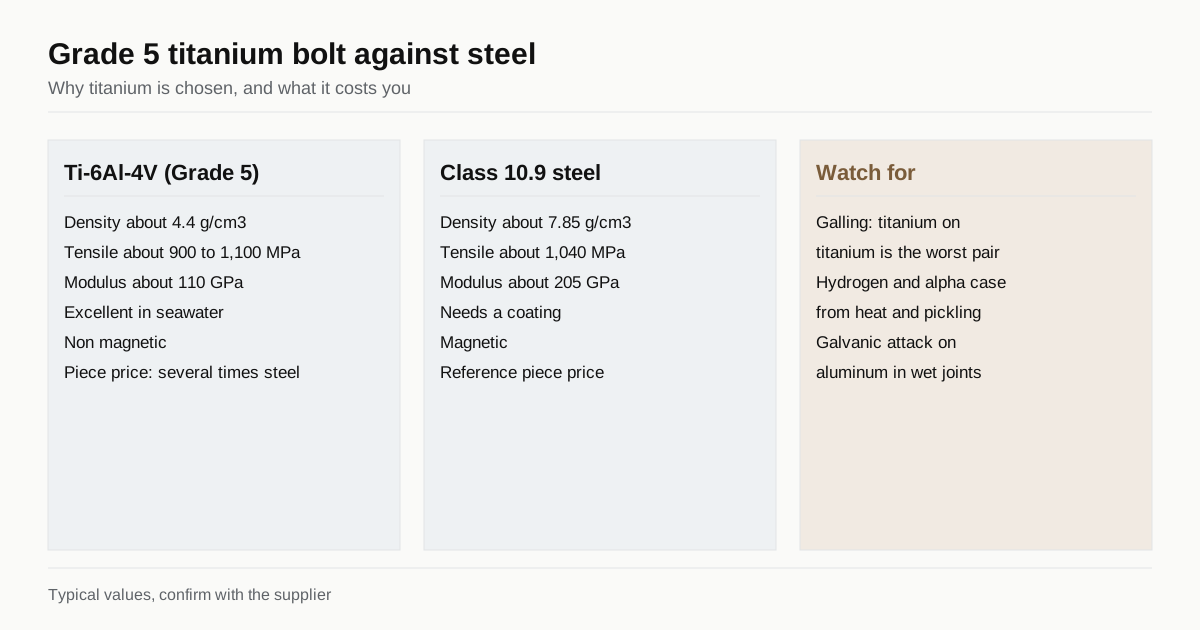
Titanium bolts solve three problems: weight, corrosion and, in some designs, magnetic response. They also create three: high cost, galling and a narrow set of processes that work. A buyer who orders Grade 5 titanium fasteners to print needs to know where the price comes from and what the plant has to do differently from a steel line.
This guide covers the grades, the figures, the galling and hydrogen risks and the points to settle on the print before the plant starts cutting bar.
Which titanium
Two grades cover most fasteners.
Grade 2. Commercially pure titanium. It is soft, with a minimum tensile strength around 345 MPa, easy to form and very corrosion resistant. It suits non structural parts, chemical plants and marine fittings. It can be cold headed.
Grade 5. Ti-6Al-4V, the workhorse alloy, with about 6 percent aluminum and 4 percent vanadium. It reaches about 900 MPa tensile strength in the annealed state and about 1,100 MPa or higher in the solution treated and aged state used for aerospace fasteners. This is the grade most buyers mean by “titanium bolt”. Bar standards include ASTM B348 and AMS 4928. ASTM F468 covers nonferrous bolts and screws including titanium.
Grade 5 is stiff and has limited cold ductility, so heads are usually formed hot or the whole part is machined from bar.
Typical figures against steel
| Property | Grade 5 titanium | Class 8.8 steel | Class 10.9 steel |
|---|---|---|---|
| Density | About 4.4 g/cm³ | About 7.85 g/cm³ | About 7.85 g/cm³ |
| Tensile strength | About 900 to 1,100 MPa | 800 to 830 MPa | 1,040 MPa |
| Modulus of elasticity | About 110 GPa | About 205 GPa | About 205 GPa |
| Corrosion resistance | Excellent in seawater and many acids | Needs a coating | Needs a coating |
| Magnetic | No | Yes | Yes |
| Typical temperature limit | About 315 to 400 °C | Higher | Higher |
| Relative piece price | Several times the steel part | Reference | Slightly above reference |
All values are typical. The temperature limit for a titanium joint depends on the load and the environment.
Weight savings are about 40 percent for the same volume. Because titanium has only about half the stiffness of steel, a titanium bolt stretches more under a given load. That gives a different joint behaviour, and a part swapped one for one with steel may need a different preload.
Where the cost comes from
Cost has several layers.
- Raw material. Titanium bar costs several times more per kilogram than stainless steel, and the price swings with the market.
- Machining. Titanium has low thermal conductivity, so heat stays at the tool edge. Cutting speeds are low, tools wear fast and cycle times are long.
- Forming. Hot heading needs induction heating and a controlled process, and the scale and the oxygen rich surface layer must be removed afterwards.
- Testing and records. Aerospace and medical users ask for full traceability, which adds cost.
- Scrap. A mistake on an expensive bar is expensive.
For small lots, machining from bar is often the only practical route. For larger lots a hot headed blank saves material, though the tooling and heating process add cost. Our guide to cold heading vs machining gives the general frame, and titanium moves the crossover point toward larger volumes.
Galling
Titanium relies on a thin oxide film for corrosion protection. In a threaded joint, the film wears away under sliding load, and the clean metal surfaces can weld together. The result is a seized bolt or a torn thread, known as galling.
The conditions that make it worse are high speed assembly, dry threads, heavy load and titanium against titanium. The conditions that help are:
- Different nut material. A stainless or bronze nut, or a coated nut, avoids the worst pairing. Titanium on titanium has the highest risk.
- Lubrication. Use a lubricant that suits the service, such as a molybdenum disulfide paste, or a nickel or copper based anti-seize where the environment allows. Check the oxygen and chlorine compatibility for the process.
- Surface treatment. Anodizing, dry film coatings and certain plated layers give the thread a surface that resists adhesion.
- Slow tightening. Use hand tools or low speed drivers and avoid impact guns.
- Rolled threads. A smooth rolled thread galls less than a cut thread with tool marks.
The lubricant also changes the torque to preload relation. If the print gives a torque value, state which lubricant it assumes, and see thread locking patches when the design needs a locking feature, since some patches suit titanium and others do not.
Hydrogen and oxygen pickup
Titanium absorbs hydrogen when it is pickled in the wrong acid or heated in a hydrogen bearing atmosphere. Hydrogen forms brittle hydrides and cuts ductility. Specifications set a maximum hydrogen content, often around 0.0125 percent for Grade 5. Plants avoid it by controlling the pickling chemistry and the furnace atmosphere.
Heating in air forms an oxygen rich surface layer called alpha case, which is hard and brittle. It must be removed by machining or chemical milling after hot heading or heat treatment, and parts should be inspected for it. If the plant skips this step, fatigue life suffers. Read hydrogen embrittlement in 10.9 and 12.9 bolts for the steel side of the same topic, which has different mechanisms but the same rule: control the process.
Galvanic effects
In a galvanic pair, titanium is the noble metal. In contact with aluminum, magnesium or carbon steel in a wet or salt environment, the other metal corrodes faster. Use isolation: sealant, a coating or a non conductive washer, and check what the surrounding metals are.
What to write on the print
- Grade and standard. Ti-6Al-4V to AMS 4928 or ASTM B348, plus the heat treatment condition.
- Strength. Minimum tensile, yield and hardness.
- Thread process. Rolled or cut, and whether before or after heat treatment.
- Surface condition. Alpha case removal, hydrogen limit, anodize or coating.
- Lubricant and nut material. For the torque value.
- Traceability. Heat lot marking and certificates.
Examples of titanium orders
Twenty M6 x 20 socket head screws in Ti-6Al-4V for a racing bicycle component. The plant turns them from bar, rolls the thread, anodizes for color and checks hardness. The buyer asks for a lot certificate and a note of the heat number. Price per piece is several times a stainless screw, which suits the weight saving.
Two thousand M10 x 40 hex bolts in Grade 5 for a marine pump housing. The plant uses hot headed blanks to save material, machines the head bearing face, rolls the thread after heat treatment and removes the alpha case. The nuts are in a different alloy to avoid galling, and the buyer asks for a lubricant spec on the torque value.
A hundred M12 studs in Grade 2 for a chemical plant. Commercially pure titanium is soft and corrosion resistant, and the load is low. The plant machines the studs from bar. The buyer chooses Grade 2 because the strength of Grade 5 is not needed, and the lower cost helps.
Substitutes and when not to use titanium
Titanium is not always the best answer. If weight does not matter and the environment is mild, a stainless or coated steel bolt is cheaper and easier to buy. If the temperature goes above about 350 to 400 °C, titanium loses strength and picks up oxygen, so a nickel alloy fits better, as covered in Inconel and Monel fasteners. If the joint needs a very high preload with a stiff bolt, titanium’s lower modulus may not suit it.
A few cases where titanium earns its price: parts in seawater where weight matters, aerospace and racing parts where each gram counts, medical or non-magnetic uses and chemical plants with chlorides or oxidizing acids. Before you commit, ask the plant to quote a stainless alternative so you can see the price gap. Sometimes a design change, such as a larger stainless bolt, removes the need for titanium. When titanium is still the answer, the quote will reflect the process steps above, and you can read it with that list in hand. For the broader quote structure, see how to source custom fasteners.
Common ordering mistakes
- Writing “titanium bolt” with no grade, condition or standard.
- Specifying a torque value without naming the lubricant.
- Pairing titanium bolts with titanium nuts and no coating.
- Assuming a stainless steel drawing tolerance on thread and head will carry over without checking the process.
- Ignoring the galvanic effect on an aluminum part next to the bolt.
- Leaving out the alpha case and hydrogen limits on a fatigue critical part.
Each point takes one line on the print and saves a failed lot or a field failure.
Checklist for the RFQ
- Grade, condition and standard.
- Drawing with head, thread class and length.
- Torque, lubricant and mating part material.
- Environment: seawater, temperature, contact metals.
- Certificates and traceability level.
- Annual volume and release size.
Titanium is one of several grade families; the whole choice by service condition is in our guide to fastener grades.
Titanium orders need a plant that already works with the metal, so tell us the application. To start, send your RFQ and we match it with up to three makers that machine or hot form titanium fasteners.
Frequently asked questions
Why do titanium bolts seize in titanium nuts?
Titanium galls easily against itself. The oxide film wears off under sliding contact, the clean metal surfaces weld together and the thread tears. The risk rises with speed, load and a dry thread. Use a different nut material or a coated nut, add a suitable lubricant and tighten slowly.
Is Grade 5 titanium stronger than steel?
It matches a medium strength steel bolt in tensile strength and weighs about 40 percent less. It does not match a class 12.9 bolt in strength. The gain is strength to weight and corrosion resistance, not absolute strength, and the modulus is about half that of steel, so the bolt stretches more under the same load.
Can titanium touch aluminum in a joint?
It can, but the aluminum is the one that corrodes. Titanium is the noble metal in a pair and drives galvanic attack on aluminum in a wet or salt environment. Use isolation such as a sealant, a coating or a washer, and check the environment.
Need this fastener made?
Send the print with the grade and annual volume. We match you with up to 3 makers that run the right route and reply within 24 business hours.
Send my RFQ