Guides / Sourcing
The Fastener Quality Act and Custom Bolts: A Buyer Guide
November 1, 2026

The Fastener Quality Act (FQA) is a US federal law. Since 1999 it no longer requires third-party certification of every lot, but it still makes it illegal to misrepresent a fastener’s grade, chemistry, strength or maker, and it still requires a registered manufacturer mark on grade-marked parts where the standard asks for one. For a buyer of custom bolts the practical effect is small and easy to meet: name the standard, require the marks that standard calls for and ask for a lot record.
This guide reads the statute text, not the myths around it. Law changes, so confirm anything that affects a shipment with your customs broker or counsel.
What the Fastener Quality Act covers today
Congress passed the FQA on 16 November 1990 after fastener failures in the 1980s. It was amended in 1996, 1998 and 1999. The 1999 amendments (Pub. L. 106-34) repealed the sections that required testing, certification and laboratory accreditation for every lot (15 U.S.C. 5404 to 5406), according to the Cornell Legal Information Institute copy of the code.
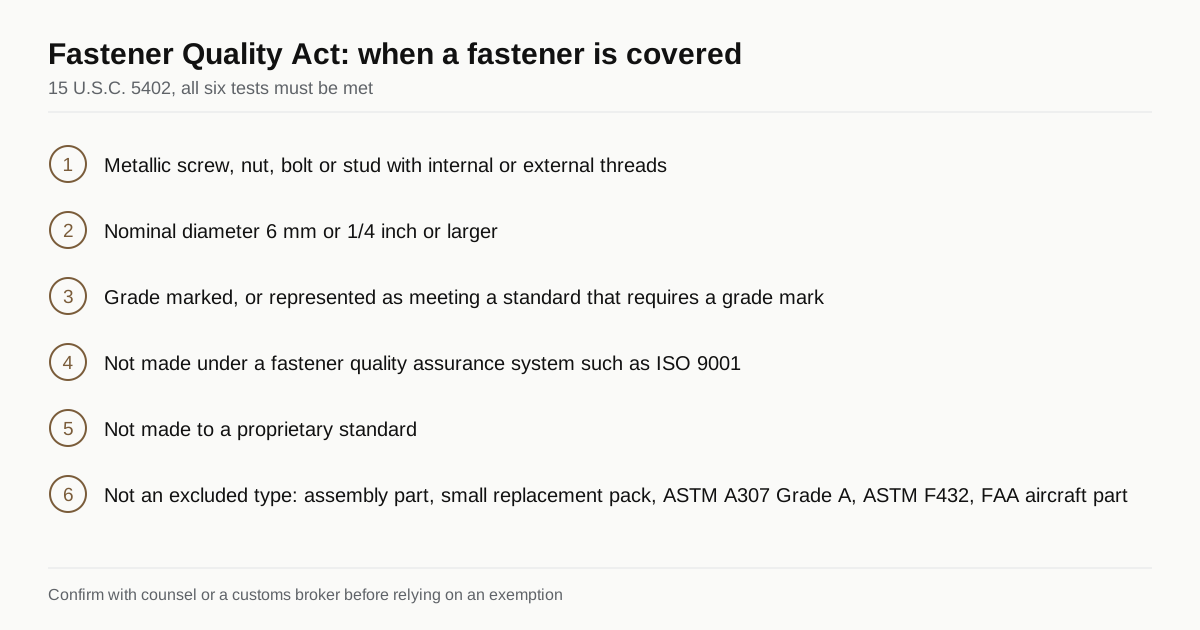
What remains in 15 U.S.C. 5402 is a definition of a covered fastener:
- a metallic screw, nut, bolt or stud with internal or external threads;
- nominal diameter of 6 mm or greater, or 1/4 inch or greater;
- grade identification marked, or represented as meeting a consensus standard that requires grade marking;
- plus through-hardened load-indicating washers.
The Act then lists what is not covered. The list is long, and it explains why many custom orders sit outside it.
| Excluded from the definition | What it means for a custom order |
|---|---|
| Part of an assembly | A bolt delivered inside a finished assembly |
| Spare, substitute or replacement parts | Unless the package holds more than 75 of one part, or it ships in an assembly kit |
| ASTM A307 Grade A, ASTM F432 | Low-strength carbon steel bolts and rock bolts |
| Aircraft parts approved by the FAA | Handled under aerospace rules |
| Made under a fastener quality assurance system | ISO 9000, 9001, 9002 or TS 16949, QS 9000, VDA 6.1, AS9000 or an equivalent third-party certified system |
| Made to a proprietary standard | A print with its own mechanical requirements and no grade mark |
The quality system exclusion does most of the work in practice. The Industrial Fasteners Institute, a trade association, wrote in a 2010 bulletin that a plant registered to ISO 9000 or a similar system is not required to register its mark with the US Patent and Trademark Office, and that most plants producing grade-marked steel fasteners are registered. Treat that as a trade view from 2010 and confirm the status of your own maker.
The parts of the Act that still bite
Two sections drive most of the risk.
Anti-fraud rule, section 5403. A manufacturer or distributor may not knowingly misrepresent or falsify the record of conformance for a lot, the identification, characteristics, properties, marks, chemistry or strength of the lot, or the manufacturer’s insignia. A reference to a consensus standard is not a claim that the part meets every clause of that standard, so the PO must state what is required.
Insignia rule, section 5407. Where the applicable consensus standard requires a manufacturer’s insignia, the fastener cannot be offered or sold in commerce unless it bears the insignia and the manufacturer has recorded it. The USPTO keeps the register. NIST’s FQA FAQ, last updated in 2019, says the insignia must be readable and permanent, and that a recordal certificate stays active for five years.
The same page says manufacturers and importers must retain the record of conformance for five years and give it on request to a distributor or to a buyer who uses the fastener in a commercial product. NIST notes that its content may not be the most current, so verify the retention period before you write it into a contract.
What a record of conformance contains
The statute defines the record of conformance per lot. It lists the manufacturer’s name and address, the fastener type, the lot number, dimensions, the standard that governs the part, the material chemistry and grade, coating details and a summary of the test results. A lot is a quantity of one part number made by the same production process from the same coil or heat of metal.
That definition is a useful template. A purchase order that asks for these items per lot gets the same document a US inspector expects, and it fits the habits of most plants. For your own checks it also pairs with proof load, wedge tensile and hardness tests, which are the results the lot record summarizes.
Marks and insignia on custom parts
Grade marks and manufacturer marks are not the same thing in the statute. A grade identification marking is a grade mark or property class symbol, and the definition excludes the manufacturer’s insignia or part number.
The IFI bulletin gives an example from the standards. Under SAE J429 a Grade 5 bolt with three radial lines must also carry a mark that identifies the manufacturer. A socket head cap screw to ASTM A574 does not need a grade mark or a maker’s mark, so it falls outside the Act. Each standard sets its own rule, so name the standard on the print and let it define the marking. The companion guide on bolt head markings shows how those marks are formed in the heading die and what the print should say.
For a plant that does need a recorded insignia, the USPTO accepts a trademark that is registered or pending, or it issues an alphanumeric designation. The 2010 IFI bulletin puts the recordal fee at $20 with a renewal every five years, so verify the current amount on the USPTO site. You can search the USPTO’s published list of active insignias to check that a mark on a sample is registered to the plant that claims it.
A short PO checklist
Use these lines on any made-to-print order for the US market:
- Name the standard and grade, such as SAE J429 Grade 8 or ASTM A193 B7. Do not rely on a generic “grade 8”.
- State the marks required: grade mark, manufacturer’s mark, position and whether raised or depressed.
- Require one lot per heat of steel, with lot number on the box label and on the record.
- Ask for the record of conformance with the items listed in section 5402: chemistry, dimensions, coating, test results.
- If the plant claims a quality system, ask for the certificate copy. If it claims a recorded insignia, ask for the number.
- Keep the records for the retention time your customer or counsel requires, at least the five years NIST names.
- Add the test method you want, for example hardness per lot, and the sampling plan.
These points belong on the print or the PO, alongside the items in the custom fastener RFQ checklist. The same logic applies to inch parts covered by SAE Grade 5 and Grade 8.
Where buyers go wrong
- Treating the FQA as a certificate scheme. It is not. The certification rules were repealed in 1999. What exists now is a fraud rule and a marking rule.
- Assuming every imported bolt is covered. Many are outside the definition because of size, standard or quality system.
- Accepting unmarked parts for a marked grade. If the standard requires a mark and the part has none, the part is non-conforming whatever the cert says.
- Using “FQA compliant” as a specification. It says nothing about hardness, chemistry or coating. Write the technical requirements on the print.
- Mixing lots. A box with two heats of steel cannot carry one honest lot record.
How this site fits
This is a matching service. It is not a fastener plant and it does not issue certificates. You send one print with grade and annual volume, and up to three makers with the right manufacturing route quote you directly, within 24 business hours. Include the standard, the marking and the record you need when you send your RFQ, so each maker can quote the same scope.
For US-bound steel fasteners, the current tariff treatment is summarised on the Section 232 and fasteners reference page.
Sources
- 15 U.S.C. 5402, Definitions
- 15 U.S.C. 5403, Prohibited acts
- 15 U.S.C. 5407, Insignia
- 15 U.S.C. 5404 to 5406, repealed by Pub. L. 106-34
- NIST, Compliance FAQs: Fastener Quality Act (page last updated 2019)
- USPTO, 1999 proposed rule on the Fastener Insignia Register
- Industrial Fasteners Institute, Manufacturer’s Identification Mark Registration bulletin, 2010 (trade association, directional)
Frequently asked questions
Does the Fastener Quality Act still apply?
Yes, in a reduced form. The 1999 amendments repealed the testing and certification sections (15 U.S.C. 5404 to 5406). The anti-fraud rule in section 5403 and the insignia rule in section 5407 remain in force, with a lot-record definition that buyers can use in a purchase order.
Do imported custom fasteners need a USPTO-recorded insignia?
Only when the consensus standard behind the part requires a manufacturer's mark and the maker is not covered by an exemption. A maker working under a recognized quality system, such as ISO 9001, falls outside the Act's definition of a fastener. Check the maker's status on the PO.
Which custom fasteners are outside the Fastener Quality Act?
Parts below 6 mm or 1/4 inch, parts without a grade mark requirement, ASTM A307 Grade A and ASTM F432 parts, aircraft parts approved by the FAA, parts made to a proprietary standard, parts inside assemblies, and parts made under a fastener quality assurance system.
Is a 3.1 certificate required by the Fastener Quality Act?
No. The Act defines a record of conformance per lot and bans falsifying it. EN 10204 3.1 is a separate document type that a buyer can add to the PO. Many buyers use it as the form the lot record takes.
Need this fastener made?
Send the print with the grade and annual volume. We match you with up to 3 makers that run the right route and reply within 24 business hours.
Send my RFQ