Guides / Grades and Materials
SAE J429 Grade 5 vs Grade 8: Inch Bolt Specs for Buyers
October 24, 2026
SAE Grade 5 and Grade 8 are the two inch bolt grades most buyers see. They share the same thread forms and the same head shapes, and they can look identical in a bin. They differ in steel, strength and risk. If you buy custom inch bolts for a machine or a vehicle, the grade on the print sets the material, the heat treatment and the testing, so you need to know what the numbers mean.
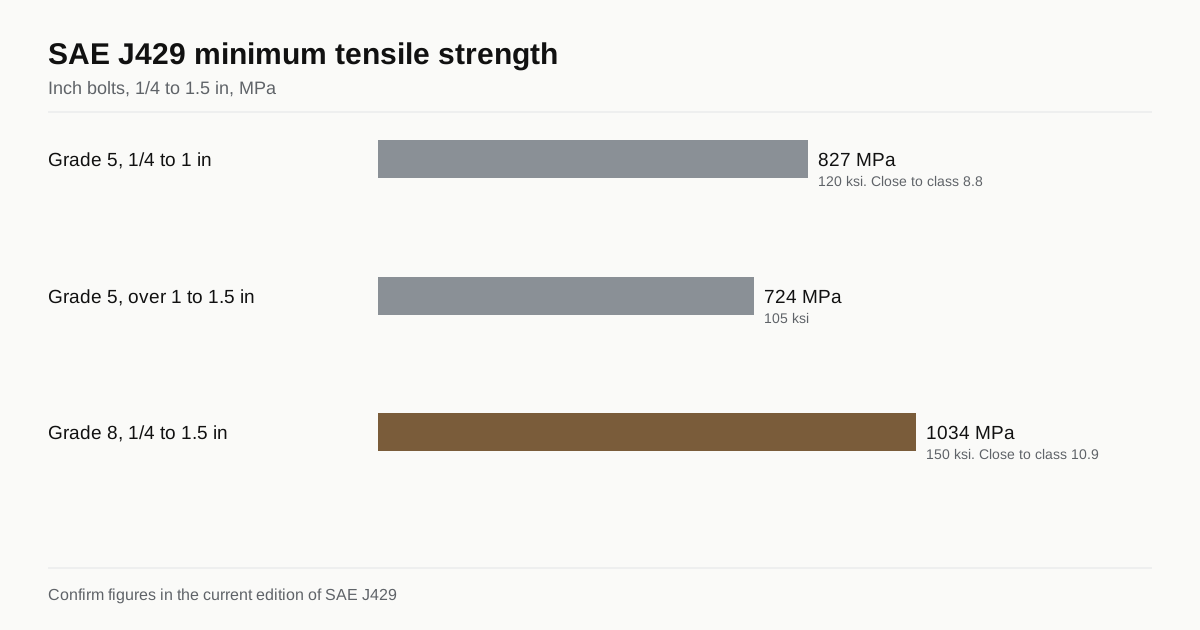
This guide uses the SAE J429 figures, explains the markings and hardness, gives the metric equivalents and shows when a made-to-print part makes sense.
The two grades in brief
Grade 5. Medium carbon steel, quenched and tempered. It covers the common sizes from 1/4 inch to 1 inch with one strength level and from over 1 inch to 1.5 inch with a slightly lower one.
Grade 8. Medium carbon alloy steel, quenched and tempered, with a higher tempering temperature range that still gives much higher strength. It has one set of values for the full range from 1/4 to 1.5 inch.
J429 also covers Grade 1 and Grade 2 for low strength parts and Grade 8.2, a low carbon boron steel with a martensitic structure that matches Grade 8 strength. Structural bolts for steel connections follow ASTM A325 and A490 rather than J429.
Strength figures from J429
| Property | Grade 5, 1/4 to 1 in | Grade 5, over 1 to 1.5 in | Grade 8, 1/4 to 1.5 in |
|---|---|---|---|
| Min tensile strength | 120 ksi (827 MPa) | 105 ksi (724 MPa) | 150 ksi (1,034 MPa) |
| Min yield strength | 92 ksi (634 MPa) | 81 ksi (558 MPa) | 130 ksi (896 MPa) |
| Proof load stress | 85 ksi (586 MPa) | 74 ksi (510 MPa) | 120 ksi (827 MPa) |
| Core hardness, Rockwell C | 25 to 34 | 19 to 30 | 33 to 39 |
Confirm every figure in the current edition of SAE J429 before you copy it into a drawing.
Take a 1/2-13 UNC bolt, whose tensile stress area is about 0.142 square inch. At proof load, a Grade 5 bolt carries about 12,100 lbf and a Grade 8 about 17,000 lbf. A common working clamp load is about 75 percent of proof, so roughly 9,000 and 12,800 lbf. That is the reason a switch from 5 to 8 allows a smaller bolt or a higher clamp load.
Markings
Head markings are part of the specification, and a custom bolt must carry them.
- Grade 5: three radial lines.
- Grade 8: six radial lines.
- Grade 2 or unmarked: no lines.
- Manufacturer mark: required on grade marked bolts, so the bolt can be traced.
The marks are formed in the head by the cold heading punch. If you want a marked bolt, ask the plant to include the punch features in the tooling. See cold forming tooling cost for how head details affect the die set.
Metric equivalents
Buyers often need to match an inch part with a metric one, or the other way around.
| Inch grade | Approximate ISO 898-1 class | Tensile strength, typical |
|---|---|---|
| Grade 5 | 8.8 | About 830 MPa |
| Grade 8 | 10.9 | About 1,040 MPa |
The match is approximate. Metric 8.8 has a tensile strength of 800 to 830 MPa depending on the size, and 10.9 has 1,040 MPa. The hardness ranges differ slightly and the sizes never match exactly. A drawing that crosses over from one system to the other needs an engineer’s check. Fastener grades and classes shows the metric side in more detail.
Ductility, hardness and what goes wrong
Higher strength brings trade-offs.
- Less ductility. Grade 8 stretches less before it breaks. A joint that relies on a bolt yielding to absorb a shock may be better with Grade 5.
- Hydrogen embrittlement. Grade 8 hardness sits in the range where plating can cause delayed cracks. Read hydrogen embrittlement in 10.9 and 12.9 bolts, since Grade 8 behaves like class 10.9 in this respect, and specify the coating with the plant.
- Notch sensitivity. A sharp under-head radius or a cut thread hurts a hard bolt more than a soft one. Rolled threads and a good radius pay off on Grade 8.
- Heat treatment quality. A decarburized skin on a Grade 8 bolt lowers fatigue life. Fastener heat treatment describes the controls.
When a custom inch bolt makes sense
Catalog distributors carry Grade 5 and 8 hex bolts in standard sizes and lengths. A custom order is the better choice when:
- The length is not in the catalog, such as 2-3/8 inch or a metric length on an inch thread.
- The head is special: a drilled head for safety wire, a flange, a shoulder, a larger bearing face.
- The thread is partial or has an unusual length.
- The grade is combined with a coating or a locking feature the catalog does not list.
- The annual volume makes direct purchase cheaper.
For these cases, the print should state the standard, the grade and the thread class. See how to source custom fasteners for how the quote is built.
Typical manufacturing routes
Grade 5 bolts up to about 3/4 inch are cold headed from medium carbon wire, then quenched and tempered and rolled to thread. Grade 8 follows the same route using alloy wire, or hot forging for larger sizes. Machined Grade 8 is possible for small lots, usually from alloy bar. The wire grade affects the heat treatment, so cold heading wire grades is worth a look.
Torque and preload for common sizes
Grade is only half the story, since the bolt carries the load it is tightened to. The table gives the approximate clamp load at 75 percent of proof for two common sizes, using the tensile stress area of the thread.
| Size | Stress area (in²) | Grade 5 clamp load, 75 percent of proof | Grade 8 clamp load, 75 percent of proof |
|---|---|---|---|
| 3/8-16 UNC | 0.0775 | About 4,900 lbf | About 7,000 lbf |
| 1/2-13 UNC | 0.1419 | About 9,000 lbf | About 12,800 lbf |
| 5/8-11 UNC | 0.2260 | About 14,400 lbf | About 20,300 lbf |
These are rough figures, and the real clamp load depends on friction, lubricant and tightening method. A torque wrench gives a clamp load scatter of plus or minus 25 percent or more, so critical joints use torque and angle or a tension method. State the method on the drawing with the torque, and say whether the threads are dry, oiled or coated.
Examples of custom inch bolt orders
A 1/2-13 x 2-3/8 hex bolt, Grade 5, zinc plated, 80,000 a year. The length is not a catalog size, so the maker heads the part from medium carbon wire, heat treats it and rolls the thread. The plated bolts get a bake, as Grade 5 hardness sits near the edge of the hydrogen risk range.
A 3/4-10 drilled head bolt, Grade 8, plain, 2,000 a year. The head has a cross hole for safety wire. The plant machines the hole after heat treatment and checks the position. A drilled head is a typical reason to leave the catalog.
A 5/16-18 x 1-1/8 flange screw with a serrated flange, Grade 5, 600,000 a year. The flange is formed in the heading die. The buyer approves the sample and asks for a torque tension test with the coating.
Substituting grades and mixed fleets
Many buyers run both inch and metric products. When a drawing from one system meets a supply chain from the other, mistakes follow. A few rules help. Do not swap grade 8 for 10.9 or grade 5 for 8.8 without an engineer’s check, even though the figures are close. Do not mix thread systems, since an M12 and a 1/2-13 look alike and do not mate. Do not swap bolts of different grades in a joint where the designer calculated for a specific preload and fatigue life.
If a joint is calculated for Grade 8 and the supply fails, the substitute is another Grade 8 from a source with test reports, and not a Grade 5 of a bigger size without a redesign. Keep the grade marking and the certificates with the lot, so the grade of any bolt in the field can be checked later. The RFQ checklist lists the items that belong on every order.
Common ordering mistakes
- Writing “grade 8 bolt” with no standard or thread series.
- Plating Grade 8 bolts with no mention of hydrogen relief.
- Assuming an unmarked bolt in the shop is Grade 5.
- Mixing grades in one fastener kit.
- Replacing a Grade 8 bolt with a metric 10.9 of a similar size without an engineer’s check.
A complete callout, such as SAE J429 Grade 8, 1/2-13 UNC-2A, with the coating and the marking, covers them.
Checklist for the RFQ
- Grade and standard: SAE J429 Grade 5 or Grade 8, or ASTM equivalents if you need them.
- Diameter, thread series (UNC or UNF), class (usually 2A) and length.
- Head type and dimensions, with the marking requirement.
- Coating, with a note on hydrogen embrittlement relief for Grade 8.
- Certificates: material, heat treatment and test results.
- Annual volume and release size.
A complete list gives you quotes you can compare. To start, send your RFQ and we match it with up to three makers that make inch bolts to print.
Metric classes, stainless and alloys are compared in our guide to fastener grades.
Frequently asked questions
How can I tell Grade 5 from Grade 8 by looking at the head?
SAE J429 marks Grade 5 with three radial lines on the head and Grade 8 with six radial lines. Parts without a mark are usually Grade 2 or an unrated bolt. A custom bolt should carry the grade mark and the maker's mark, and the print should state the marking.
Is Grade 8 always better than Grade 5?
It is stronger but not always better. Grade 8 has higher hardness, less ductility and a higher risk of hydrogen embrittlement after plating. For many joints Grade 5 gives enough clamp load at lower cost and with less risk. Pick the lowest grade that meets the load, as with any bolt.
What metric class matches Grade 5 and Grade 8?
Grade 5 is close to ISO property class 8.8 and Grade 8 is close to class 10.9. The match is approximate, because the strength figures differ slightly and the size ranges and hardness windows are not identical. Do not swap them on a drawing without checking the design.
Need this fastener made?
Send the print with the grade and annual volume. We match you with up to 3 makers that run the right route and reply within 24 business hours.
Send my RFQ