Guides / Sourcing
Custom Fasteners for Solar Racking and Mounting Systems
October 26, 2026
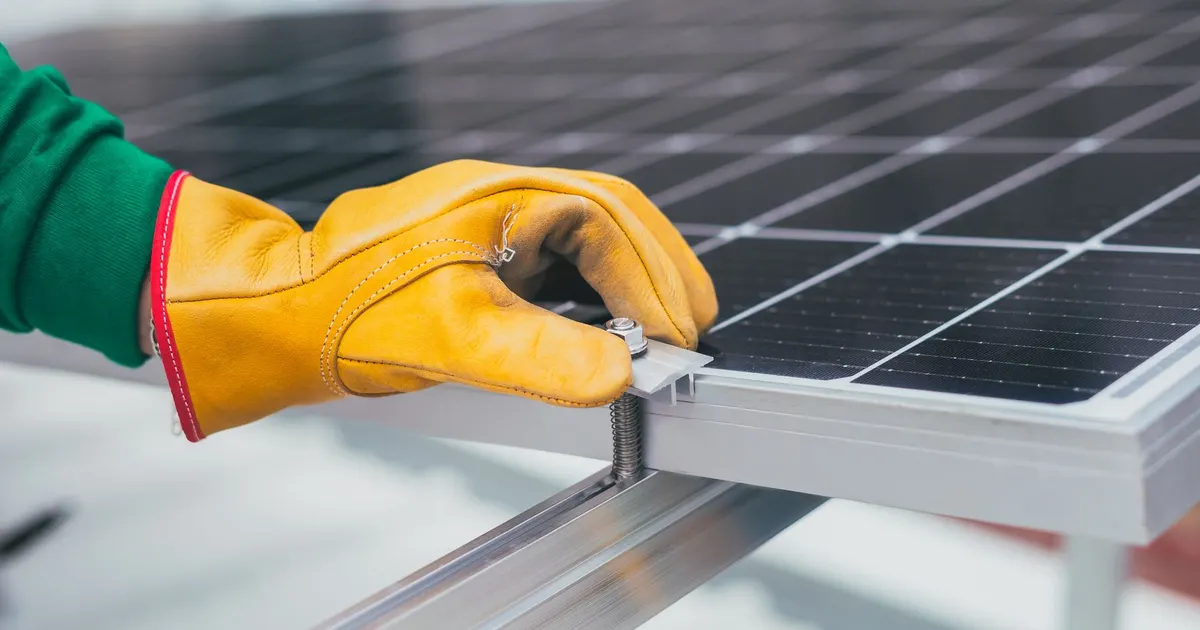
A solar array has thousands of fasteners and none of them can fail quietly. Panels ride on rails for 25 years or more, through wind loads, heat cycles and rain. Racking makers buy fasteners in volume and in specific forms that catalogs do not always list: T-bolts, serrated flange nuts, special clamp screws and structural bolts in set lengths. For a buyer that sources them to print, the work is to match the part to the corrosion category of the site and to the assembly method on the roof or in the field.
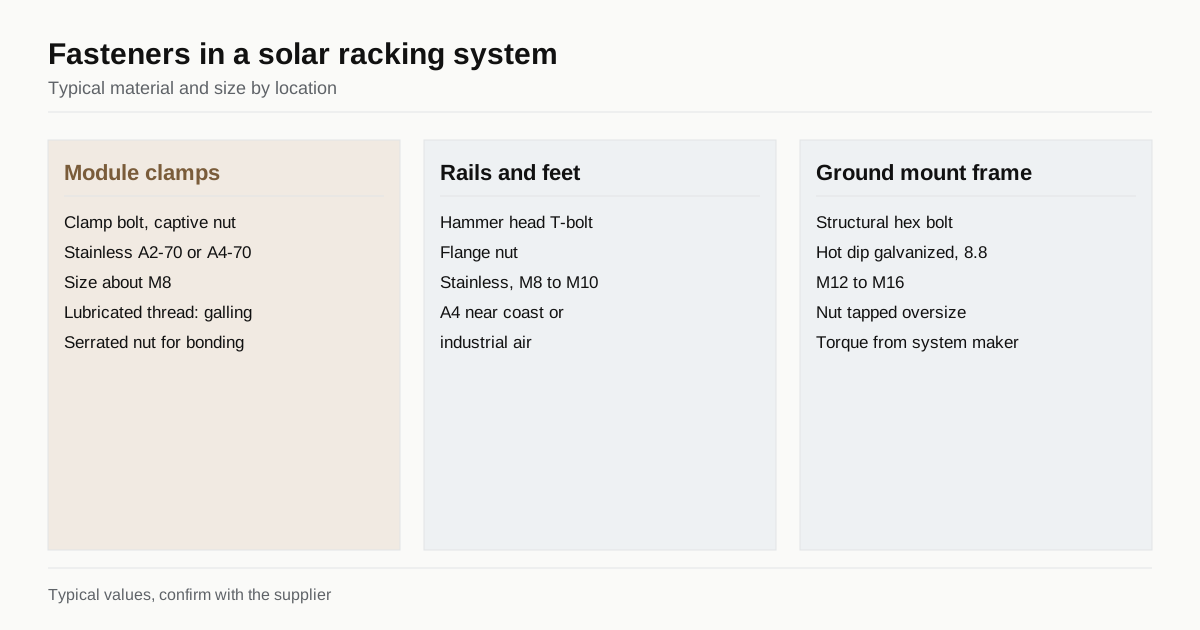
This guide lists the typical fastener types in a racking system, the materials, the failure modes to design out and the items to put on the RFQ.
The fasteners in a racking system
A roof or ground mount uses a short list of parts, repeated many times.
| Location | Typical fastener | Typical material | Typical size |
|---|---|---|---|
| Module to rail | Mid and end clamp bolt, often with a captive nut or a flange nut | Stainless A2-70 or A4-70 | M8 |
| Rail connection | Hammer head T-bolt with flange nut | Stainless A2-70 or A4-70 | M8 or M10 |
| Rail to foot or bracket | Hex bolt or T-bolt with flange nut | Stainless, or zinc coated steel | M8 to M10 |
| Foot to roof structure | Lag screw or self-drilling screw | Stainless or coated steel | M8 to M12 equivalent |
| Ground mount frame | Structural hex bolt, nut and washer | Hot dip galvanized steel, class 8.8 | M12 to M16 |
| Grounding lug | Machine screw with a lug | Stainless or tin plated copper | M5 or M6 |
These are typical combinations. System designers set the real values from load calculations and the listing of the product.
Materials and corrosion
Racking sits outdoors, so corrosion decides the material.
Stainless steel. A2 (304 type) and A4 (316 type) in property class 70 dominate small fasteners. They resist corrosion without a coating and keep the finish for decades. A4 suits coastal and industrial sites, where chloride attacks A2. ISO 3506-1 sets the properties and ISO 9223 classes outdoor corrosivity from C1 to CX.
Hot dip galvanized steel. Ground mount frames and piles use galvanized steel, following ISO 10684 or ASTM A153 for fasteners. The zinc layer is thick, so the nut is tapped oversize to fit. Class 8.8 is typical, and for the same reason as in all coated bolts, galvanizing above class 10.9 raises the risk described in hydrogen embrittlement.
Zinc flake coatings. Coated steel with ISO 10683 flake coatings is used for structural bolts where galvanizing does not fit the thread tolerance.
Aluminum. Rails are often 6005-T5 or 6063-T6 aluminum. Stainless against aluminum is a common pair and the galvanic gap is moderate, but in a wet salt site the aluminum around the bolt can corrode. Use isolating washers or sealant where the site is harsh.
Failure modes to design out
Galling. Stainless nuts on stainless bolts can seize when assembled fast, which is common with powered drivers on a roof. The result is a stripped thread or a twisted bolt. A wax or dry film lubricant on the thread, combined with moderate driver speed, prevents it. Some plants coat the nut or the bolt to cut friction.
Loosening. Wind makes the array vibrate. Serrated flange nuts, locking features or nylon patches resist rotation. See thread locking patches vs prevailing torque features for what each does and where the temperature limit matters. A rooftop panel can see surfaces above 70 °C, which is inside the range of nylon but needs checking for adhesives.
Fatigue. Cyclic wind load can crack a bolt at a notch or a cut thread. Rolled threads help, as thread rolling vs cutting explains.
Crevice corrosion. Under a washer or in a thread, oxygen runs out and stainless can corrode locally, especially in chloride. A4 resists better than A2.
Poor bonding. If the hardware forms the grounding path, a loose or coated joint can break it. This is a system level detail set by the product listing.
Features that custom racking fasteners add
Racking makers often need parts that no catalog sells.
- Hammer head T-bolts in set head sizes to fit a rail slot, with a locating neck or a square shoulder that stops rotation.
- Serrated flange nuts with teeth that bite through anodizing for bonding, and that resist loosening.
- Captive nuts or bolts pre-assembled into a clamp, which saves labor on the roof.
- Special lengths, set by the clamp height range, which depends on the thickness of the module frame, often in the range of 30 to 40 mm.
- Pre-applied lubricant or dry film to stop galling and to give consistent torque.
- Tamper features or a color mark that shows the bolt was tightened.
These come from cold forming or machining, depending on volume. Thousands of identical parts a month favor cold heading, as in cold heading vs machining, and the tooling cost is spread across a project.
Torque and assembly
Installers tighten to a torque value. That value depends on friction, and friction depends on the thread condition. Stainless, lubricated and plated threads all give different values for the same preload, so state the lubricant and the condition on the drawing. A torque value from the system supplier should match the supplied hardware. If you change the supply, confirm the torque again.
For assembly on a roof, drive speed and tool type matter. A lower speed setting limits heat and galling. Impact tools can overtorque small bolts.
Examples of racking fastener orders
A hammer head T-bolt, M8 x 25, A2-70, with a serrated flange nut, 3 million sets a year, for a rooftop rail system. The bolt head is formed to fit the rail slot, and the nut is cold formed with teeth for bonding. The plant applies a dry film lubricant to the thread to prevent galling. The buyer ships the sets in bags of 100 for the installers.
A structural bolt, M16 x 50, class 8.8, hot dip galvanized with a nut tapped oversize, 400,000 a year, for ground mount frames. The plant cold heads or hot forges the bolt, galvanizes the lot and tests the nut fit on a sample. Delivery is planned in step with the project schedule.
A clamp bolt, M8 x 40, A4-70, with a captive spring nut, for a coastal project. A4 is picked for chloride resistance, and the captive nut saves time on the roof. The plant checks that the spring and the nut survive the salt spray test with the bolt.
Corrosion categories and design life
A racking system is designed for a life of 25 years or more, so fastener corrosion must be low enough to last that long. ISO 9223 classes the corrosivity of an outdoor site, from C1 for very low to CX for extreme. A rural inland site is often C2 or C3, an industrial or urban coastal site is C4 and a marine or offshore site is C5 or CX. For C3 and C4, hot dip galvanizing or A2 stainless is usual. For C5, A4 stainless or a thicker coating is better. A site near a swimming pool, a farm with ammonia or a chemical plant can be worse than its category suggests.
The owner or engineer sets the category, and the fastener buyer should ask for it. State on the RFQ the site category and the life you need, so the plant can propose the material and the coating and the test that backs it. Salt spray hours are a comparison tool and not a life prediction, so ask what field data or standard the plant relies on.
Quality at volume
Racking runs are large, and a fault in one lot can affect an entire project. Ask the plant to describe its in-process checks, such as head and thread gauging at set intervals, a torque test on a sample of nut and bolt pairs and a visual check for coating defects. Keep lot numbers on the bags, so you can trace a problem to a shipment. Hold a retained sample from each lot for the life of the project, since a field complaint months later is easier to settle with a sample on the shelf.
What to state in the RFQ
- Fastener type, size, length and thread class, with a drawing.
- Material and property class: A2-70, A4-70, class 8.8 hot dip galvanized or other.
- Corrosion category of the site, such as ISO 9223 C3 or C5.
- Coating or lubricant, and the torque it should support.
- Features: flange teeth, captive parts, shoulder or neck.
- Packing: bags of a set count to match the installer’s kit.
- Annual volume and release size, since projects ship in waves.
For the general structure of a quote, see custom fastener RFQ checklist. When you are ready, send your RFQ and we match it with up to three makers that make racking fasteners.
Frequently asked questions
Which stainless grade should solar racking bolts use?
A2-70, which is 304 type, is common for inland sites. A4-70, a 316 type, is the usual pick near the coast or in industrial air with chlorides. Both are common property class 70, with a minimum tensile strength of 700 MPa. Choose by the corrosion category of the site, not by price alone.
Why do stainless nuts seize on solar clamps?
Stainless steel galls when threads slide under load. Tightening with a fast driver generates heat and the surfaces weld. Remedies include a dry film or wax lubricant on the thread, a lower driver speed and different grades for bolt and nut.
Do solar fasteners need to bond the modules to ground?
Many systems use the mounting hardware as part of the bonding path. Serrated flange nuts and special clamps bite through the anodized layer on the rails or module frames. That is a system level feature governed by the product listing, so the system supplier sets the requirement for the fastener.
Need this fastener made?
Send the print with the grade and annual volume. We match you with up to 3 makers that run the right route and reply within 24 business hours.
Send my RFQ