Guides / Sourcing
Tamper-Resistant Security Screws: Drive Types and Tooling
October 15, 2026
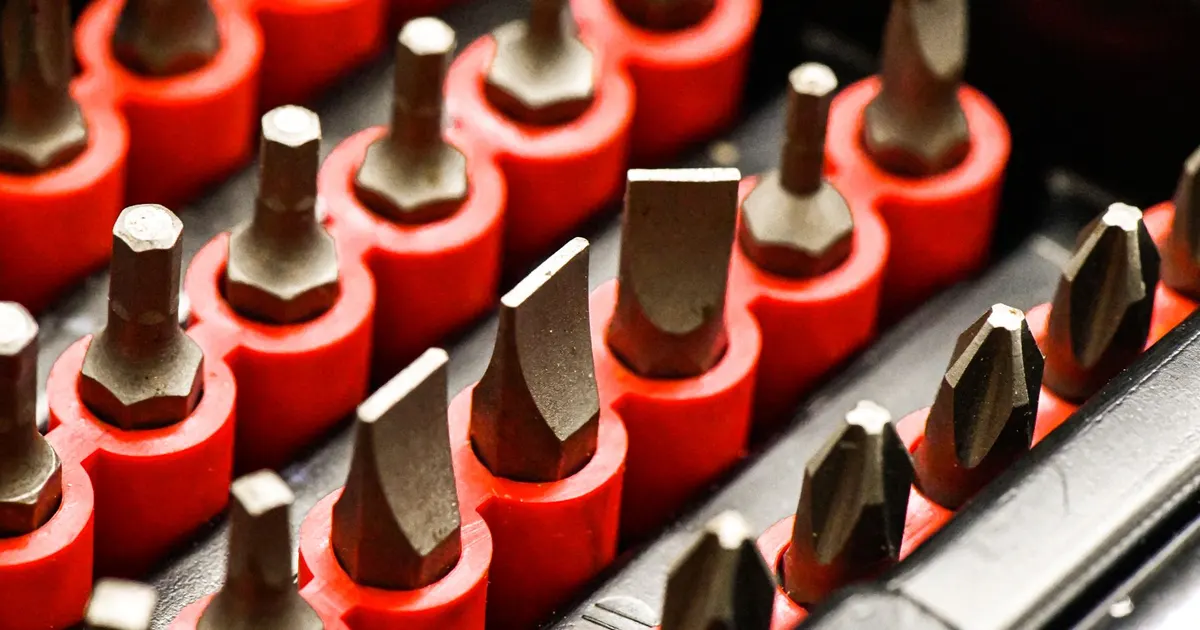
A security screw has a recess that ordinary tools cannot turn. It keeps a panel closed on a vending machine, a lamp in a street fixture, a cover on a charger or a plate on a public seat. The goal is to slow down casual removal and give the owner control of who has the tool. What the screw does not do is stop a determined attack, so the choice of drive is a balance among protection, service access and cost.
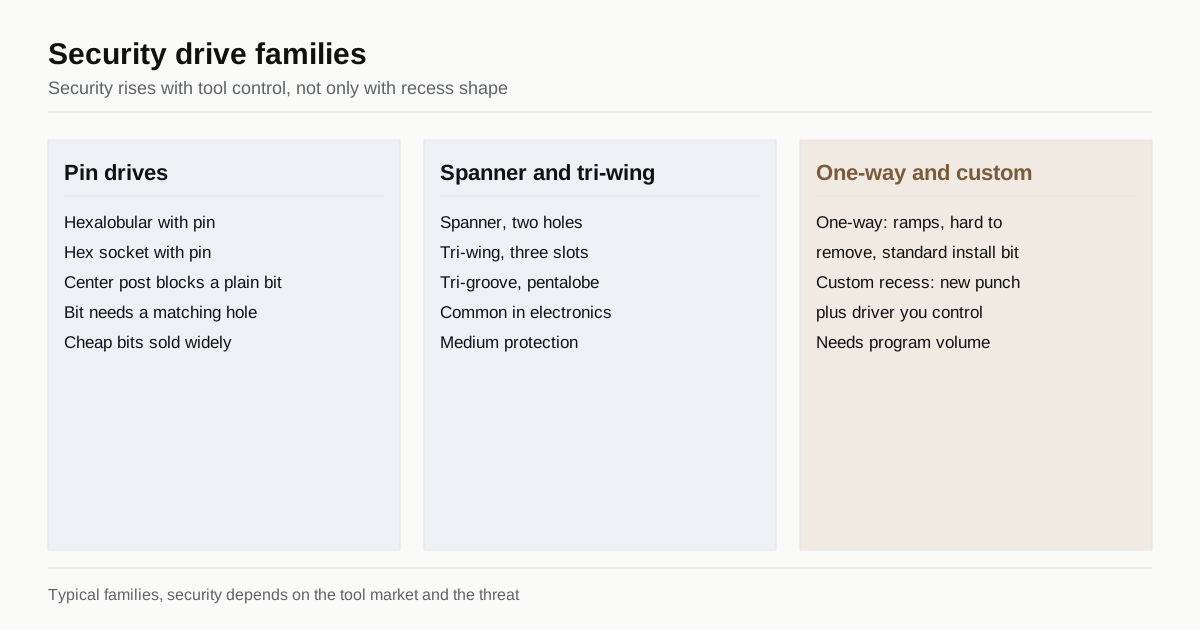
This guide covers the most common drive types, how the tooling works, how the screws are made and what to put on an RFQ.
Common security drive types
| Drive | How it works | Security level | Tool availability |
|---|---|---|---|
| Hexalobular with pin (pin torx type, from ISO 10664) | Six lobed recess with a center post | Medium | Common, sold widely |
| Hex socket with pin | Hex recess with a center post | Medium | Common |
| Spanner or snake eye | Two round holes in the head | Low to medium | Common |
| Tri-wing | Three offset slots in a triangle | Medium | Common in electronics |
| Tri-groove | Three grooves in a Y shape | Medium | Less common |
| Pentalobe | Five lobed recess, small sizes | Medium | Mostly electronics repair |
| One-way or clutch | Slot with ramps that only turn one direction | Low to high, since it is hard to remove | Installation with a standard slotted bit |
| Proprietary custom drive | Recess unique to one customer | Highest, since the tool is controlled | Only from the program owner |
Security level here is a rough guide and depends on the tool market. A popular drive has cheap bits sold online, which lowers its security. A rare drive may protect better but makes service harder.
How the tooling works
The pin. In a pin drive, the center post blocks a plain bit. The driver bit has a matching hole so it can slide over the post. The pin also gets in the way of simple hacks, like a flat blade wedged in a torx recess.
Driver bits. The bit is made from tool steel, hardened, and sized to the recess. Bits wear and round off, so a service team needs spares. The bit size must match the screw size. A T20 recess takes a T20 bit, and a pin version of it takes a T20 pin bit.
Torque capacity. A six lobe recess carries more torque than a hex of the same size, and it resists cam out, so it works well in thin parts. A pin reduces the recess depth a little, so check the torque rating. Use a driver with a torque limit during assembly. An over tightened screw is a common cause of damage, and it also makes the screw harder for service.
Matching the drive to the head. The recess has to fit the head size, so a tiny pan head cannot hold a large recess. Common head styles are pan, button, flat, truss and low profile cap.
How the recess is made
A cold headed security screw is formed by a punch that carries the recess shape. The punch has a hole at its tip for the pin, so the pin forms as the metal flows around it. This punch is a precision tool and it wears, so tooling cost and life matter. Cold forming tooling cost explains how head details enter the die set price. Common drives, like the hexalobular with pin, use standard punches that most plants have, and a custom recess needs a new punch.
Machined screws get the recess from a broach or a milled pocket, which suits low volumes but gives less accuracy on small drives. For very small parts, cold forming is often the only practical route.
Stainless screws work harder in the die than carbon steel and wear the punch faster, so they carry a higher tooling cost. See martensitic and PH stainless fasteners for grades that can be headed.
Material and coating
Security screws are made in carbon steel with a coating, in stainless steel and in brass for special cases.
- Carbon steel, class 8.8 or lower, with zinc or a flake coating, for general use indoors and outdoors.
- Stainless A2 or A4, for outdoor and washdown areas.
- Hardened screws resist drilling better, and they can be a security feature on their own. A hardened head makes drilling out slow. The trade-off is brittleness.
- Color and finish are often a design choice for visible panels.
For parts under vibration, a locking patch can keep the screw tight, see thread locking patches vs prevailing torque features. Remember that a patch changes the removal torque, so a service team may need a higher driver torque.
Where each type fits
Public equipment and street furniture. Pin torx or pin hex screws in stainless, since both tool and screw are easy to obtain and the cost is low.
Electronics and appliances. Tri-wing, pentalobe and small pin torx screws on covers, where the aim is to limit user repair or protect safety parts.
Transit and detention. One-way screws and hardened or proprietary drives, where tools must stay under control.
Utility and lighting. Pin hex and special drives on cabinet doors and meter housings.
Child resistant uses. Security drives on battery covers and toys, where a tool is a barrier.
What to put on the print
- Drive type and size, with the standard or the drawing of a custom recess.
- Head style and dimensions.
- Thread size, length and class, see thread gauging.
- Material, property class and coating.
- Torque range for assembly, and any locking feature.
- Driver bit supply. Whether the plant supplies bits, and how many.
- Marking, if the head carries a logo.
Examples of security screw orders
M4 x 12 button head screws with a hexalobular pin recess, A2 stainless, 200,000 a year, for a street lighting cabinet. The route is cold heading with a standard pin punch, so tooling cost is modest. The buyer orders 500 driver bits with the first lot and specifies a torque range for installers.
M3 x 8 tri-wing flat head screws, steel with black oxide, 1 million a year, for appliance covers. Tri-wing recess punches are common in plants that serve electronics. The buyer wants the screw to be removable by service staff with a standard tri-wing bit.
A custom recess on an M5 pan head, hardened steel, 3 million a year, for a vending machine maker. A new punch is made for the recess, and a dedicated driver is made for the buyer and supplied to authorized service staff. The program volume justifies the tooling, and the buyer owns the punch.
Managing the driver supply
A security screw is only as secure as the control of its tool. If the driver is sold in every hardware shop, the protection is modest. If the driver is held by a small group, the protection is real. Decide who needs the tool, how many are needed and how they are replaced.
For a standard drive, drivers come from tool suppliers and any buyer can restock. For a custom drive, the plant or a tool maker supplies bits, and the buyer should agree on a minimum stock, a lead time for restocks and a rule against selling the tool to third parties. Put that in the purchase terms. Also plan the service side: a technician who cannot remove a screw in the field loses an hour, so the right bit has to be in the kit. Some owners keep a second class of screw for areas that need frequent access and use the security drive only where protection matters.
Legal and safety notes
Fasteners with special drives are normal commercial goods. If the screws go into equipment covered by electrical safety rules or child safety rules, the equipment maker decides the drive and the strength, and the screw supplier follows the drawing. Treat the standard drive of your market as a starting point and let the safety file of the equipment drive the final choice.
Common ordering mistakes
- Choosing a drive from a catalog photo without checking that bits exist in the size you need.
- Specifying a pin drive on a very small head, where the pin and the recess leave too little wall.
- Forgetting that a hardened screw head can crack a worn bit and leave the tool broken in the recess.
- Ordering drivers late, so the first assembly line runs without them.
- Not stating a maximum assembly torque, which leads to rounded recesses and stuck screws.
- Assuming a one-way screw can be reused. It cannot, and the service plan must say so.
Each mistake is cheap to avoid when the print and the purchase terms name the drive, the size, the tool supply and the torque.
Checklist for the RFQ
- Drawing or part number of the screw and the recess.
- Number of drivers needed and who supplies them.
- Whether the drive is standard or custom, and who owns the tooling.
- Annual volume and release size.
- Environment and expected service life.
- Packaging, for example bags of a set count in kits.
Terms like blow, station and blank are defined in the fastener manufacturing glossary.
A custom drive needs a program with enough volume to justify the punch. To start, send your RFQ and we match it with up to three makers that form security screws. For more on writing a complete RFQ, see custom fastener RFQ checklist.
Frequently asked questions
Is a security screw tamper proof?
No fastener is tamper proof. A security drive raises the effort and the tools needed, which stops casual removal and most opportunistic tampering. A determined person with time and tools can drill out or grind off a screw. Choose the drive for the threat level, and treat the screw as one layer of protection.
Can I use a standard driver bit on a pin drive screw?
Not in most cases. A pin torx or pin hex screw has a post in the center of the recess, and a standard bit has no hole for it. The bit must have a matching hole. That is the security feature. A standard bit can damage the pin and the recess if forced.
What does a proprietary drive cost to add?
It adds a punch for the recess, which is part of the heading tooling, and requires a matching driver. The tooling is a one time cost, and the drivers are bought separately. Proprietary drives suit large, stable programs where control of the driver is part of the goal, and not small lots.
Need this fastener made?
Send the print with the grade and annual volume. We match you with up to 3 makers that run the right route and reply within 24 business hours.
Send my RFQ