Guides / Grades and Materials
ASTM A193 B7, B16 and L7 Studs: Which Grade for Pressure Service
October 10, 2026
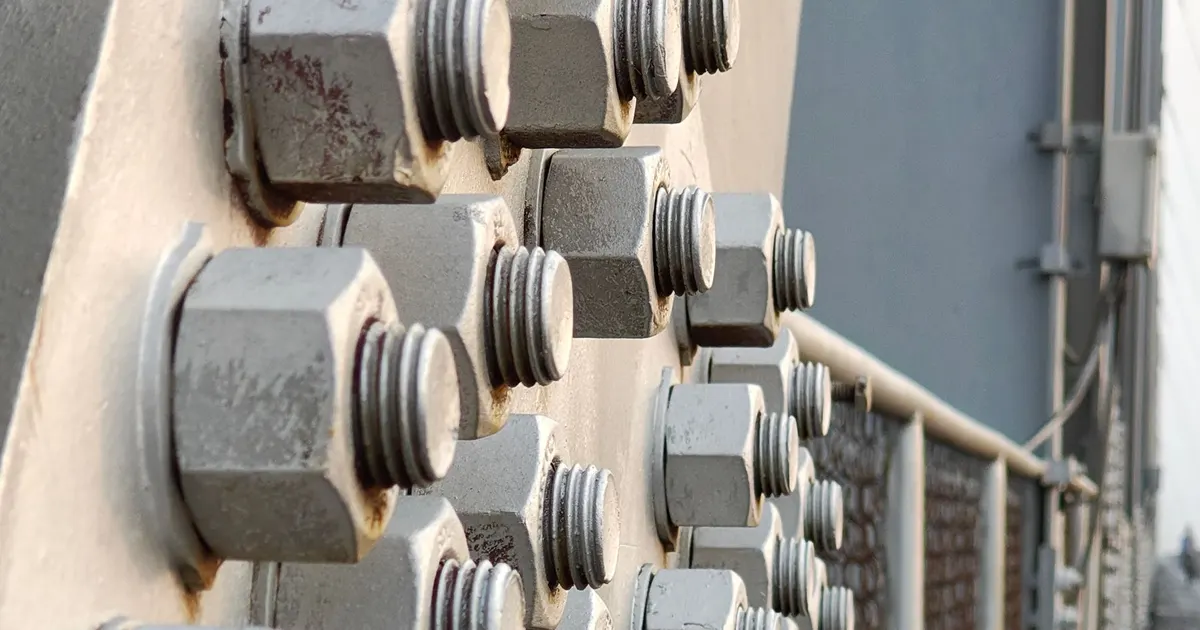
Studs in pressure service hold flanges, valve bodies and pump casings together while the line sees heat, cold and cycling. The buyer rarely needs to design the stud, but the buyer has to choose the right grade and write the right standard on the order. A193 B7, B16 and A320 L7 look alike on the shelf. They differ in temperature range and in testing, and the wrong one causes a rejected lot or a field failure.
This guide compares the three, explains B7M, covers nuts and threads and lists what to include in an RFQ.
The standards in short
ASTM A193 covers alloy steel and stainless steel bolting for high temperature or high pressure service. It includes B7, B7M and B16 among many grades. ASTM A320 covers alloy steel and stainless bolting for low temperature service, with L7 among its grades. ASTM A194 covers the nuts for both.
A stud for a pipe flange is a rod threaded on both ends or along the full length, with no head. Dimensions follow ASME B16.5 for flange bolting, thread form follows ASME B1.1 and the usual thread series for 1 inch and larger is 8 threads per inch with a 2A fit.
What B7, B16 and L7 are
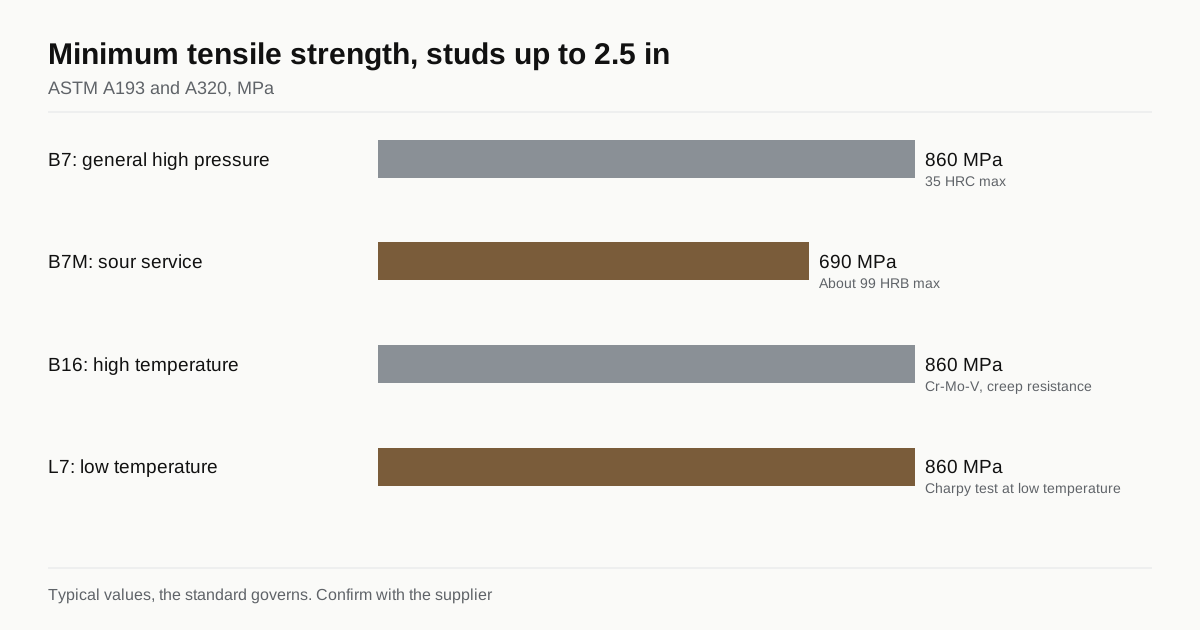
B7. A chromium molybdenum steel, typically 4140 or 4142 type, quenched and tempered. It is the standard stud for general high pressure service. A193 gives a minimum tensile strength of 125 ksi (860 MPa) and a minimum yield of 105 ksi (720 MPa) for diameters up to 2.5 inch, with lower figures at larger diameters. The maximum hardness is 35 HRC.
B7M. The same steel but tempered to a lower hardness, up to about 99 HRB or 235 HBW, to resist sulfide stress cracking in sour service per NACE MR0175 and ISO 15156. Because of the lower hardness the strength is lower, and the design must allow for it.
B16. A chromium molybdenum vanadium steel. The vanadium gives creep resistance at temperatures where B7 begins to relax. It is the choice for high temperature service, such as steam and hot process lines, up to temperatures above where B7 is limited.
L7. From A320, a 4140 type steel quenched and tempered like B7, with the added requirement of Charpy V-notch impact testing at a low temperature, commonly minus 101 °C (minus 150 °F), at a minimum energy value stated in the standard. It carries the same strength levels as B7 in the common sizes.
Comparison
| B7 | B7M | B16 | L7 (A320) | |
|---|---|---|---|---|
| Steel type | Cr-Mo | Cr-Mo | Cr-Mo-V | Cr-Mo |
| Min tensile, up to 2.5 in | 125 ksi (860 MPa) | 100 ksi (690 MPa) typical | 125 ksi (860 MPa) | 125 ksi (860 MPa) |
| Hardness cap | 35 HRC | About 99 HRB | About 35 HRC | About 35 HRC |
| Impact test | Not required | Not required | Not required | Required at low temperature |
| Typical service | General high pressure | Sour service | High temperature, creep | Low temperature |
| Usual nut (A194) | 2H | 2HM | 4 or 7 | 4 or 7 |
Figures are typical and the standard governs. Check the table for the diameter range, because strength drops as the stud gets thicker.
Temperature and the reason for each grade
Studs lose strength when hot and lose toughness when cold.
- Hot service. B7 handles typical carbon steel flange service. Above a few hundred degrees Celsius, the stud can relax, which means it stretches slowly under load and the gasket loses compression. B16 resists this, and for very hot service austenitic or nickel alloys take over. See Inconel and Monel fasteners for those.
- Cold service. Carbon steel loses toughness as it cools. A stud that is tough at room temperature can fracture in a brittle way at minus 50 °C. L7 proves its toughness with the impact test and is the right call for cold lines and cryogenic work, with other grades for the coldest.
- Sour service. Hydrogen sulfide makes hard steel crack. B7M exists for this, with a hardness cap that keeps the risk down. Do not mix B7 and B7M in one joint without engineering approval.
Nuts, threads and lengths
The nut is half the joint. A193 and A320 studs run with A194 nuts, and the grades are matched by strength and, for cold service, by impact. Write the nut grade on the order, even if the nuts come from the same plant.
Threads are cut or rolled to the class that the print states. Many flange studs are 2A, and the nut is 2B, which leaves a clearance fit. Custom stud lengths and thread lengths are common, as flange thickness and gasket vary. A stud is measured from end to end, and the thread length at each end is part of the print. Thread gauging explains the checks.
Coatings and marking
Pressure studs are supplied plain, with zinc or hot dip galvanizing or with fluoropolymer coatings that reduce friction and protect against corrosion. Each choice changes the torque to preload relation and the nut fit, so state the coating and the nut tapping. For galvanized studs, the nut is tapped oversize to take the zinc layer.
Each stud is marked with the grade and the maker’s mark. Standards set where and how. If you need heat numbers on the studs, say so, since marking adds an operation.
Testing and certificates
Pressure bolting usually requires full certification:
- A mill certificate for the bar with chemistry and heat number.
- Mechanical test results: tensile, yield, elongation, reduction of area.
- Hardness results.
- For L7, impact test results with test temperature and energy values.
- Heat treatment records.
A material test report in EN 10204 type 3.1 form is the usual request. Read fastener testing for what each test shows. If a third party must witness the tests, state it before the order.
How to choose
- Minimum design temperature below about minus 30 °C? Choose L7, or the grade your engineer specifies for the coldest case.
- Sour service? Choose B7M with 2HM nuts and check the strength.
- High temperature, creep or relaxation concern? Look at B16 or a nickel alloy.
- General service? B7 with 2H nuts.
When in doubt, send the design conditions to the engineer, not only the grade.
Two sample orders
Forty sets of flange studs, 1-1/8 in 8UN, 7 in long, B7 with 2H nuts, for a refinery turnaround. The plant cuts bar to length, threads each end to 2A and quenches and tempers the studs, or buys heat treated bar. Each set ships with a mill test report, hardness results and nut test results. The order has a date tied to the shutdown, so the buyer confirms lead time before the purchase order and asks for partial shipments by size.
A few hundred L7 studs, 3/4 in, for a cold storage plant at minus 40 °C. The plant needs bar that can pass the Charpy test at the L7 test temperature, so it uses certified bar with impact results, then tests a sample from the heat treated lot. Impact testing adds cost and a few days. The buyer asks for the impact energy values on the certificate and checks that the nuts are the correct grade for low temperature.
Common mistakes in pressure bolting orders
- Ordering by grade name only, such as “B7 studs”, with no standard or edition. A193 has several grades and the nut grade must match.
- Leaving out the nut grade, so nuts arrive in the wrong grade for the stud.
- Mixing B7 and B7M in one flange without approval.
- Forgetting the coating allowance on nuts for galvanized studs.
- Specifying thread length from the stud’s overall length instead of dimensioning each end.
- Assuming one certificate covers all studs in one order, when the studs come from more than one heat.
A short purchase specification that names the standard, the grade, the nut, the dimensions and the certificates removes most of these.
Documentation and marking checks on receipt
When the studs arrive, check four things before they go to the field. The marking on each stud or bundle matches the grade and the maker’s mark on the certificate. The nut marking matches the grade you ordered, such as 2H or 4. The lot or heat numbers on the certificate match those on the boxes. The dimensions of a sample, including overall length and thread length at each end, match the print. A short receiving inspection of this kind takes minutes, and it catches a wrong grade or a wrong length before a flange is closed.
Keep the certificates with the project file for the life of the joint, since a pressure system audit or an incident review may ask for them years later.
Checklist for the RFQ
- Standard and grade: A193 B7, B7M, B16 or A320 L7, and the edition if it matters.
- Nut grade and quantity per stud.
- Diameter, thread series and class, overall length and thread length at each end.
- Coating and any torque or friction requirement.
- Certificates and marking, including heat numbers and impact data.
- Quantity and delivery date.
Beyond B16 for heat, see A286 fasteners.
Studs made to print are usually quoted per set with nuts. For general guidance on quoting custom parts, see custom fastener RFQ checklist. When your list is ready, send your RFQ and we pass it to up to three makers that can make and certify the studs.
Frequently asked questions
What is the difference between B7 and B7M studs?
B7 is quenched and tempered Cr-Mo steel to a minimum strength and a maximum hardness of 35 HRC. B7M is the same steel tempered harder to a lower hardness cap, about 99 HRB, for sour service where high hardness raises the risk of sulfide stress cracking. B7M has lower strength than B7, so check the design load.
Can B7 studs be used at low temperature?
B7 has no impact test requirement in A193, so it is not specified for low temperature service. For temperatures down to the impact test limit, designers choose A320 L7, which adds Charpy testing at a low temperature. Confirm the minimum design temperature with the engineer of record.
Which nut goes with each stud?
ASTM A194 sets the nut grades. Grade 2H pairs with B7, grade 2HM with B7M and grade 4 or 7 with B16 and L7, with the exact pairing set in the standard. A pressure joint can fail at the nut as well as the stud, so write the nut grade on the order.
Need this fastener made?
Send the print with the grade and annual volume. We match you with up to 3 makers that run the right route and reply within 24 business hours.
Send my RFQ