Guides / Sourcing
Wheel Bolts and Lug Nuts: Custom Specs for Trailers
October 18, 2026
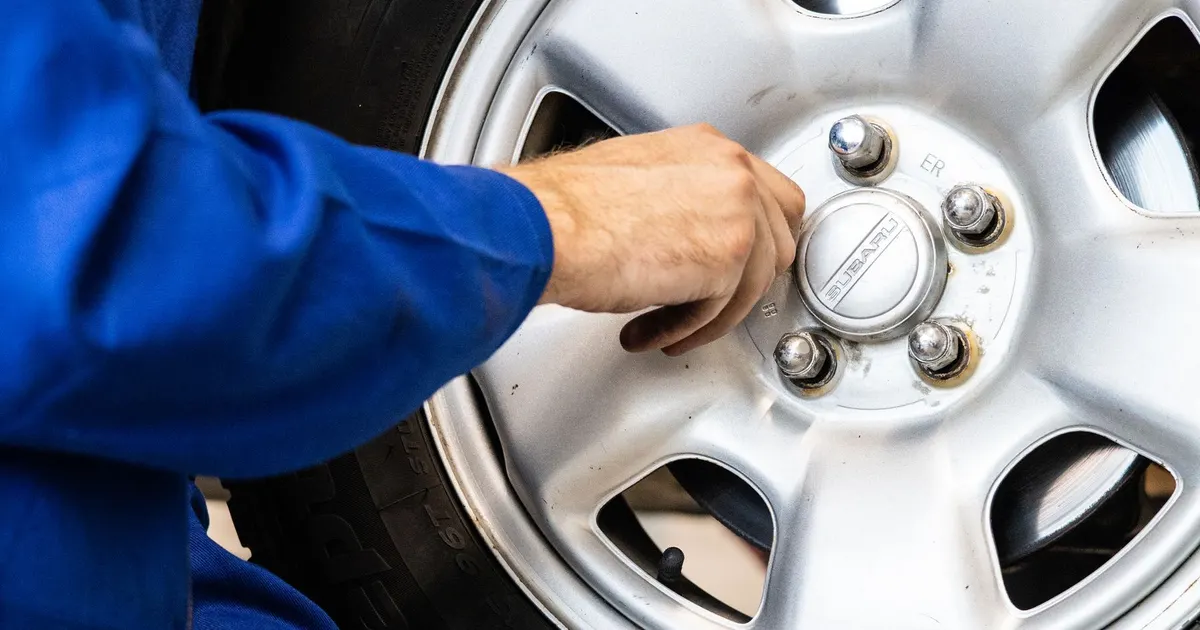
A wheel holds on by five or ten small fasteners, and when one lets go the result is often a lost wheel at speed. That is why wheel bolts, studs and lug nuts are among the most tightly specified fasteners in any vehicle. Trailers add a twist: axle makers, wheel makers and trailer builders all use different sizes, seats and hub fits, so a catalog part that looks right can be wrong. Custom orders cover odd sizes, special seats, long studs and coatings that survive road salt.
This guide explains the specs a buyer needs to write down and how plants make these parts.
Studs, bolts and nuts
Wheel stud. A threaded rod with a knurled or serrated section that is pressed into a hole in the hub flange. The stud has a thread at the outer end for the nut, and often a collar or a head on the inboard side.
Wheel bolt. A bolt with a head that has a seat, a washer face or an integral washer, and a thread that screws into a tapped hole in the hub. Cars from some European makers use bolts, and so do some trailer hubs.
Lug nut. The nut that clamps the wheel onto a stud. It has a seat that matches the wheel, a hex or a smaller drive for a tool and a thread that matches the stud.
All three carry the clamp load of the wheel, the cyclic load from braking and cornering and the shock of potholes, so they are fatigue loaded and safety critical.
Thread sizes
Trailer axles use a short list of threads, and the pitch is fine.
| Size | Thread | Typical application |
|---|---|---|
| 1/2-20 UNF | Inch fine | Light trailers, 4 or 5 lug hubs |
| 9/16-18 UNF | Inch fine | Medium duty trailers |
| 5/8-18 UNF | Inch fine | Heavier axles |
| M12 x 1.5 | Metric fine | Small European trailers and cars |
| M14 x 1.5 | Metric fine | Cars and light trailers |
| M18 x 1.5 to M22 x 1.5 | Metric fine | Commercial vehicles |
These are typical and not complete. The axle or hub maker sets the thread. Fine pitch threads give high preload for a given torque and resist loosening better than coarse threads, at the cost of more care when the thread is damaged or dirty.
Seat types
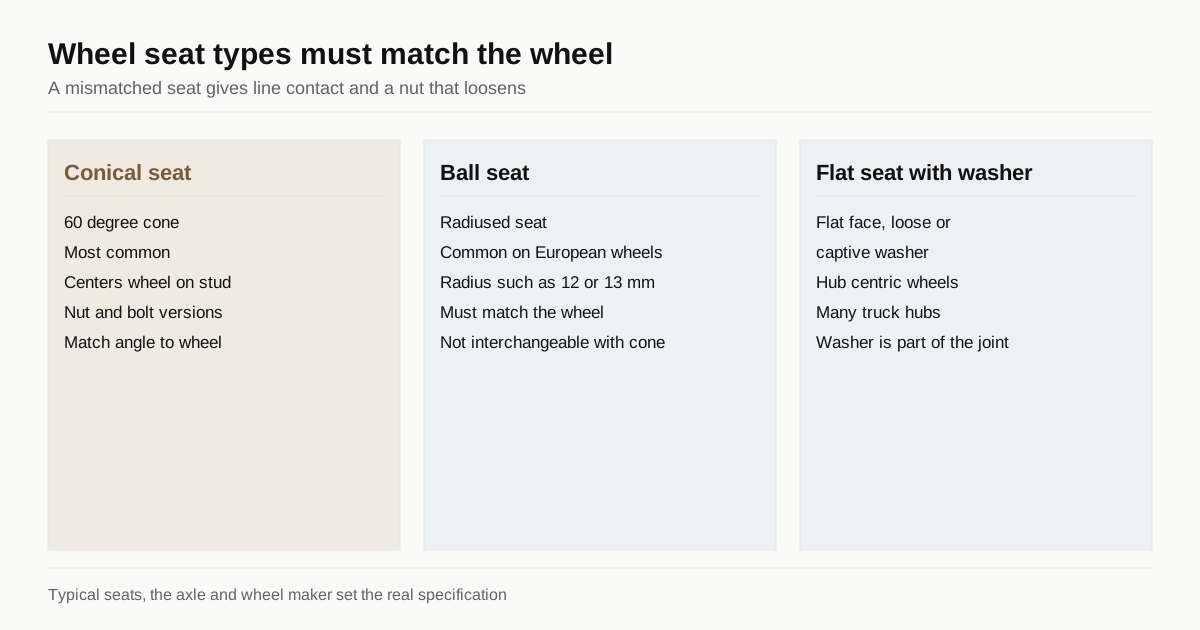
The seat is the shape of the bearing surface on the nut or bolt head. It must match the wheel.
- Conical seat. A 60 degree cone is the most common on both nuts and bolts. It centers the wheel on the stud.
- Ball seat. A radiused seat, used on many European wheels. The radius, such as 12 or 13 millimetres, must match.
- Flat seat with washer. A flat face with a loose or captive washer, used on hub centric wheels and on many trucks.
An angle or radius that does not match leaves a line contact. The wheel then clamps on a small area, the preload falls and the nut works loose. State the seat and the wheel it fits on the print.
Strength, material and testing
Wheel bolts and studs are normally class 10.9 under ISO 898-1, made from medium carbon boron or alloy steel, quenched and tempered. Nuts match one class lower or the same. Some heavy duty parts use class 12.9, but the risk of hydrogen cracking is greater after coating, as explained in hydrogen embrittlement in 10.9 and 12.9 bolts.
Typical tests for this type of part are:
- Tensile and proof load, with wedge test on bolts with a head. See fastener testing.
- Hardness and decarburization checks.
- Torque tension tests for the coating and nut combination.
- Fatigue testing on a sample, if the buyer asks for it.
- Salt spray testing for the coating.
Automotive buyers often ask for control plans and a production part approval process. Mention it on the RFQ so the plant can say if it runs those.
Hub fit
A wheel stud sits in the hub with an interference fit. The serrations bite into the hole, so the hole diameter, the knurl diameter and the stud collar must match. The stud is pressed in to a set seat depth and checked for pull-out force. The print must show the knurl diameter, the length under the head and the press fit data from the hub maker. A stud that rotates in the hole is useless, and one that is too tight can crack the hub flange.
Stud length depends on the wheel thickness and the nut. The thread should engage the nut for at least about the diameter of the stud, and the stud end should project beyond the nut by a few threads. A stud too short loses engagement, and one that is too long fouls the brake drum or the hub cap.
Coating
Wheel hardware sits in the splash zone, so it needs corrosion protection that does not change the dimensions much.
- Zinc and zinc-nickel plating is common, followed by a passivation. Hydrogen relief baking is needed for class 10.9.
- Zinc flake coatings under ISO 10683 give long salt spray life without hydrogen from plating, and the thickness is controlled to stay within thread tolerance.
- Black oxide and oil is for indoor or low corrosion uses.
- Chrome and decorative finishes are used on cosmetic lug nuts, which are often thinner walled and weaker.
The coating affects the friction between the thread and the nut, so the torque for a given preload changes. State the coating, the friction range and the torque on the print. Gauging after coating needs to be defined, as in thread gauging.
How the parts are made
Wheel studs and bolts are cold headed from boron or alloy wire, rolled to thread, heat treated and coated. Rolled threads give better fatigue life, as described in thread rolling vs cutting. Knurls on studs are rolled or formed in a separate operation. Nuts are cold formed on multi-station nut formers, then tapped, heat treated and coated. For volumes of tens of thousands, tooling for a custom head or seat pays off, as in cold forming tooling cost. For small runs, machined parts are possible.
Typical failure modes
Wheel fastener failures follow a few patterns, and each one points back to a spec item.
- Loose nuts after a short trip. Usually caused by a wrong seat, paint or coating trapped under the seat, or a low initial torque. The fix is a seat match, a clean seat and a re-torque instruction.
- Broken studs at the thread root or under the collar. Fatigue from low preload, a worn hub or a cut thread. Rolled threads, correct torque and a good fillet help.
- Stripped threads. Damaged by cross threading, by an impact wrench or by rust. A good coating and a controlled thread fit reduce it.
- Cracked hub flanges at the stud holes. Too much interference from an oversize knurl or a stud pressed in at the wrong depth.
- Galled or seized nuts. From dry assembly of stainless, or from damaged plating. A matched friction coating prevents it.
When you write the spec, think about which of these your product has seen, and add the control that blocks it.
Torque, friction and the test that proves it
Torque turns into clamp load only through friction. At typical values, most of the torque goes to friction at the thread and under the nut seat, and only a small part stretches the stud. A coating that lowers friction gives more preload at the same torque, which could overload the stud, and a rough or dry coating gives less preload. That is why a wheel nut and stud pair should be validated together.
A torque tension test on a sample of nut and stud pairs, with the coating that will be shipped, shows the preload range at the specified torque. Many buyers ask for it on a first article and again when the coating or the lot of wire changes. State the torque, the friction range you accept and the number of samples, and the plant can quote the test.
Common ordering mistakes
- Giving the thread size and forgetting the seat type.
- Ordering a stud with the right thread and the wrong knurl or collar diameter for the hub.
- Skipping a torque tension test after a coating change.
- Using decorative lug nuts with thin walls on a load bearing trailer axle.
- Failing to state left or right hand thread when the axle needs it.
- Not giving the wheel thickness, so the stud length is wrong.
Putting these on the print gives the plant what it needs to quote the right part.
Checklist for the RFQ
- Part type: stud, bolt or nut, with a drawing.
- Thread size, pitch and class, with the length and the thread engagement.
- Seat type, angle or radius, and the wheel it fits.
- Property class and standard.
- Knurl or hub fit data for studs.
- Coating, corrosion test and friction range.
- Torque the part is designed for.
- Control plan or approval requirements.
- Annual volume and release size.
When the list is ready, send your RFQ and we match it with up to three makers that run wheel fastener lines.
Frequently asked questions
What is the difference between a wheel stud and a wheel bolt?
A wheel stud is pressed into the hub and the wheel is held by a nut. A wheel bolt, or lug bolt, passes through the wheel and screws into a tapped hole in the hub. Many trailer axles use studs with lug nuts, while some European style hubs use bolts. The print must say which, because the heads, shanks and fits differ.
Why does the seat type matter?
The seat is the surface that centers the wheel and carries the clamp load. A conical seat, a ball seat and a flat seat with a washer are not interchangeable. A wrong seat gives a wheel that looks tight but is held on a line contact, and the nut loosens. Match the seat to the wheel and the hub.
Do wheel nuts need re-torquing?
Axle and wheel makers commonly call for a check after the first short trip, since the clamped surfaces settle and paint or coating compresses. The exact distance and torque come from the axle or wheel maker. A custom fastener spec should state the torque the part is designed for.
Need this fastener made?
Send the print with the grade and annual volume. We match you with up to 3 makers that run the right route and reply within 24 business hours.
Send my RFQ