Guides / Sourcing
Custom Micro Screws for Electronics: M1 to M2 Made to Print
October 14, 2026
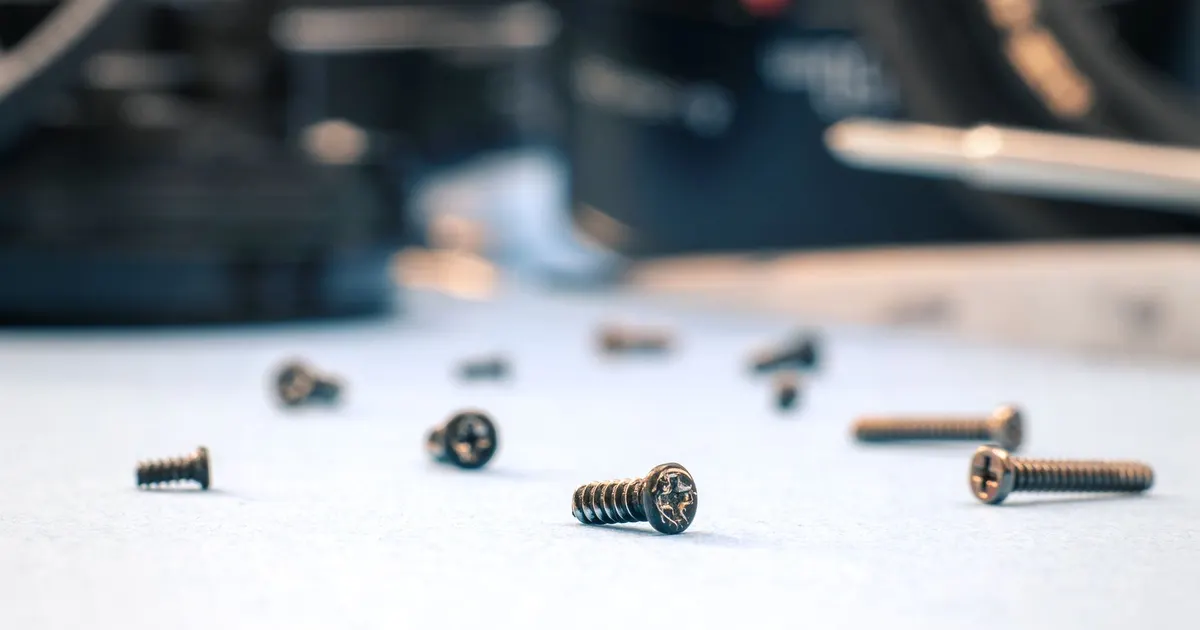
Micro screws hold together phones, cameras, hard drives, watches, glasses and instrument housings. They are small, from M1 to M2, and they are made in huge quantities. A custom micro screw changes one thing about a catalog part, such as a head height, a drive, a length, a washer face or a coating, to fit a design. Buying them to print is more demanding than larger bolts, because tolerances shrink with size while handling and inspection get harder.
This guide gives the basic numbers, the manufacturing routes and the print and inspection points to settle before ordering.
Thread data for M1 to M2
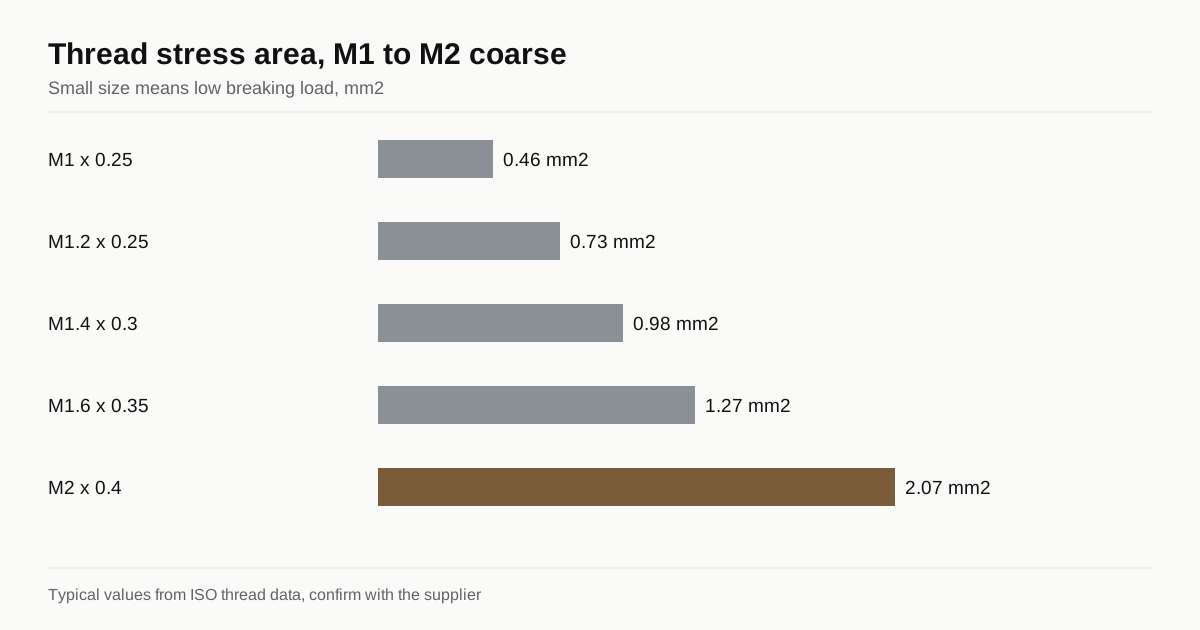
ISO coarse pitches for these sizes are small. The stress area is the area used for load calculations.
| Size | Pitch (mm) | Stress area (mm²) | Typical wire or bar diameter (mm) | Typical recess size |
|---|---|---|---|---|
| M1 | 0.25 | 0.46 | About 1.0 | Hexalobular T1 or small cross |
| M1.2 | 0.25 | 0.73 | About 1.2 | T2 or small cross |
| M1.4 | 0.30 | 0.98 | About 1.4 | T3 or small cross |
| M1.6 | 0.35 | 1.27 | About 1.6 | T4 or cross |
| M2 | 0.40 | 2.07 | About 2.0 | T5 or T6, or cross |
These are typical values, and the standard for the thread, ISO 261 and ISO 724, and the head standard set the real figures. Recess sizes vary by head type. Fine pitch threads exist for some designs and need their own gauge.
For a stainless screw of about 700 MPa tensile strength, the breaking load of an M2 is roughly 1.4 kN, and an M1 about 0.3 kN. These loads are low, so the screws fail easily by over-tightening. Torque control during assembly matters more than the property class.
Heads and drives
Common head types include pan, cheese, flat, button and low profile. Heads are small, so the recess is shallow. Drive choices:
- Hexalobular, sizes T1 to T6, carry the most torque in a tiny recess and resist cam out. They are the standard choice in electronics. See custom security screws for the pin versions.
- Cross recess, in Phillips or Pozidriv forms, is cheap and common, but it cams out more easily.
- Slotted, used in watches and instruments where a visible slot is part of the design.
- Special drives, like tri-wing or pentalobe, for covers that users should not open.
A screw also needs a washer face, a captive washer or a flange in some designs, which affects tooling and the route.
How micro screws are made
Cold heading. Fine wire goes through a small multi-station former. The head is formed, the recess is punched and the blank is cut at speeds of hundreds of parts a minute. The thread is rolled on a flat die machine. This route is cheapest at volume, from tens of thousands to millions of pieces. The punches for a tiny recess are delicate, and tooling cost depends on the head and drive. See cold forming tooling cost for the factors.
Swiss turning. A sliding headstock lathe turns the part from bar, with the cutting tool near the guide bush, which keeps slender work straight. It makes screws with special heads, shoulders, flats and cross holes, in lots from a few hundred upward. Cycle time is longer and the unit price higher than cold heading. Cold heading vs machining shows where the crossover usually falls.
Thread rolling. Rolled threads suit micro screws. They are fast and strong, and they avoid chips. Flat dies are common for the smallest sizes. A thread rolled on a very small blank needs precise blank diameter control. See thread rolling vs cutting.
Secondary operations. Heat treatment applies to steel screws that need hardness. Plating or passivation follows. Many micro screws also get a pre-applied adhesive or nylon patch for locking.
Materials and coatings
- Stainless steel, A2 or A4 type, for corrosion resistance. 303 type for turned parts.
- Carbon steel, with zinc, nickel or black coating, for low cost.
- Brass, for electrical parts and decoration, see silicon bronze and brass fasteners.
- Titanium, for light and corrosion resistant parts, in small lots.
Coating needs care at this size. An M1 thread has a depth of about 0.15 mm. A plated layer of 5 to 8 micrometres on each flank can change the pitch diameter by more than the tolerance allows. Passivation, thin electroless nickel or a coating applied under tight control keep the thread within limits. Define the coating thickness limit, and the gauging point, as in thread gauging.
Plating also carries a hydrogen risk on hard steel screws. Small hard parts can be sensitive, so ask about baking. See hydrogen embrittlement.
Tolerance, inspection and cleanliness
Tight tolerances on tiny parts mean measurement tools matter. A plant should be able to inspect with:
- An optical comparator or vision system for head diameter, height and length.
- Thread ring gauges or plug gauges sized for the pitch.
- A microscope for recess form and burrs.
- Automatic optical sorting for missing recesses, damaged heads and mixed parts.
Electronics buyers also ask for cleanliness: no oil residue, no loose burrs and no metal dust. Parts can be washed and packed in sealed bags. State any cleanliness or particle rules on the print. Count accuracy matters too. Counting a bag of 10,000 screws by weight can be off by a few percent, so say whether you want a count tolerance.
Price and lead time
Piece price depends on quantity, route and material. A cold headed M2 steel screw costs a small fraction of a Swiss turned stainless one. Tooling for a new head or recess adds a one-time cost. Lead time for a new part with tooling is often several weeks to first samples. Typical quantities per order range from a few thousand for turned parts to hundreds of thousands for cold headed parts.
Examples of micro screw orders
M1.6 x 4 pan head screws with a T4 hexalobular recess, stainless, 1.5 million a year, for a phone accessory. The route is cold heading from fine wire, with rolled threads and passivation. Tooling for the head and recess is a one-time cost. The buyer asks for automatic optical sorting for missing recesses and for bags of 5,000 with a count tolerance.
M1.2 x 3 flat head screws in titanium, 5,000 a year, for a lightweight optical frame. Titanium is hard to form at this size, so the plant turns the parts on a Swiss lathe, rolls or cuts the thread and anodizes for color. Piece price is high, lot sizes are small and the plant quotes a setup charge.
M2 x 6 pan head screws with a pre-applied adhesive patch, steel with a thin nickel finish, 300,000 a year, for a handheld device. The patch locks the screw against vibration and adds a few seconds to cure at assembly. The buyer ships a sample lot for assembly testing before the first release.
Handling and packaging at this size
Micro screws are lost, mixed and damaged easily, so packaging belongs in the spec. The usual choices are bulk in bags with a counted quantity, reels or tape for automatic feeding, or trays that hold parts upright for a robot. The choice follows the assembly method.
Points to settle include the lot mixing rule, so that two lots never share a bag, the labeling with part number and lot number, and the clean packing for electronic assembly, such as sealed bags with no loose oil. Also decide how the plant counts. Counting by weight is cheap and accurate to a few percent. Counting by machine is more exact and costs more. For tape and reel, state the pitch, the pocket size and the orientation of the head. A good plant has done this for other customers, and it can quote a standard pack.
Finally, keep spares in the plan. A screw that drops into an enclosure is hard to find, and assembly lines expect a small overage on each order.
Common ordering mistakes
- Specifying a plating thickness that is fine on M6 and too heavy on M1.
- Leaving the recess size off the print, so the plant picks one that does not match your driver.
- Asking for a count by weight and expecting an exact count.
- Forgetting that a tiny screw needs a head height tolerance that the former can hold.
- Not stating a cleanliness rule for parts that go into optics or sensors.
- Ordering a first article lot and the production lot at the same time, with no room to change the drawing.
A short first article run, measured and tested in the real assembly, avoids most of these.
Checklist for the RFQ
- Drawing with head, recess, thread, length and tolerances.
- Material and property class or strength.
- Coating or finish, with a thickness limit and gauging point.
- Inspection method and cleanliness rules.
- Locking feature, if any.
- Packaging: bag size, count tolerance and labeling.
- Annual volume and release size.
Prototype lots before tooling are covered in custom fastener prototypes.
For a general structure for the first message, see custom fastener RFQ checklist. When you are ready, send your RFQ and we match it with up to three makers that run fine wire formers or Swiss lathes.
Frequently asked questions
How small can a cold headed screw be?
Plants with fine wire formers make screws down to about M1 in volume, using wire near 1 mm in diameter. Below that, and for complex heads or special lengths, Swiss turning is more usual. The limit depends on the plant and the wire handling, so ask each maker for its smallest regular size.
Why is coating a problem on very small threads?
The thread depth on an M1 screw is a fraction of a millimetre, and a coating of several micrometres on each flank uses up a large share of the tolerance. Plating that is routine on M6 can make an M1 thread too big to gauge. Use thin or non-dimensional finishes, or make the thread smaller before coating.
How are micro screws inspected?
By sampling with optical comparators, pin gauges and thread gauges for the size, and often with automatic optical sorting for head defects, missing recesses and contamination. Some buyers ask for 100 percent optical sorting on critical lots. State the requirement, since it affects price and lead time.
Need this fastener made?
Send the print with the grade and annual volume. We match you with up to 3 makers that run the right route and reply within 24 business hours.
Send my RFQ